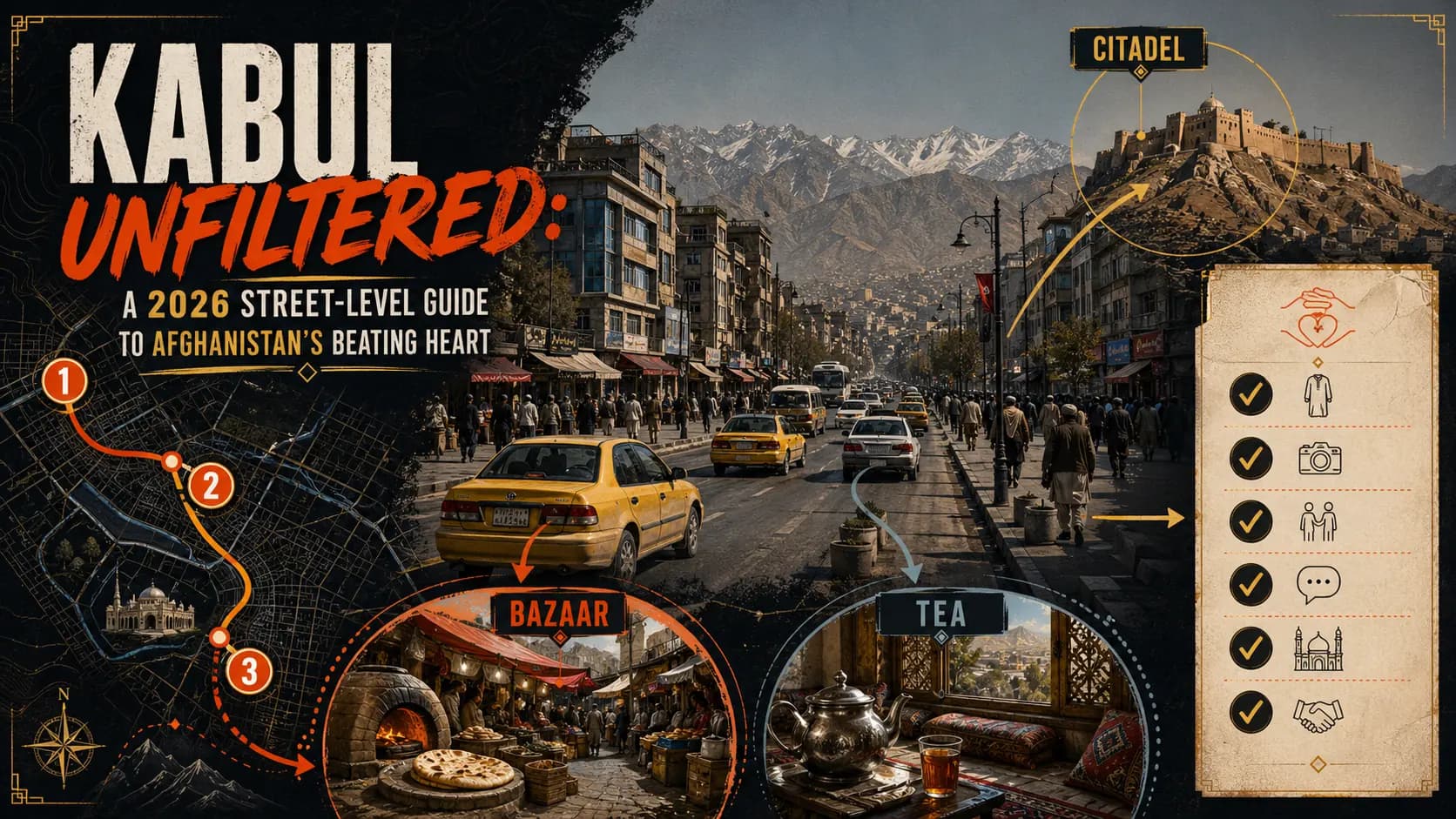
Forget the headlines. The Kabul you’ll find in 2026 isn't the one-dimensional city of cable news. It’s a place of profound contradiction and raw, resilient energy. It’s the scent of naan baking in a clay oven next to the roar of a generator. It’s the silent, watchful gaze of a 15th-century citadel overlooking a gridlocked street of yellow Corollas. This isn't a destination for passive tourists; it's a living classroom for the intrepid. To understand modern Afghanistan, you start here, in its chaotic, generous, and utterly compelling capital. This kabul travel guide 2026 is your street-level primer, written from the ground after our March 2026 expedition. It strips away the abstraction and gives you the map, the mindset, and the methods to engage with Kabul on its own terms, setting the stage for deeper afghanistan tours.
The Two Speeds of Kabul
Kabul in 2026 operates on two speeds. There’s the official rhythm, dictated by checkpoints and curfews. Then there’s the city’s own heartbeat: the frantic commerce of Chicken Street, the philosophical debates in hidden chaikhanas, the defiant reopening of a music school. According to a 2025 UNAMA report on urban livelihoods, Kabul’s population has swelled to an estimated 5.2 million, a 15% increase since 2021, creating a pressure cooker of ambition and survival. Navigating this space requires a specific type of awareness—one part cultural sensitivity, one part street smarts, and a total commitment to seeing the person behind the preconception. This kabul travel guide 2026 is not a sales pitch for normalcy. It’s a tactical field manual for travelers who know that the world’s most rewarding stories are often found in its most complex chapters. Think of it as your first briefing before the adventure truly begins out on the road with specialist afghanistan tours.
The Foundation: Navigating Kabul's Reality
What Is Navigating Kabul in 2026?
Navigating Kabul in 2026 means accepting a fluid set of rules defined by local knowledge, not guidebooks. It is a city where logistics are paramount and cultural intuition is your most valuable currency. The U.S. State Department’s Travel Advisory for Afghanistan, updated January 2026, maintains its "Level 4: Do Not Travel" warning, citing critical threats of kidnapping, armed conflict, and terrorism. This is the non-negotiable backdrop. Your movement, therefore, isn't about freedom in a Western sense, but about managed, respectful access facilitated by trusted local partners who understand the city’s invisible boundaries and daily rhythms. This foundational understanding is what separates a reckless trip from a profound expedition, and it’s the core of any legitimate kabul travel guide 2026.
How does security shape a day in Kabul?
Security dictates the skeleton of every day. A typical movement plan with a professional operator involves convoy procedures, pre-coordinated routes, and strict adherence to a curfew that currently starts at 10 PM. According to security protocols shared with our team by our ground partners, mobile phones are often left behind or stored in signal-blocking bags when visiting sensitive locations to prevent tracking. The city is a patchwork of police, army, and other checkpoints; our drivers know which ones to approach, how to speak, and when to simply wait. This isn't paranoia—it's the basic operating system. For a deeper dive into managing risk, our article on /blog/is-afghanistan-safe-to-visit breaks down the layered security approach required.
Where is the cultural pulse of the city?
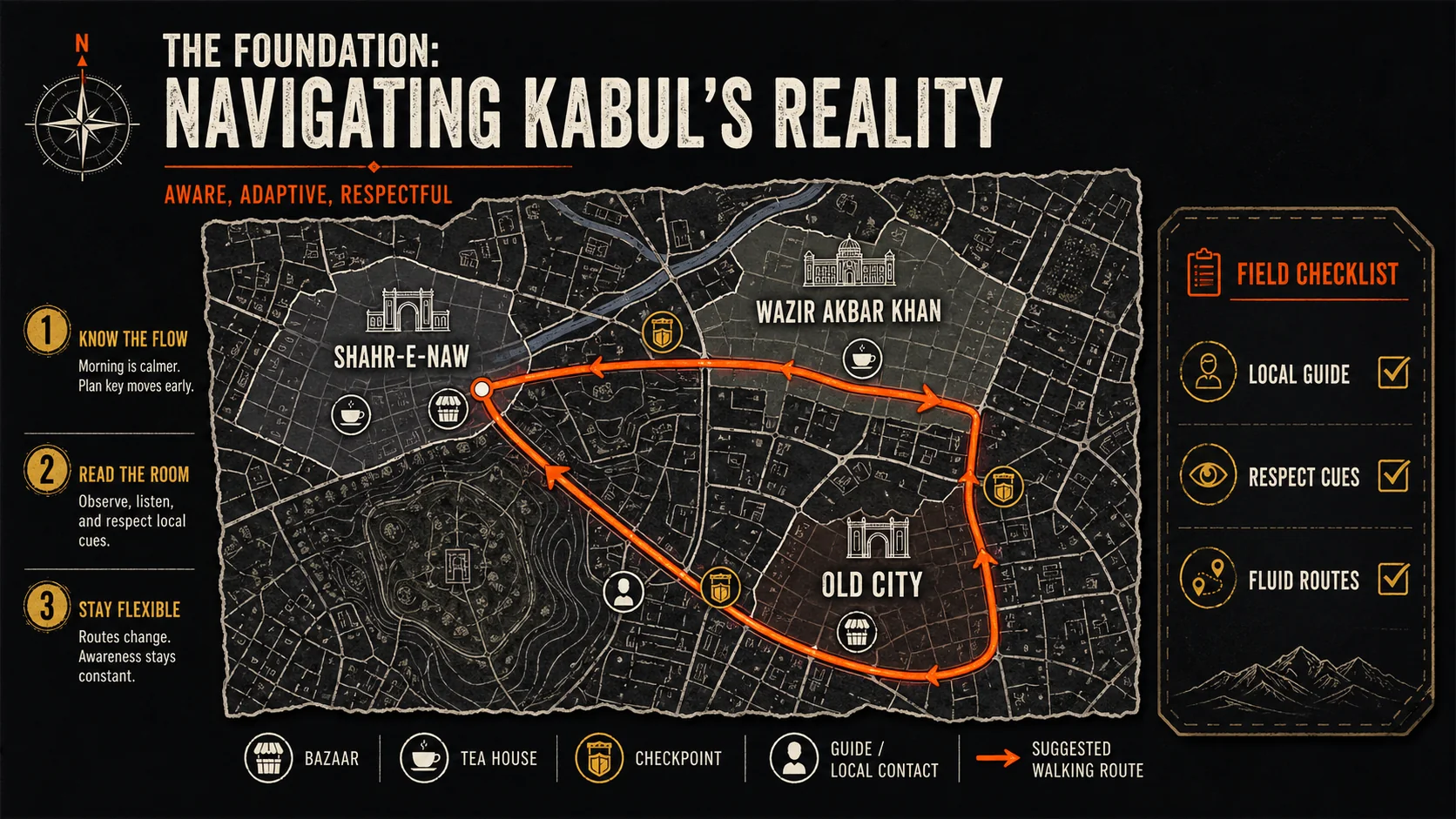
The cultural pulse beats strongest in places of commerce and conversation. The Bird Market (Ka Faroshi) near the river remains a chaotic symphony of songbirds and barter. In the Shahr-e-Naw district, you’ll find a different energy: internet cafes buzzing with young Afghans, shops selling smartphones, and restaurants serving surprisingly good pizza alongside mantu. The real magic, however, happens in the chaikhanas (tea houses). In a quiet one in Karte Parwan, we spent an afternoon with a former professor discussing Persian poetry, a conversation that never would have happened in a hotel lobby. Lonely Planet has long noted these spaces as the country's social nervous system, and that remains truer than ever.
What are the key districts for a traveler?
Kabul’s districts serve vastly different functions. Knowing which is which is essential for planning and perception.
| District | Vibe & Primary Function | Key Landmarks | Traveler Note |
|---|---|---|---|
| Wazir Akbar Khan | Diplomatic/Governmental | Embassies (closed to public), many NGO offices. | Heavily secured; transit only for most travelers. |
| Shahr-e-Naw | Commercial & Modern | Shopping centers, restaurants, coffee shops. | Center for contemporary Afghan urban life; good for supervised walks. |
| Old City (Around Bird Market) | Historic & Artisanal | Ka Faroshi Bird Market, traditional bazaars. | Intense sensory experience; requires a guide for navigation. |
| Karte Parwan | Residential & Local | Local markets, mosques, community chaikhanas. | Authentic slice of daily life; low-profile visits recommended. |
Why Context and Preparation Are Everything
Why does context matter more here than anywhere?
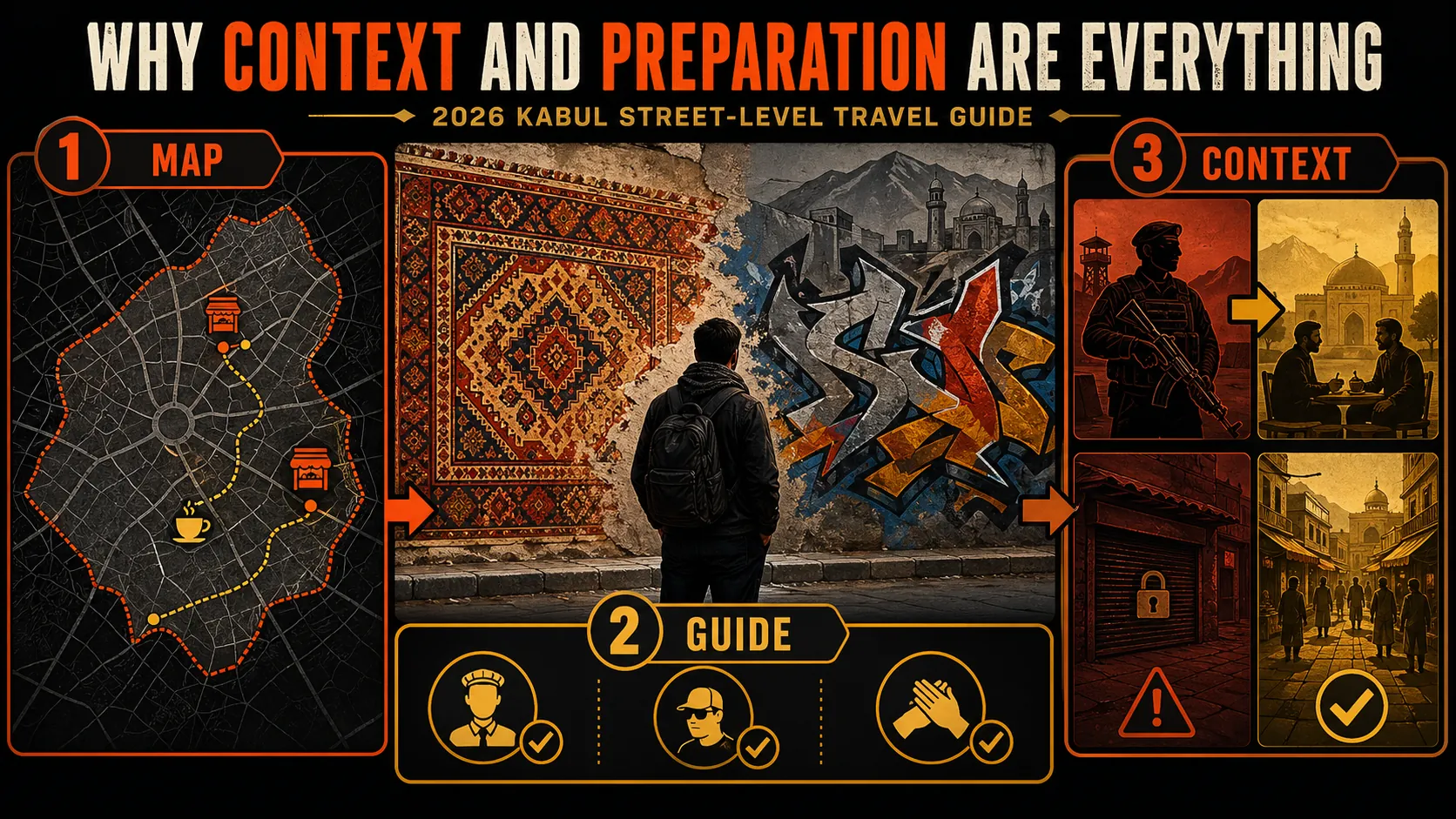
Context is your lifeline because the gap between perception and reality is a canyon. Visiting without it is disrespectful and dangerous. The problem isn't just physical risk; it's the risk of misunderstanding everything you see. A man carrying a rifle isn't necessarily a militant—he could be a private security guard for a local business, a common sight. A closed storefront might signal a security alert, a power outage, or simply the owner's prayer time. According to National Geographic, responsible travel in complex environments demands "radical contextualization," moving beyond the snapshot to understand the story. On our last trip, our guide explained that the vibrant re-painting of houses in a central district was a quiet, collective act of defiance and normalcy—a nuance completely lost without local insight.
Why can't you just "wing it" in Kabul?
The logistical and security infrastructure for independent tourism does not exist. There is no hostelling network, no tourist police, and no reliable public transport for foreigners. The Australian Government’s DFAT advice, current as of February 2026, explicitly states that "the capacity of Australian officials to provide consular assistance in Afghanistan is severely limited." This is true for all nations. A simple problem—a lost phone, a missed meeting point, a flat tire—can escalate rapidly without a trusted local handler who has the contacts and authority to resolve it. "Winging it" isn't adventurous; it's a burden on a system already under immense strain and potentially a direct threat to your safety.
Why is cultural preparation non-negotiable?
Because your behavior directly impacts your safety and the reputation of future travelers. Cultural missteps here aren't just faux pas; they can offend, create suspicion, or attract unwanted attention. For example, photography is a minefield. Pointing a camera at a government building, a checkpoint, or even a person without explicit permission can have serious consequences. Dress code, especially for women, requires strict modesty in line with local norms. Understanding basic Dari greetings, how to accept tea (always accept the first cup), and the profound importance of hospitality (mehman nawazi) are the keys that unlock genuine interaction. For a full primer, our /blog/afghan-cuisine-guide starts with the food but goes into the etiquette of shared meals.
The How-To: Your Kabul Method
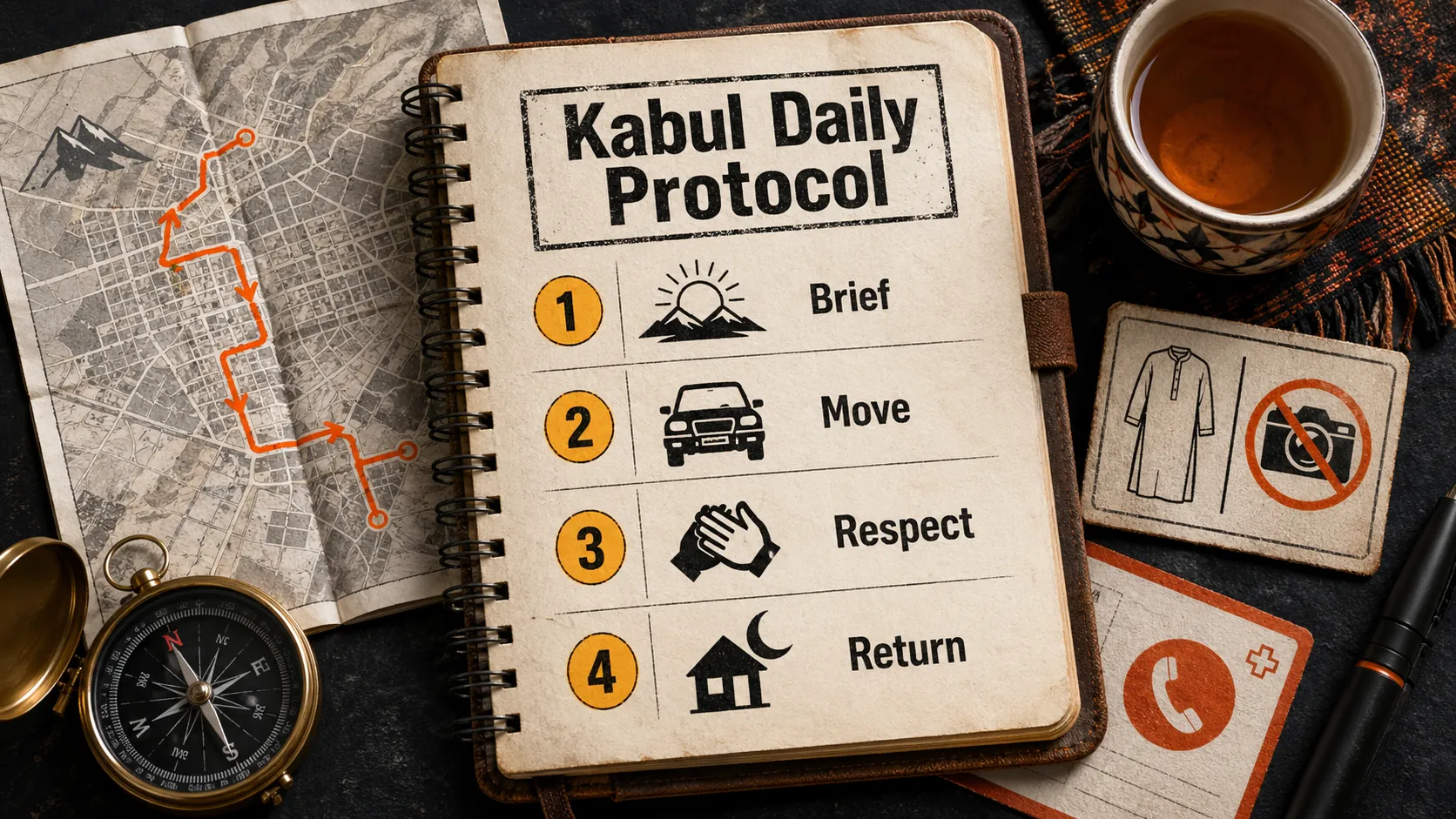 ," and "Emergency contact card.")
How to build your essential Kabul itinerary
A Kabul itinerary is built around secure logistics, not whimsy. Start by identifying 2-3 core objectives per day, with significant buffer time for the unpredictable. A standard day with our tours begins with a security briefing at 8 AM, movement by 9 AM, and aims to return to the secure guesthouse by 5 PM, well before nightfall. One must-see is the National Museum of Afghanistan, which has painstakingly reclaimed about 70% of its looted collection, a powerful testament to resilience. Another is a guided walk through the Old City bazaars, not for shopping but for immersion. According to Lonely Planet, the essence of adventure travel is "planned serendipity"—you structure the day to put yourself in the path of authentic moments, which in Kabul happens in the spaces between the scheduled stops.
How to move through the city: The convoy method
You move in a minimum two-vehicle convoy with experienced Afghan drivers and a lead security advisor. The lead car scouts ahead and communicates via handheld radio about checkpoint status and traffic anomalies. You follow in the second vehicle. Routes are never advertised in advance and are often altered last minute based on the advisor's real-time information network. The average speed for cross-city travel is 20-25 km/h due to traffic and checkpoints, meaning a 10 km trip can take 45 minutes. You do not get out of the vehicle unless instructed. This method reduces your profile and provides redundancy; if one vehicle has a mechanical issue, you are not stranded.
How to engage with people respectfully
Respectful engagement starts with letting interactions happen on local terms. Your guide makes the initial introduction. You greet with "Salaam alaikum" with a hand over your heart. You accept offers of tea. You listen more than you speak. Ask open-ended questions about family, work, and hopes—not politics or conflict. On a recent visit to a carpet workshop, we spent an hour learning about symbolism in Turkmen designs before any transaction was even hinted at. This patience builds rapport. According to cultural guidelines used by experienced aid workers, spending the first 80% of an encounter building social capital is the only way to gain meaningful insight. For more on building these connections, see our guide on /blog/hub-culture.
How to manage your communications and money
Assume no digital privacy. Use a basic local Nokia-style phone for calls and a local SIM for essential SMS. Your smartphone stays in airplane mode, used only offline for photos, stored in a Faraday bag when not in use. For money, bring crisp, unmarked U.S. dollars (post-2006 series) for major expenses and exchange a portion for Afghanis (AFN) for daily small purchases. As of March 2026, the exchange rate hovers around 1 USD = 75 AFN. Never flash large amounts of cash. Keep funds in multiple locations on your person. Your guide can advise on fair prices to prevent you from accidentally inflating the local economy.
How to dress for anonymity and respect
Your goal is to blend in, not stand out. For men: long pants, collared shirts or long-sleeved polos, and a vest or jacket. Avoid shorts, graphic tees, or military-style clothing. For women: a loose, ankle-length dress or tunic and pants, a headscarf that fully covers the hair, and a longer coat (manteau). Dark, neutral colors are best. This dress code, outlined in our /blog/what-to-pack-afghanistan checklist, is a sign of respect that reduces stares and demonstrates your awareness, making every interaction smoother.
How to document your experience safely
Document with extreme discretion. No photos of military, police, government buildings, or infrastructure like bridges and power stations. Never photograph people, especially women and children, without unambiguous verbal consent obtained by your guide. The best approach is to ask your guide, "Is a photo possible here?" and abide by their immediate "no." When you can shoot, use a small camera or phone discreetly. Your most valuable documentation will be your written journal, filled with details, snippets of conversation, and sketches—things no camera can capture.
Advanced Strategy: Moving Beyond the Surface
Proven Strategies to move beyond the surface
To move beyond the surface, you must trade spectacle for depth. Instead of trying to see ten landmarks, choose two and spend real time there. At the Darul Aman Palace, don't just snap the bombed-out facade. Discuss with your guide its history as a symbol of modernization and its failed restoration attempts—a metaphor for the nation's struggles. Seek out craftspeople, not shops. Visit a calligrapher in his home studio or a kilim weaver in her courtyard. These are not staged encounters; they are windows into a culture that values artisanal skill and oral history. National Geographic frames this as "traveling deep," where the value is measured in understanding, not miles covered.
How to read the city's security posture
Learn to read the subtle cues. An increase in police or army presence on a normally quiet street is a signal. Shops suddenly pulling down their metal shutters in unison means something is happening. Your local team is your primary source, but you can corroborate by observing body language: are people on the street relaxed and chatting, or is there a tense, hurried silence? After the Friday noon prayers, the city often feels quieter as families gather at home—this is normal rhythm, not a threat. This situational awareness, honed over our 15+ years of running expeditions, turns you from a passive passenger into an engaged, responsive traveler.
How to leverage hospitality for genuine connection
The Afghan tradition of mehman nawazi (hospitality to guests) is a powerful social law. If you are invited into a home—a great honor—understand the protocol. Bring a small gift of sweets or fruit from the bazaar. Remove your shoes at the door. Compliment the home sparingly but sincerely. You will be offered the best seat and the first and best portions of food. Accept them graciously. Eating with your right hand from a shared platter is common; watch your host and follow. This shared meal is a contract of goodwill. It’s in these moments, far from any itinerary, that you’ll hear stories and share laughter that define the true purpose of trips to afghanistan.
Final Takeaways
Kabul in 2026 is a city of layered realities where security protocols and cultural respect form the absolute foundation of any visit. Independent travel is not feasible; movement requires professional, local-guided logistics using methods like two-vehicle convoys. The cultural experience is found in slow, respectful engagement in spaces like chaikhanas and artisan workshops, not in ticking off tourist sites. Your safety and success depend on meticulous preparation, from discreet dress and communication plans to understanding unspoken social codes. This kabul travel guide 2026 provides the framework, but the real understanding comes from being there, guided by those who call it home.
FAQ
Is it possible to get a visa for Afghanistan in 2026? Yes, but the process is entirely sponsor-based. You cannot get a tourist visa by simply applying at an embassy. A licensed Afghan tour company, like ours, must apply for a Letter of Invitation (LOI) and visa authorization from the Ministry of Foreign Affairs in Kabul on your behalf. This process takes a minimum of 45-60 days and requires passport scans and a detailed itinerary. The visa itself is then stamped into your passport upon arrival at Kabul International Airport. This system underscores why traveling with a registered operator is mandatory.
What is the biggest cultural mistake you see travelers make? The most common and damaging mistake is inappropriate photography. Travelers often see a compelling scene and raise their camera without thinking. In Kabul, photographing people (especially women), security forces, or damaged buildings is a serious violation of privacy and can be perceived as espionage. It instantly creates distrust and can lead to confrontation. Always, without exception, ask your guide for explicit permission before taking any photo outside of your private guesthouse.
Can I use credit cards or ATMs in Kabul? No. Afghanistan is a 100% cash-based economy for travelers. There are no functional international ATMs, and credit cards are useless. You must bring all the money you will need for your entire trip in U.S. cash. Ensure the bills are in excellent condition, as worn or marked bills may be rejected when exchanging for Afghanis. Your tour operator will typically quote an all-inclusive price to minimize your need to carry excessive cash.
How do you handle medical emergencies in Kabul? Medical evacuation is the only viable option for serious emergencies. Kabul has some private clinics that can handle basic issues, but for anything major, you would need to be evacuated to a country like the UAE or India. This is a core reason for traveling with a professional operator. We include mandatory emergency medical and evacuation insurance in our packages and have direct contracts with air ambulance services that can activate a flight from Dubai within hours. All travelers are briefed on this protocol upon arrival.
CTA
Kabul is the uncompromising, unforgettable prologue to the Afghan story. If you’re ready to move beyond the theoretical and step onto its storied streets with the right team and the right mindset, your expedition begins with a conversation. Claim Your Spot on our next small-group exploration and let’s start planning your 2026 journey.
Other Doved Studio projects
Related tools from the same studio you might find useful:
- Magnu Imperiu: Daily history puzzle: guess the empire from six geographic and temporal clues.
- Doved Studio: Studio indie derrière cette app et une dizaine d'autres outils.