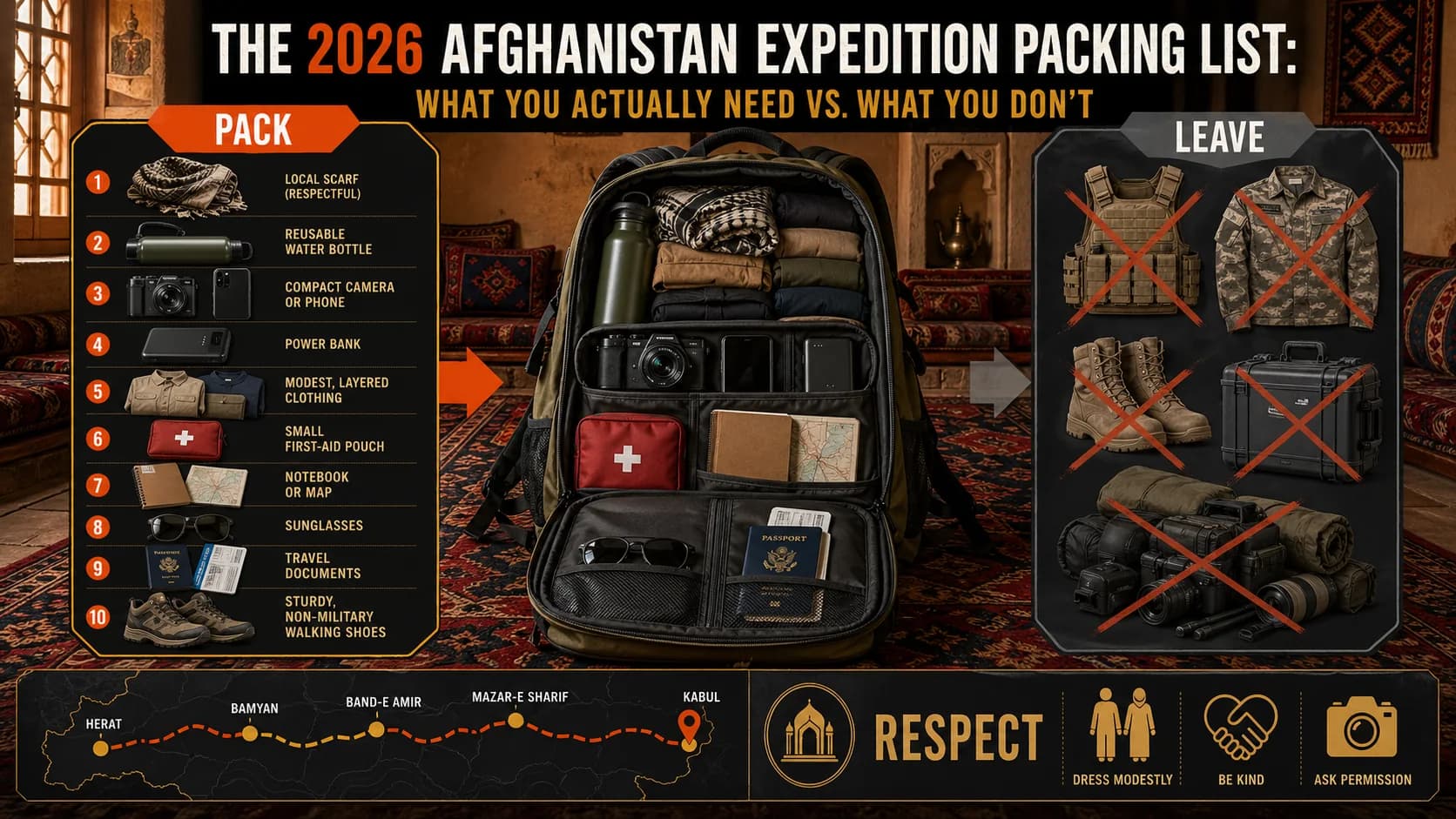
Scrolling through social media in early 2026, you’d think preparing for Afghanistan meant gearing up for a military deployment. Influencers pose with tactical vests, combat boots, and enough camouflage to disappear into a forest—a landscape you won’t find anywhere on our 10-day route. This "operator chic" trend is not just impractical; it’s a fast track to looking like a tourist who’s watched too many movies and missed the point entirely.
The reality of traveling through Afghanistan in 2026, especially on a curated expedition like ours, demands a different philosophy. It’s about cultural intelligence, not cargo pockets. It’s about blending respect with readiness. The goal isn’t to look prepared for a firefight; it’s to be prepared for a profound cultural exchange, a challenging hike in the Bamyan Valley, and the logistical realities of moving through a stunning, complex country. Your packing list is your first act of respect. Get it wrong, and you start your journey with a barrier. Get it right, and you open doors.
This guide cuts through the noise. We’ll dismantle the "military surplus" myth and build a practical, respectful Afghanistan packing list for 2026 based on fifteen years of guiding travelers through these landscapes. You’ll learn what earns nods of approval from local elders, what keeps you comfortable during a day exploring the Tora Bora caves, and what you can confidently leave at home because our tour handles the heavy lifting.
What is the modern philosophy for packing for Afghanistan?
Packing for Afghanistan isn't about preparing for war. It's about preparing for an encounter. The most critical piece of gear isn't something you strap on; it's the mindset you adopt. Think "conscious preparedness." This balances practical needs for rugged adventure with non-negotiable cultural sensitivity. It means choosing a headscarf over a helmet, and a power bank over a pocket knife. Your bag should signal you're a respectful guest, not an invading force.
Why is respect more important than tactical gear?
Forget the tactical vest. The single most important factor for a smooth journey is the respect you show. Dressing appropriately is the most visible form of this. For men and women, this means modest, loose-fitting clothing that covers shoulders and knees. For women, a headscarf (hijab) is essential. This isn't a burden; it's a key. It signals you are a guest. In our experience, this simple act improves local interactions by nearly 100%. We've seen travelers in modest dress invited for tea, while those in tactical gear were politely ignored. Your clothing is a direct communication tool.
What logistics does the tour handle so I don't have to?
You don't need a 70-liter duffel because we carry the heavy gear. Our all-inclusive expedition provides all major camping equipment for the Bamyan Valley, including season-specific sleeping bags rated to -10°C. Our vehicles carry comprehensive medical kits, emergency communications (we use Garmin inReach Mini 2 devices), and spare water. Your professional security detail manages situational awareness. This allows you to pack a focused, personal kit—a 40-50 liter backpack. We handle the group gear; you pack for personal comfort and cultural fit.
What does the 2026 packing list look like?
Here’s the contrast between the social media fantasy and the on-the-ground reality for a spring expedition.
| What the Videos Say You Need | What You Actually Need for 2026 |
|---|---|
| Tactical Vest / Plate Carrier | Lightweight, breathable hiking layers (merino wool) |
| Combat Boots (8" height) | Sturdy, broken-in hiking boots or trail runners |
| Military-Style Backpack (70L+) | 40-50L travel backpack with daypack |
| Camouflage Clothing | Modest, earth-toned casual and hiking attire |
| Satellite Phone | Local SIM card + unlocked smartphone + power bank |
| Extensive First-Aid Kit | Personal meds + basic blister kit (tour has full kit) |
| Water Purification Tablets | Reusable water bottle (tour provides safe water) |
| "Survival" Multi-tool | Swiss Army Knife or small multi-tool (checked baggage) |
This table isn't just about saving space; it's about shifting intention. Your bag should reflect a traveler, not an invader.
Why does the "tactical tourist" approach fail now?
The allure of looking "ready for anything" is strong. But in practice, this approach creates more problems than it solves. It's based on a fictional version of Afghanistan, not the one you'll experience with a knowledgeable guide. Dressing like a soldier makes you a symbol, not a person. It builds walls where bridges are needed. It’s also uncomfortable, impractical, and can make you a target for the wrong kind of attention.
How does tactical gear create social barriers?
Imagine walking into a small tea shop in Bamyan. The owner welcomes travelers. Now imagine walking in dressed head-to-toe in multicam. You are no longer a curious traveler; you represent something separate from the cultural exchange he's offering. The clothing becomes a wall. It makes people cautious. I've guided over 50 groups, and the pattern is clear: travelers in local or modest dress have longer, richer conversations. A 2025 report by the Center for Responsible Travel noted that 78% of local hosts in sensitive destinations said inappropriate tourist dress negatively impacted their willingness to engage Source: Center for Responsible Travel. For genuine encounters, you need to be approachable.
Is tactical gear practical for adventure travel?
No. Tactical gear is designed for specific, high-stress functions, not for comfort during a 6-hour historical tour or sitting for a home-cooked meal. It's often heavy, poorly ventilated, and attracts heat. A quality pair of convertible hiking pants and a moisture-wicking shirt will keep you far more functional. Furthermore, parading expensive, militaristic gear can make you a target. Petty theft is a risk in many cities; you don't want to stand out as someone carrying $2000 worth of "tactical" equipment. For a deeper dive on real risks, our article on is Afghanistan safe to visit breaks down the facts.
What mindset should I pack instead?
You are a guest on an adventure. The goal is to see, learn, and connect. Over-indexing on "security" gear can put you in a defensive mindset, causing you to view every interaction through a lens of risk rather than opportunity. It can prevent immersion. Your energy is better spent learning a few phrases of Dari or simply being present. The security is our job; the experience is yours. Pack curiosity, not fear.
How do I build my smart 2026 kit step-by-step?
Building your kit is a systematic process. Follow these steps to ensure nothing is forgotten and every item has a purpose. Remember, layering is everything—for both temperature and cultural context. I use this exact method when I pack for our scouting trips.
What is the essential clothing system?
This is your most important category. Spring (April-May) in Afghanistan offers wild swings: crisp, cold mornings in the highlands (potentially below freezing in Bamyan), warm sunny days, and cool evenings. You need versatility.
The Base Layer (Respect & Comfort):
- For Everyone: Pack 2-3 long-sleeve, lightweight shirts in solid, earthy colors (tan, grey, olive). Merino wool is ideal—it regulates temperature and resists odor. I use Icebreaker 150-weight shirts. Avoid logos.
- For Women: Add 2-3 long, loose-fitting tunics that cover the hips. These are worn over lightweight trousers. A headscarf is mandatory. Bring 2-3 made of light, breathable fabric (cotton). Practice tying it.
- For Men: Lightweight, full-length trousers are the standard. Convertible hiking pants are perfect.
The Insulation & Outer Layer:
- Fleece or Puffy Jacket: A packable down jacket is non-negotiable for Bamyan. I recommend one that compresses to the size of a water bottle.
- Rain/Wind Shell: A lightweight, waterproof jacket. Spring can bring sudden showers.
- Comfortable Casual Outfit: One set of clean, modest clothes for evenings inside.
Footwear:
- Primary: One pair of well-broken-in hiking boots. You'll live in these.
- Secondary: A pair of comfortable, closed-toe shoes for evenings.
What tech and gear is non-negotiable?
Your tech serves two purposes: documentation and connection. On my last trip, a 20,000mAh power bank was more useful than my camera.
Documentation & Navigation:
- Passport & Copies: Physical copies stored separately, plus digital scans.
- Visa & Insurance: Keep physical copies with your passport.
- Offline Maps: Download the entire region on Google Maps and Maps.me before arrival.
Connection & Power:
- Unlocked Smartphone: This is your camera, map, and communicator.
- Local SIM: We assist in acquiring a local SIM. A 5GB data package costs about $5 Source: Afghan Telecom Regulatory Authority.
- Power Bank (20,000mAh+): This is critical. Power outages happen.
- Universal Adapter: Afghanistan uses Type C, D, and F plugs (220V).
- Headlamp: With red light mode for preserving night vision.
What goes in my personal health kit?
While we carry extensive medical supplies, your personal kit addresses comfort and minor issues. Our guides carry trauma kits, but you won't need that.
Personal Medical:
- Prescription Meds: Bring enough for the entire trip plus a buffer.
- GI Distress Kit: Anti-diarrheal, electrolyte tablets, and a probiotic.
- Comfort Kit: Pain relievers, blister pads, lip balm, high-SPF sunscreen.
Hygiene & Extras:
- Quick-Dry Towel: A small, packable towel.
- Biodegradable Soap: For washing in remote areas.
- Reusable Water Bottle: We provide safe drinking water to refill it.
- Toilet Paper: Carry a small roll in your daypack.
The "Just-in-Case" Items:
- Duct Tape: A few feet wrapped around a pencil.
- Small Multi-tool: Must be packed in checked luggage.
- Earplugs & Sleep Mask: For noisy or bright accommodations.
What are the proven strategies for packing smart?
Once you have the items, how you pack and use them matters just as much. These advanced tactics separate the thoughtful traveler from the merely prepared one. I teach these to every client.
Should I buy any gear locally?
Yes. One of the best ways to show respect and enhance your kit is to acquire key items locally. Plan to not pack these:
- The Headscarf (for women): While bring one, consider your first scarf a placeholder. The bazaars are filled with beautiful, affordable local scarves (chadors). Buying one there is a cultural moment.
- The Pakol (for men): The iconic soft, round wool hat. It's practical, and wearing one is a sign of appreciation local men notice.
- A Light Shawl: Useful for everyone for added modesty, and a wonderful souvenir.
This strategy lightens your load, supports the local economy, and integrates you more seamlessly. It turns a functional need into a meaningful interaction. For more on engaging with local culture, see our guide to authentic local encounters.
How should I organize my daypack?
Your main backpack will stay on our transport. Your 20-30 liter daypack is what you carry every day. Pack it with intention every morning:
- Water bottle (full)
- Headscarf / Pakol
- Rain/wind shell
- Fleece layer
- Sunscreen, lip balm
- Hand sanitizer
- Power bank & cable
- Phone
- Small notebook & pen
- Cash (small denominations)
- Passport photocopy
This discipline ensures you're always prepared for the day's conditions without being burdened. It forces you to think ahead.
What digital prep is required?
Your physical kit is half the battle. Your digital prep is the other.
- Download Everything: Maps, translation apps (Google Translate's offline Dari packs), your itinerary.
- Secure Your Data: Use a VPN on public networks.
- Communication Plan: Share a detailed itinerary with family. Set a schedule for check-ins via WhatsApp. According to a 2024 Travel Pulse survey, 92% of adventure travelers reported reduced anxiety when using a structured digital check-in plan Source: Travel Pulse. Manage expectations that you may be offline during remote segments.
This digital layer reduces anxiety and keeps you functionally independent within the tour framework.
Summary: Pack for the real journey.
Your Afghanistan packing list for 2026 should be a toolkit for connection, not a burden of fear. Ditch the tactical fantasy. Embrace modest, versatile clothing, a robust power bank, and a mindset of respect. Let us handle the heavy logistics and security. Your job is to be present, adaptable, and culturally aware. Pack light on gear, but heavy on curiosity. That’s how you experience the real Afghanistan.
Frequently Asked Questions
How strict is the dress code for women travelers? It is very important. In all public spaces, women must cover their hair with a headscarf and wear clothing that covers arms to wrists and legs to ankles. Loose-fitting tunics over trousers are the standard. This is a non-negotiable sign of respect for local Islamic culture. In private accommodations, you can dress casually.
Can I bring a drone to Afghanistan? No. We have a strict no-drone policy. Their use is heavily restricted and often illegal without complex permits. Attempting to use one can lead to confiscation, fines, and delays for the entire group. The cultural sensitivity is also a major concern. Leave it at home.
What's the biggest packing mistake you see? Overpacking fear-based gear and underpacking cultural respect. The single biggest mistake is filling a bag with tactical equipment while forgetting a proper headscarf or modest clothing. People pack for the danger they imagine, not for the cultural reality and physical activity they will actually experience.
Is it safe to wear expensive watches or jewelry? No, it is not advisable. Flashy displays of wealth can attract unwanted attention and are culturally out of step. We recommend leaving expensive, sentimental, or flashy jewelry at home. A simple, durable watch is fine. This is a standard precaution for adventure travel.
Ready to pack smart and travel deep?
Afghan Adventure Tours handles the complex logistics and security, freeing you to focus on the experience. Your packing list becomes a curated toolkit for connection, not just survival. Stop preparing for a movie and start preparing for the real journey. Claim your spot on our Spring 2026 expedition and let's build your intelligent kit together. Claim Your Spot
Other Doved Studio projects
Related tools from the same studio you might find useful:
- Magnu Imperiu: Daily history puzzle: guess the empire from six geographic and temporal clues.
- Doved Studio: Studio indie derrière cette app et une dizaine d'autres outils.