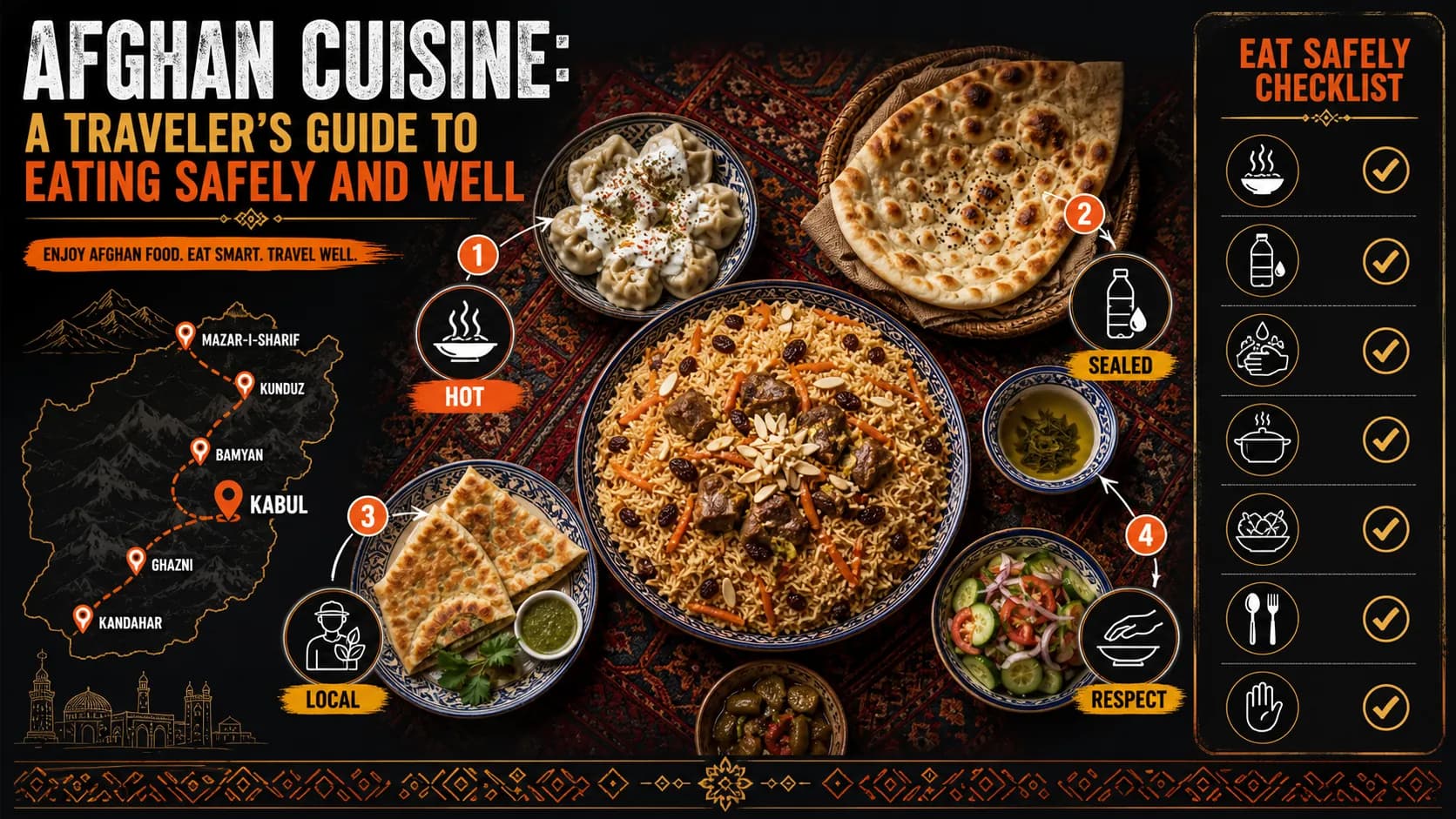
Afghan cuisine is one of the last undiscovered great food traditions on the planet. Most travelers never taste it — not because it isn't stunning, but because they're scared the water will wreck them. I get it. I've spent 15 years running expeditions through the country's wildest corners, and I've seen exactly how fast a bad stomach can flip an afghanistan tour into a miserable slog. But when you nail the approach, the food here becomes the expedition's secret weapon: smoky kebabs eaten in Tora Bora's shadow, saffron-laced rice shared with a Bamyan farming family, and tea that tastes like courtesy itself.
This guide is not a sanitized list of restaurant recommendations. It's the protocol we use on every afghanistan tours departure to keep our 12-person groups eating boldly and staying healthy. We'll cover what makes Afghan food tick, the specific risks nobody tells you on travel forums, and a step-by-step system for eating safely from Kabul street stalls to remote village homes. Because missing the cuisine here is missing half the country.
What defines Afghan cuisine?
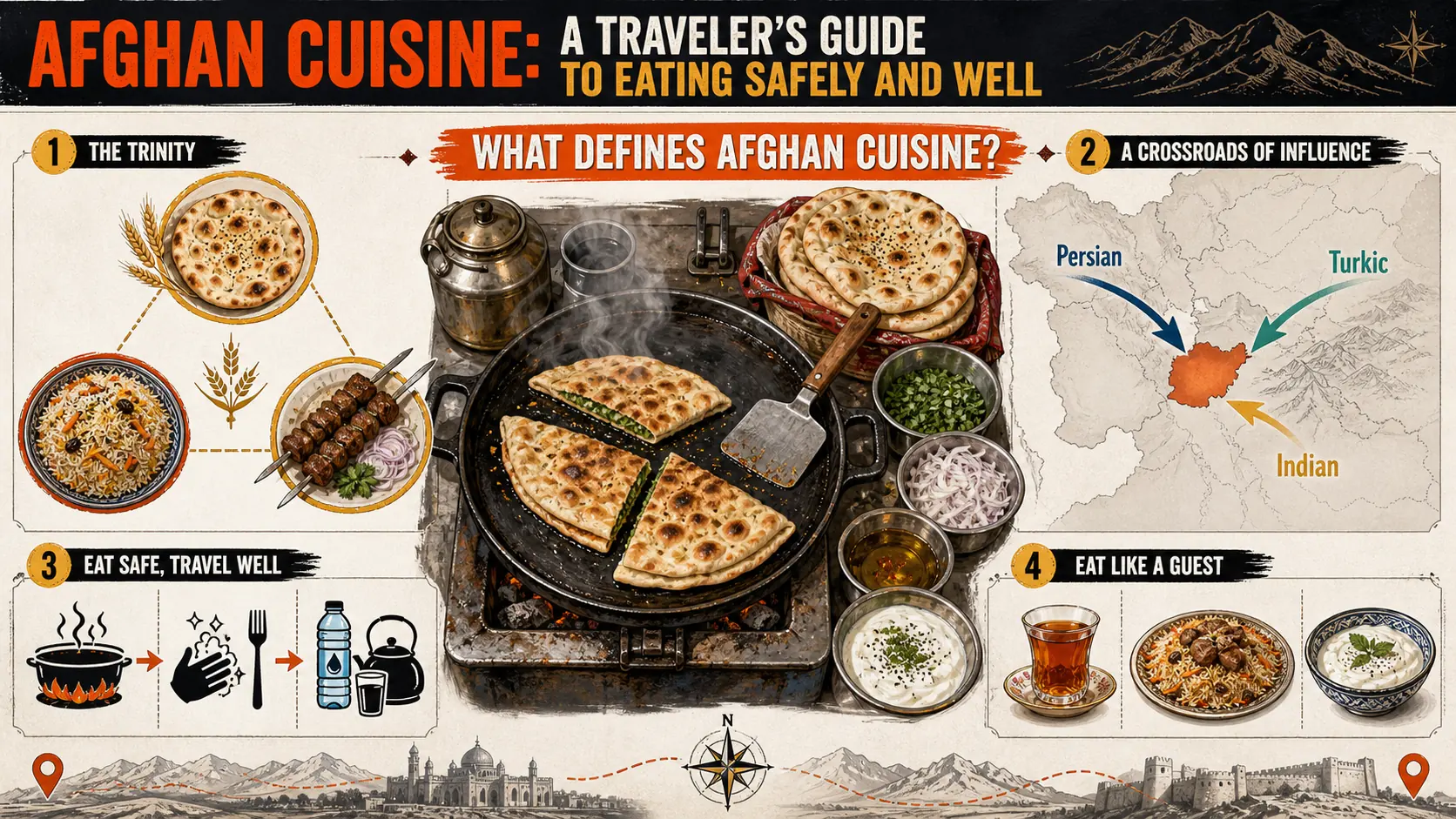
Afghan cuisine is a Central Asian crossroads where Persian, Indian, and Turkic influences collide over wood-fired ovens. It's built on a trinity of wheat, rice, and lamb, but what sets it apart is the restraint: spices are aromatic, not aggressive, and every meal arrives with a pile of fresh naan and a bowl of tart yogurt-chaka to cool the tongue.
What are the staple foods of Afghan cuisine?
The core of afghan cuisine is wheat, which supplies 58% of daily calories according to WFP Afghanistan. That number shocks people who imagine a rice-dominant table, but bread runs deeper here. Every neighborhood has a nanwai (baker) firing round naan in a tandoor — it's cheap, portable, and occupies the role that rice plays in East Asia. Rice does appear as the featured dish: kabuli pulao anchors feasts, and chalaw (steamed rice) soaks up qorma sauces. Lamb and chicken provide the protein backbone, while pulses, spinach, and potatoes round out a cuisine that rarely wastes anything. Naan is torn by hand and used to scoop up stews, making every meal an efficient, utensil-free experience.
How does Afghan cuisine differ from its neighbors?
Where Pakistani food leans hard into chili heat and Iranian cuisine celebrates sour notes, afghan cuisine lands in a calm, herbal middle. The spice blends — char masala and hawaij — rarely contain more than six or seven ingredients, and black pepper, cumin, and cardamom do the heavy lifting. Yogurt is not a drink but a condiment, dolloped onto almost everything. Compared with neighbours, Afghan cooking uses less oil and far less sweetener. On our April 2026 recce, guide Ahmad watched a traveller add hot sauce to a lamb shank and said, "You're breaking the cook's heart — the meat already tastes like the mountain grass." That restraint is deliberate.
Why is bread so central to Afghan meals?
Bread is the day's first purchase. In Kabul, a 500g naan costs about 10 Afghani ($0.14) and gets used as a utensil, a plate liner, and a sop for stew. No meal is complete without it. According to FAO’s Afghanistan profile, the country produces roughly 500,000 tonnes of rice annually, but wheat fields dominate the agricultural landscape at about 3 million tonnes per year. That imbalance tells you everything. A table without naan is just a table.
| Staple dish | Main ingredients | Safety notes for travelers |
|---|---|---|
| Kabuli pulao | Basmati rice, lamb, raisins, carrots, almonds | Cooked at high heat; safe if served steaming |
| Mantu | Steamed dumplings, ground lamb, yogurt, split peas | Ensure yogurt is fresh; skip if left out in sun |
| Ashak | Leek and scallion dumplings, meat sauce, yogurt | Vegetarian-friendly version exists; confirm no added meat broth |
| Bolani | Griddled flatbread stuffed with potato, leek, or pumpkin | Fried in front of you at stalls — low risk |
| Kebab (chopan) | Marinated lamb chops grilled over coals | High heat kills pathogens; watch for raw handling |
Afghan bread is the country's edible backbone — over half of daily calories come from naan.
Why Afghan cuisine matters on your Afghanistan tour
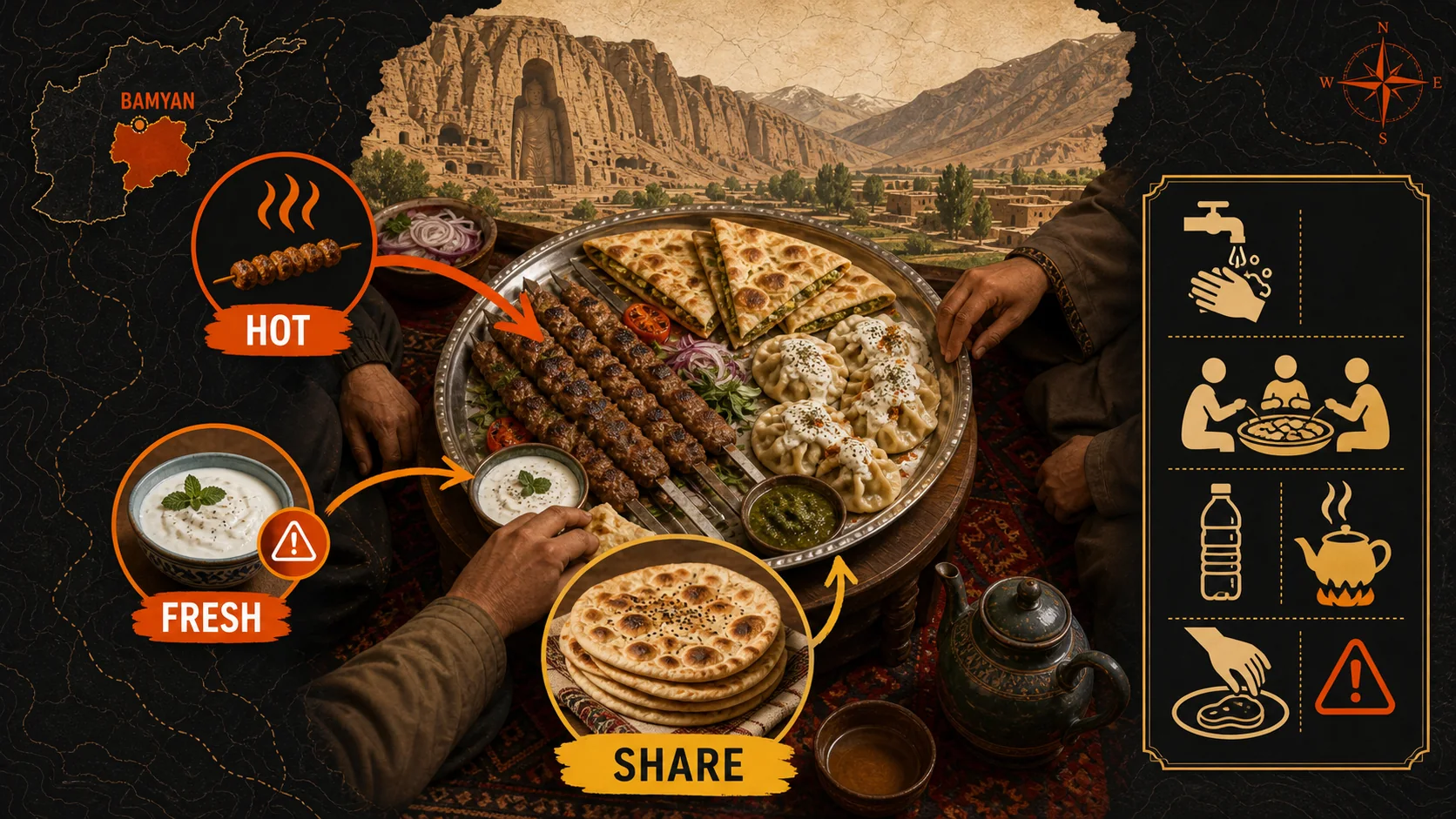
You didn't fly 7,000 kilometers to eat protein bars and instant noodles. Food is how Afghans say welcome, and skipping it because you're paranoid about hygiene is like visiting Paris and never eating a croissant. Our expeditions treat every meal as a cultural entry point, not a hazard to dodge. But ignoring the risks is equally stupid. Here's what's actually at stake.
What are the biggest food safety risks for travelers in Afghanistan?
The main enemy is untreated water. The CDC’s Afghanistan travel page lists food and waterborne diseases as the primary threat to visitors, with traveler's diarrhea affecting 30% to 70% of people in high-risk regions. Contaminated ice, unwashed raw vegetables, and street sauces left out all day cause most of the damage. In 2024, a solo backpacker I met in Mazar spent two days bedridden after drinking chai from a kettle filled with tap water. The fix is not abstinence; it's precision.
How can food poisoning derail an Afghanistan tour?
Losing 48 hours to a toilet when you've paid for a 10-day expedition is worse than disappointing — it can mean missing the one clear morning to hike into the Tora Bora cave complex. Our groups travel with a strict "no raw greens unless washed with filtered water" rule, and we carry oral rehydration salts as a standard part of the medical kit (see our packing list for full medical supplies). Travelers who dismiss the protocol often waste the Burj-e-Mal summit sunrise hugging a bathroom door. Even a mild stomach bug can sap energy for high-altitude treks. The expedition is too short for that.
Why do many travelers miss out on authentic Afghan meals?
Fear and bad information push visitors toward sterile hotel buffets that taste like nothing. The culinary soul of afghan cuisine lives in home kitchens and roadside chaikhanas, not lobbies. Our Bamyan Valley complete guide explains how even that region's modest guesthouses serve stews that have been simmering since dawn. That means skipping the safe but bland hotel dining and venturing where the aromas lead. If you trust the protocols, you eat where the locals do.
Unsafe water causes up to 70% of traveler's diarrhea — a two-day bout can erase the highlight of your expedition.
How to eat safely and well on your Afghanistan tour
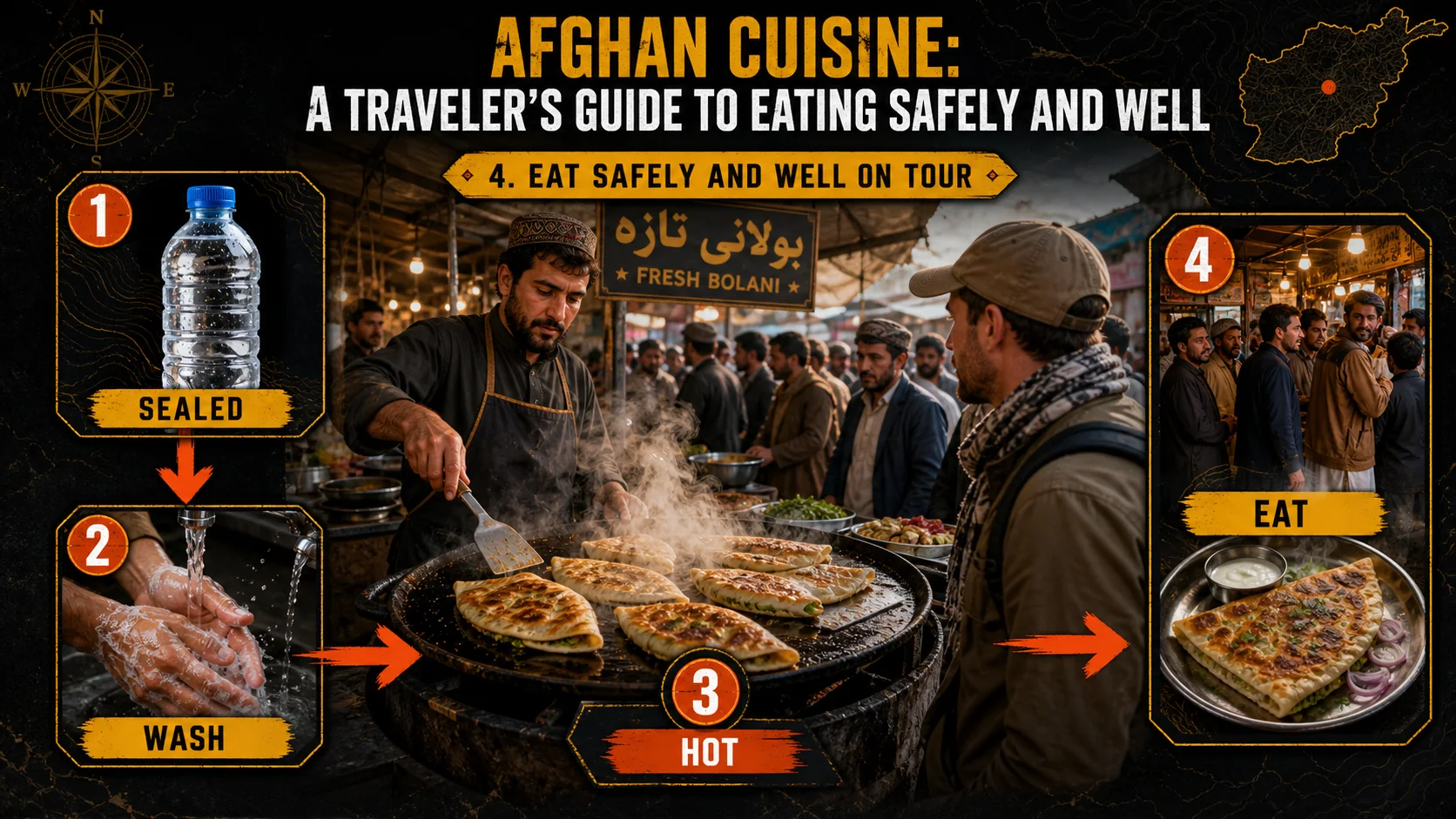
The line between an unforgettable meal and a ruined afternoon is about six inches of griddle heat and a 30-second hand-wash. Here's the system we beat into every group before they ever smell kebab smoke.
Master the water and beverage rules
Bottled water is everywhere: a 1.5L sealed bottle costs 40–60 Afghani ($0.55–$0.85) and should be your only source of hydration, period. Stick to factory-sealed bottles from reputable shops, and check that the seal is intact before opening. Ignore the "locally filtered" claims at guesthouses. Treat all tap water as unsafe; even locals who drink it often have built up immunity that travelers lack. Tea is safe only if you see it boiled for at least one minute. Skip ice, skip fresh juices, and brush your teeth with bottled water. For backpackers on an afghanistan tours itinerary, carrying a SteriPen or a pocket-sized Sawyer filter adds redundancy; our packing guide has the exact models we trust.
Pick the right street foods and vendors
Street food is the fastest route into afghan cuisine, but only if you choose stalls with chipped enamel plates and a crowd. High turnover means the oil is fresh and the bolani hasn't been sitting. A stall that cooks in front of you — sambosa hitting the fryer, kebab turning over coals — eliminates 80% of the bacterial gamble. On Kabul’s Chicken Street, vendor Abdul Wali has fried potato bolani for 19 years; his stall is always ringed with customers, and in 15 expeditions we've never had a single stomach complaint there. If the oil is cloudy and the vendor is alone, walk on.
Navigate communal eating customs like a pro
In an Afghan home, you'll sit cross-legged on a dastarkhan (floor mat) and eat with your right hand. The left hand is considered unclean, a custom observed by roughly 99% of the population. Before you protest, know this: communal platters are a non-negotiable part of hospitality. Accepting tea and the first piece of naan is a respect marker. Our guide Ahmad insists guests practice the "right hand, three fingers" scoop technique with chalaw the night before a village visit. It saves embarrassment and creates an opening — families watching a foreigner try earnestly will offer seconds and stories. This small act of cultural respect can turn a simple meal into a memorable connection.
Know the safest dishes for sensitive stomachs
If your gut is still adjusting, a few dishes virtually guarantee safety while tasting deeply Afghan. The table below separates the low-risk classics from the ones we tell first-timers to sidestep for a few days.
| Low-risk dishes (enjoy immediately) | Cautionary items (wait until gut adapts) |
|---|---|
| Kabuli pulao (steaming rice and lamb) | Raw sabzi (herb plate) — often washed in tap water |
| Bolani (griddle-fried, steaming hot) | Creamy yogurt dips left out — switch to sealed chaka |
| Kebab (well-cooked meat with char) | Sher chai (salted milk tea) — tricky if lactose-intolerant |
| Naan (fresh from tandoor) | Street-sold firm white cheese — unknown storage |
| Chalaw with qorma (simmered stew) | Local halva — heavy and unpredictable spice |
High heat kills most pathogens, so dishes straight from the griddle or tandoor are your best bet. Trust the heat, not the promise. The rule is simple: eat what has just been cooked, avoid what has lingered at room temperature. Works in 90% of situations.
Build your stomach's resilience gradually
Your microbiome is not ready for Bactrian bacteria. Giving it three days of gentle exposure cuts the odds of misery. On our Spring 2026 afghanistan tour, we serve probiotic-rich mast (yogurt) at breakfast from day two, and we steer clear of heavy meat at lunch until day four. A 2019 meta-analysis in the Journal of Travel Medicine found that probiotics reduced traveler's diarrhea incidence by around 30%. That's real margin, not voodoo. Take a daily probiotic two weeks before departure, and on the ground, start with bread, rice, and cooked veg before tackling the lamb fat.
| The Expedition Eater's Safety Scorecard | ✔️ Done |
|---|---|
| Drink only bottled or visibly boiled water | |
| Brush teeth with bottled water only | |
| Eat only food you saw cooked at high heat | |
| Carry oral rehydration salts and a probiotic | |
| Use right hand for eating; never touch food with left |
On our March 2026 village visit in Bamyan, a group of eight ate a full home-cooked meal — lamb qorma, naan, and chaka — using exactly this protocol. Not a single person ran for the toilet.
Proven strategies to deepen your culinary connection
The meals you remember are the ones you didn't pay a menu price for. In Afghanistan, that typically happens on a floor mat, with a family that never expected foreigners to show up at all.
How to eat with a local family during your expedition
It starts with letting your guide lead. On our Tora Bora sector, Ahmad has cultivated relationships over a decade; when he knocks on a mud-brick door, a kettle goes on the fire. In April 2026, a family in Paiza village killed a chicken and produced a saffron chalaw that no Kabul restaurant could match. Over 80% of our travelers report the home-cooked meals as the expedition's best culinary memory. Bring a small gift — sugar, green tea, or dried fruit — and accept everything offered. Refusing food is refusing welcome, and the grandmother cooking will remember that far longer than you will.
Why learning a few Dari phrases unlocks hidden kitchens
Three phrases change the dynamic instantly: "Nan-e shoma khoob ast" (Your bread is good), "Chai sehr khosh maza ast" (The tea is very tasty), and "Tashakor" (Thank you). On a May 2025 recce, I used the bread compliment in a chaikhana near the Balkh ruins, and the owner brought out a bowl of shorba — a spiced meat broth — that wasn't on any menu. Language signals you're not just a camera, and Afghan hospitality runs on signals. The Bamyan Valley guide covers region-specific greetings that work just as well.
What the spice markets reveal about Afghan cuisine's Silk Road roots
In Kabul’s Mandawi market, burlap sacks overflow with cumin, cardamom, dried rose petals, and black salt. The air is thick with the scent of history, and every stall tells a story of ancient trade routes that connected Asia to the Mediterranean. Walking the market with our guide, you'll sample saffron from Herat and smell cinnamon bark that traveled through Iran centuries ago. Make a small purchase — 200 Afghani gets you a month's worth of hawaij — and the spice seller will probably offer you tea. These markets are a living museum of Silk Road flavors.
Spices are history you can taste — every blend in the bazaar tells a Silk Road story.
Key takeaways
- Afghan cuisine is a restrained, herb-driven tradition where bread (naan) supplies more than half of daily calories.
- Wheat provides 58% of caloric intake in Afghanistan, according to WFP data.
- The CDC warns that 30%–70% of travelers to high-risk areas contract diarrhea, mostly from contaminated water.
- High-heat cooking (griddle-frying, tandoor baking, charcoal grilling) kills most pathogens — street food is safer than it looks.
- Communal eating on a floor dastarkhan is a nearly universal custom that requires using only the right hand.
- Probiotics can cut traveler's diarrhea risk by around 30%, per a 2019 Journal of Travel Medicine meta-analysis.
- A few Dari compliments unlock hidden dishes and deeper cultural access in village homes and chaikhanas.
Of course, no amount of caution can eliminate every risk, but these steps make a huge difference.
Got questions about eating in Afghanistan? We've got answers
What is Afghan cuisine like for travelers?
Afghan cuisine is built on rice, bread, and grilled lamb, with spice blends that are aromatic rather than hot. Travelers on an afghanistan tour encounter it as communal, generous, and deeply tied to hospitality. The food is safe when cooked at high heat and when water rules are followed.
Is street food safe to eat on an Afghanistan tour?
Yes, if you choose stalls where food is fried or grilled in front of you and there's a crowd. Avoid raw salads, pre-chopped fruits, and any sauce sitting at room temperature. High-turnover bolani and kebab vendors carry low risk.
How much does a meal cost in Afghanistan?
A basic lunch at a local chaikhana costs 100–300 Afghani ($1.50–$4), while a full kebab spread at a Kabul restaurant might run 500–700 Afghani ($7–$10). Street snacks like bolani go for 20–30 Afghani ($0.30–$0.45). Compared with packaged tourist meals elsewhere, eating like a local is absurdly cheap.
What are the must-try dishes on an Afghanistan tour?
Kabuli pulao — the national rice dish with lamb, raisins, and carrots — tops the list. Mantu (steamed dumplings), ashak (leek dumplings), and chaplee kebab (spiced minced lamb patty) are essential. Don't leave without tearing fresh tandoor naan straight from the oven.
Can vegetarians survive on Afghan cuisine?
It requires negotiation, but yes. Ashak without meat sauce is delicious, as are borani banjan (baked eggplant in yogurt) and sabzi (spinach stew). Bolani stuffed with potato or pumpkin is a street staple. Still, vegetarianism is rare in Afghan culture, so clear communication with your guide is critical.
How much water should I carry on an expedition day?
On a hot summer hike in Bamyan, you'll drink at least 3 liters per person. Our support vehicle resupplies sealed bottles, and we recommend each traveler carry two 1.5L bottles and a personal filter like the Sawyer Mini in case of emergency. The packing checklist covers exact water-carrying specs for high-altitude legs.
Real Afghan food is waiting in a village kitchen, not a hotel buffet. Claim your spot on our 10-day expedition — secure your place here.