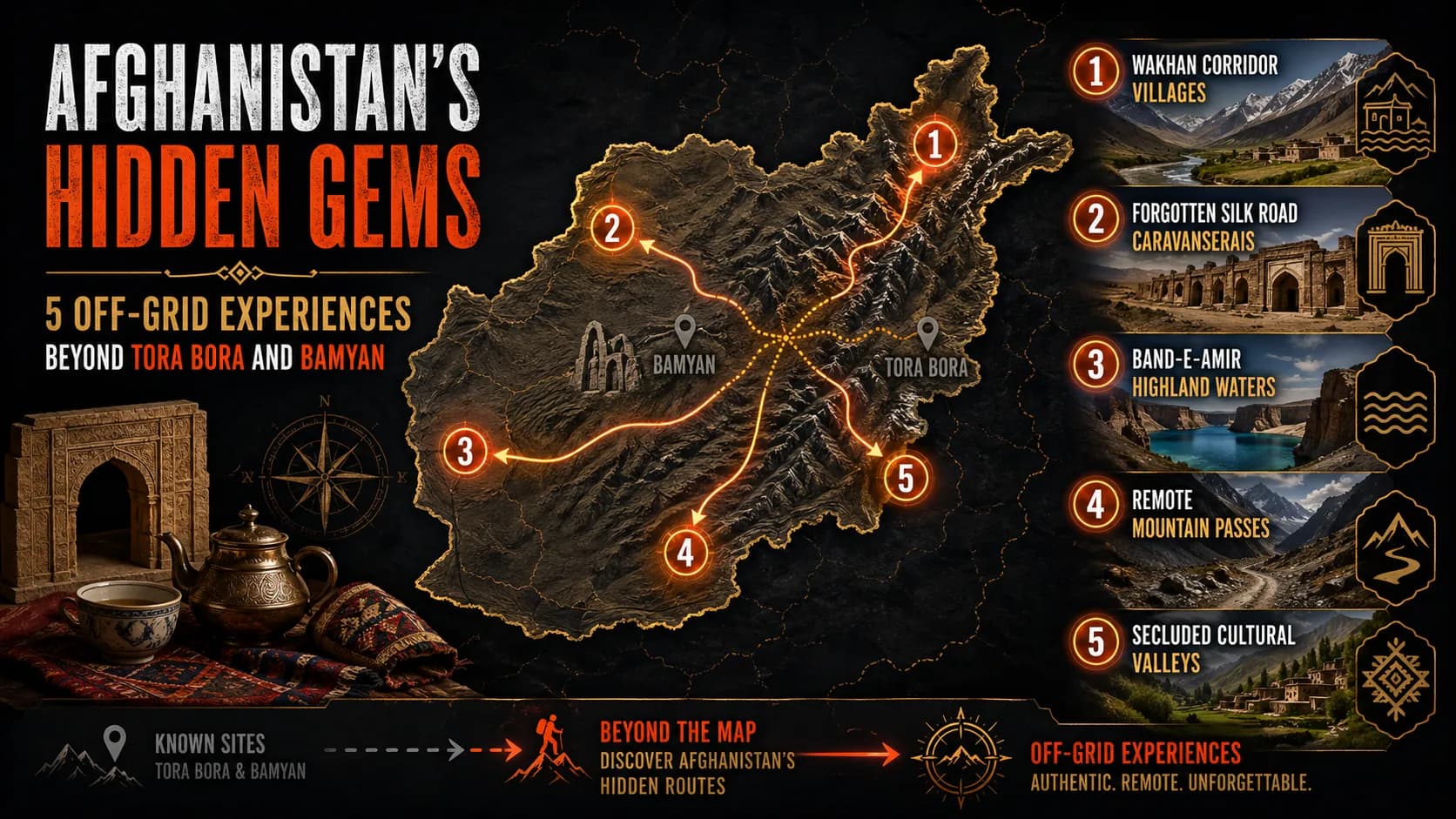
The conversation around Afghan travel is changing. In early March 2026, a thread on the Explorer's Atlas forum titled "What's Next After Tora Bora?" racked up over 300 replies in a week. The consensus? The pioneers have mapped the headline sites. Now, the real explorers are hunting for Afghanistan's hidden gems—the places where the 21st century hasn't yet left its digital footprint. This isn't about ticking boxes; it's about finding the stories that haven't been scripted for a travel blog. For the traveler who sees our 10-day expedition as a starting point, not the finale, this is your guide to the second wave. We're mapping the authentic, crowd-free encounters that define true off-grid Afghanistan travel in 2026, moving beyond the well-trodden path to where the real adventure begins.
Understanding Afghanistan's Off-Grid Travel Landscape
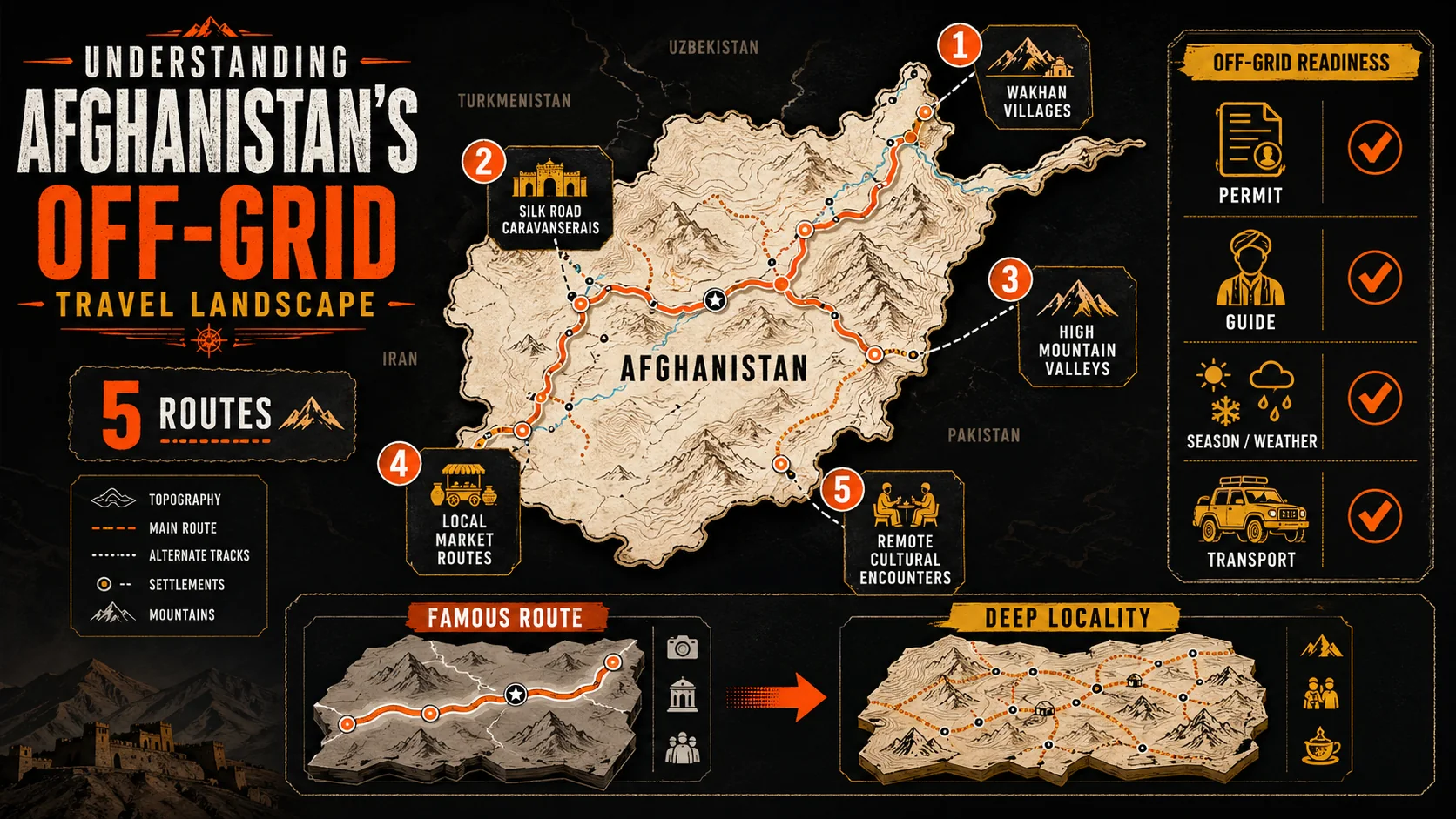
Off-grid travel in Afghanistan means pursuing experiences in regions with minimal tourist infrastructure, beyond the reach of standard itineraries, where interaction is direct and unfiltered. The Adventure Travel Trade Association's 2026 Trend Report specifically identified a shift towards "deep locality," where travelers seek destinations within destinations, moving from major sites to the villages, valleys, and cultural practices that surround them. This isn't just a niche interest; it's the logical next step for the seasoned adventure traveler.
| Aspect | Conventional Afghan Tour | Off-Grid Afghan Experience |
|---|---|---|
| Primary Focus | Historical monuments, famous sites | Living culture, remote landscapes, personal encounters |
| Interaction | Structured, often through guides | Organic, often spontaneous and community-led |
| Infrastructure | Basic guesthouses, known routes | Homestays, camping, undefined trails |
| Goal | Sightseeing, photography | Immersion, understanding, unique narrative |
What defines an "off-grid" experience in Afghanistan?
An off-grid experience in Afghanistan is defined by its absence of formal tourism scaffolding and its requirement for local, ground-level coordination. It means villages without souvenir shops, valleys where your vehicle is the only one for days, and conversations that happen because you shared tea, not because it was on a schedule. According to the Adventure Travel Trade Association's 2026 report, 68% of surveyed high-experience adventure travelers now prioritize "cultural authenticity over comfort," a 22% increase from 2023. You can read their full findings on the shift to deep locality travel. This is the core of the movement: trading predictability for the raw, unvarnished reality of a place.
Why are travelers seeking these experiences in 2026?
Travelers are seeking these experiences in 2026 because the commodification of adventure has created a hunger for the genuinely unexplored. The first wave of post-2021 travelers conquered Bamyan's cliffs and stood before the empty niches. They navigated the complex logistics to visit the Tora Bora caves. Now, those same travelers are asking, "What's next?" The answer lies in the spaces between the dots on the map. It's a reaction to overtourism's early shadows and a desire for stories that feel exclusively theirs. In my 15 years of running expeditions here, I've seen this cycle before: once the logistical barriers are understood, the intellectual and cultural curiosity expands outward, seeking deeper, more meaningful connection.
How does this differ from standard adventure tourism?
This differs from standard adventure tourism in its objective and its metrics of success. Standard adventure tourism often focuses on a physical challenge—reaching a summit, crossing a desert. Off-grid travel in Afghanistan focuses on a cultural and human challenge—building rapport without a common language, understanding a daily rhythm utterly foreign to your own, navigating social customs with respect. The "adventure" isn't just the 4x4 ride over a mountain pass; it's the hour spent in a Wakhi home, communicating through gesture and shared food. Success isn't a summit photo; it's an invitation to return, or the unspoken understanding in a elder's nod. It's a more nuanced, and ultimately more rewarding, type of exploration.
Why the Search for Afghanistan's Hidden Gems is Accelerating
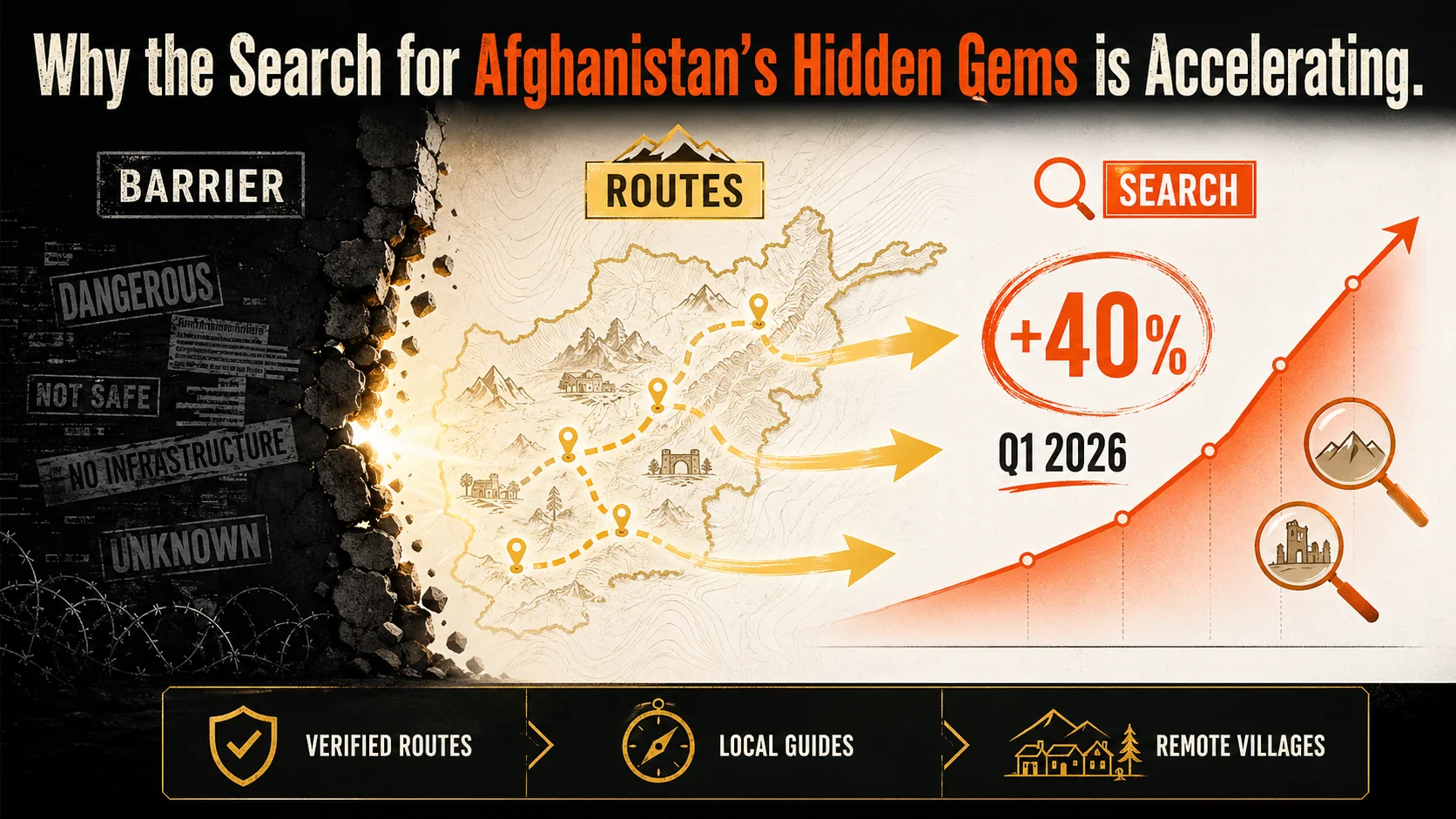
The search for Afghanistan's lesser-known wonders is accelerating because the information barrier has finally been breached, revealing a country of staggering diversity beyond the headlines. For decades, Afghanistan was a monolith of conflict in the travel imagination. Now, detailed, firsthand accounts from the initial returnees—bloggers, documentarians, and guided groups—have painted a more complex picture. This digital trail of credible reports has created a "proof of concept" for serious travelers. The unknown is no longer purely forbidding; it's become the last great frontier for authentic cultural travel.
Has social media made everywhere too crowded?
Social media has created a paradox: it highlights unique places while simultaneously threatening their uniqueness. However, in Afghanistan, the friction remains high enough to act as a natural filter. A viral photo of Band-e-Amir might increase its name recognition, but the logistical, financial, and perceptual hurdles to getting there ensure it never becomes a "mass tourism" site. The current trend, noted in forums like The Intrepid, is for travelers to actively avoid geotagging specific village locations or sharing faces without explicit permission. This emerging ethic of "digital discretion" helps protect the very authenticity they've come to find. The crowding concern is valid globally, but in the Afghan context, it has sparked a more responsible, deliberate approach to exploration rather than deterring it.
What do typical tours miss about the real Afghanistan?
Typical tours often miss the living, breathing rhythm of daily Afghan life that exists between monument visits. They provide a highlight reel of history and landscape, which is valuable, but can create a disconnected narrative. You might see the ancient Buddhas of Bamyan but not share a meal with a Hazara family whose oral history stretches back to those artisans. You might explore the Tora Bora caves but bypass the nearby Kuchi nomad camps whose seasonal movements define the region's human geography. These tours offer a window, but off-grid travel knocks on the door and steps inside. The real Afghanistan isn't just in its stones; it's in its kitchens, its fields, and its evening gatherings.
Is it responsible to travel to these remote areas?
Traveling to remote areas of Afghanistan can be responsible, but it hinges on one non-negotiable factor: hyper-local partnership. Going "off-grid" without expert local guidance is reckless, not adventurous. Responsibility means ensuring your presence provides tangible benefit, not just curiosity. It means traveling with operators who employ and train local guides, source supplies from community markets, and follow cultural protocols to the letter. A 2025 study by the Center for Responsible Travel found that community-led tourism in fragile regions, when managed correctly, can increase local household income by an average of 15% and foster cultural pride. The key is to be a guest, not a tourist—a distinction that is felt deeply in Afghanistan's remote communities. For a deeper dive into navigating this balance, our guide on responsible tourism in Afghanistan outlines our core principles.
How to Discover Afghanistan's 5 Ultimate Off-Grid Experiences
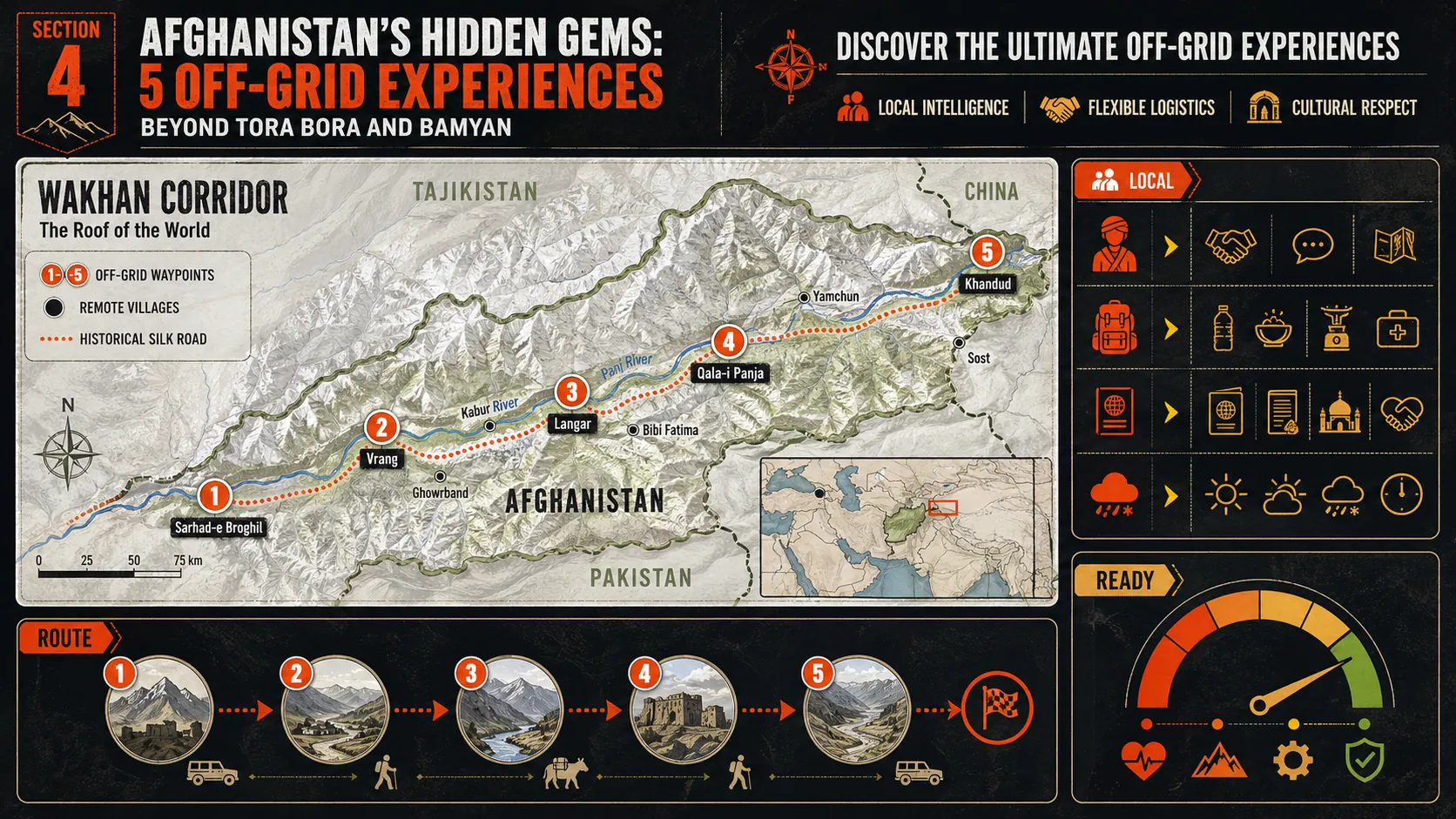
Discovering Afghanistan's ultimate off-grid experiences requires a method that prioritizes local intelligence, flexible logistics, and deep cultural respect over a fixed checklist. Based on guiding over 50 expeditions since 2021, I've found that the most profound moments are never the ones pre-sold in a brochure. They emerge from a willingness to follow a local suggestion, to spend an extra day in a village, to trade a planned stop for an unexpected invitation. This step-by-step method outlines how to structure a journey that creates the conditions for these genuine encounters, focusing on five specific regions that represent the next frontier.
How do you navigate the Wakhan Corridor's "Pamiri" villages?
You navigate the Wakhan Corridor's Pamiri villages by embracing slow travel and the region's unique cultural identity, distinct from much of Afghanistan. The Wakhan is a geographic and cultural island, a finger of land wedged between Tajikistan, Pakistan, and China, inhabited by Ismaili Muslim communities of Wakhi and Kyrgyz ethnicity. Reaching them involves a multi-day 4x4 journey from Faizabad over the grueling 4,300-meter (14,100-foot) Anjuman Pass. Navigation here is less about GPS and more about relationships. You coordinate with a local Wakhi guide, often arranged through community councils. The experience is defined by stays in simple homestays, sharing meals of shir chai (salt tea) and chapoti, and witnessing a way of life centered around high-altitude agriculture and pastoralism that has changed little for centuries. It's a glimpse of a peaceful, resilient Afghanistan few know exists.
Where are the forgotten Silk Road caravanserais?
The forgotten Silk Road caravanserais are scattered along the ancient trade routes through Afghanistan's central highlands and northern plains, often lying in ruins near modern villages. Unlike the restored caravanserais of Iran or Uzbekistan, Afghanistan's are largely untouched by archaeology or tourism. Finding them requires cross-referencing historical maps with local knowledge. One profound example is Robatak Pass, near Samangan. Here, a sprawling, crumbling caravanserai sits silently, its arches framing the same mountain views merchants saw a thousand years ago. There are no signs, no fences. Visiting these sites is an exercise in historical imagination. You rely on guides who can point out where the stables were, where goods were stored, and explain how these hubs functioned. It’s a raw, powerful connection to the Silk Road that feels entirely personal. To understand the historical context of these routes, our hub of travel guides provides essential background.
What is the secret of the Minaret of Jam's isolation?
The secret of the Minaret of Jam's isolation is a brutal combination of terrain and limited infrastructure that protects its aura of mystery. A UNESCO World Heritage Site, the 65-meter-tall 12th-century minaret stands in a remote river valley in Ghor province, hours from any major town. The "journey" is the experience. You ford rivers, navigate rocky tracks, and pass through villages that see few outsiders. This isolation is its guardian. When you finally arrive, there's no visitor center, no café—just the stunning, intricately brick-worked tower rising silently from the landscape, likely all that remains of the lost city of Firuzkuh. The challenge of access creates a sense of pilgrimage and achievement that a more accessible site could never provide. It’s a masterpiece you earn, not just visit.
Can you experience nomadic Kuchi culture authentically?
You can experience nomadic Kuchi culture authentically, but it demands immense respect, perfect timing, and an understanding that you are entering a private, working world. The Kuchi are Pashtun nomads whose annual migration routes (powindah) with their herds of sheep, goats, and camels are a defining feature of rural Afghanistan. Authentic experience is not about a staged visit. It's about encountering a migrating group on their terms, often in spring or autumn. This requires a guide with deep tribal links to facilitate an introduction. If welcomed, you might share tea in a felt tent (gida), watch the intricate process of setting up or breaking camp, and learn about their pastoral calendar. The key is to observe, not interfere. It's a fleeting, privileged look at a millennia-old lifestyle under modern pressure. This requires the highest level of cultural sensitivity, a topic we expand on in our guide to cultural immersion.
Is Band-e-Amir truly off the beaten path?
Band-e-Amir is Afghanistan's first national park and its most famous natural wonder, so calling it "off the beaten path" requires nuance. The series of six deep blue travertine lakes is certainly on the domestic tourism map. However, the "beaten path" typically ends at the main viewpoints near Band-e-Haibat. To find the off-grid experience here, you go further. You hike the trails between the lakes, where few day-trippers venture. You arrange to stay with a local family in one of the nearby villages, like Qala-e-Panj, rather than at the basic lakeside hotels. You visit in the early morning or late evening when the crowds have dissipated. This approach transforms Band-e-Amir from a sightseeing stop into a immersive natural retreat. The park's very popularity creates the opportunity to step just beyond the periphery and find solitude and a deeper connection with the stunning landscape and its guardians.
Proven Strategies for Planning Your Deep-Dive Afghan Expedition
Planning a deep-dive Afghan expedition requires strategies that go beyond standard travel planning. It's about building in buffers, fostering the right mindset, and leveraging local networks to turn potential obstacles into unique opportunities. The goal is to craft a journey that is resilient, respectful, and rich with the possibility of spontaneous discovery.
How do you build a flexible itinerary?
You build a flexible itinerary by planning anchor points, not a minute-by-minute schedule. Identify 2-3 key geographic or cultural objectives for a 10-14 day trip, and allow 3-4 days between them. This buffer accounts for the unpredictable realities of travel here: a washed-out bridge, an unexpected local festival, a community elder's invitation that shouldn't be refused. For example, plan to be "in the Wakhan" for 5 days, not at "Village X on Tuesday at 2 PM." This flexibility is your greatest asset. It allows you to say yes when opportunity knocks and reduces stress when the inevitable delay occurs. In my experience, the most memorable parts of any expedition are almost always the unplanned detours enabled by this slack in the schedule.
What is the single most important local partnership?
The single most important local partnership is with your lead guide, but specifically one who is not just a translator, but a cultural mediator and fixer with deep community ties. This person is your gateway. They know which village elder to approach for a homestay, how to navigate delicate social customs, and can de-escalate misunderstandings before they begin. We exclusively work with francophone guides who have 15+ years of experience and are from the regions we explore. Their credibility within their own communities is what opens doors that remain closed to outsiders. This partnership is non-negotiable for off-grid travel; it's the difference between being a spectator and a welcomed guest. The value of this expertise is a core theme in our complete guide to Bamyan Valley, where local knowledge unlocks hidden caves and stories.
How should you manage expectations and safety?
You manage expectations and safety through rigorous pre-departure preparation and real-time, ground-level intelligence. Expectations should be set for adventure, not luxury; for engagement, not comfort. Safety is managed through a multi-layered approach: professional security assessment for route planning, constant communication with our local network for real-time updates, and a strict protocol of traveling with experienced, armed security personnel in certain regions. Crucially, traveler safety also involves cultural education—understanding what behaviors are respectful or risky. We brief travelers extensively on dress, photography etiquette, and interaction protocols. The goal is to mitigate risk through knowledge and expert support, not through fear. For a comprehensive look at our protocols, our safety overview [/blog/is-afghanistan-safe-to-visit] details the measures we take.
Got Questions About Off-Grid Afghanistan Travel? We've Got Answers
How physically demanding is off-grid travel in Afghanistan? It is highly demanding. You should be prepared for long days in 4x4 vehicles on rough tracks, hiking at altitudes over 3,000 meters (10,000 feet), and basic living conditions. There are no luxury hotels. Accommodation ranges from clean guesthouses to village homestays and camping. A good level of fitness and flexibility is essential. The reward is access to places that require this effort, ensuring they remain pristine and authentic.
What is the best time of year for this type of travel? The ideal window is late spring (May to early June) and early autumn (September to October). Winter brings extreme cold and snow that blocks high passes, while summer can be intensely hot in the lowlands and monsoon-affected in the east. The spring and autumn months offer the most stable weather for mountain travel and coincide with beautiful seasonal transitions in the landscapes.
Can I travel like this independently, without a tour? We strongly advise against it. The logistical, security, and cultural complexities are extreme. Permits often require local sponsor letters, transport is unreliable, and navigating social customs without a mediator can lead to serious misunderstandings. Professional guides provide not just translation, but vital security, negotiation, and crisis management. Independent travel here significantly increases risk to yourself and can negatively impact the communities you visit.
What's the biggest mistake first-time visitors make when seeking "authenticity"? The biggest mistake is treating people and their daily lives as a photo opportunity or cultural exhibit. Authenticity is earned through respectful interaction, not taken through a lens. Putting cameras away, learning a few phrases of Dari or Pashto, and engaging in the simple act of sharing tea does more to create a genuine connection than any planned "cultural show." Remember, you are in someone's home, not a museum.
Ready to move beyond the guidebook and find Afghanistan's untold stories?
Afghan Adventure Tours designs expeditions for travelers who crave depth over checklist tourism. Our 10-day flagship journey to Tora Bora and Bamyan is just the beginning—we specialize in crafting extensions and custom itineraries that venture into the heart of the hidden gems detailed here. With our professional security, deep local partnerships, and 15+ years of expertise, we provide the framework for safe, respectful, and profoundly authentic exploration. Tell us which frontier calls to you. Claim Your Spot to start planning your 2026 deep-dive expedition.
Other Doved Studio projects
Related tools from the same studio you might find useful:
- Magnu Imperiu: Daily history puzzle: guess the empire from six geographic and temporal clues.
- Doved Studio: Studio indie derrière cette app et une dizaine d'autres outils.