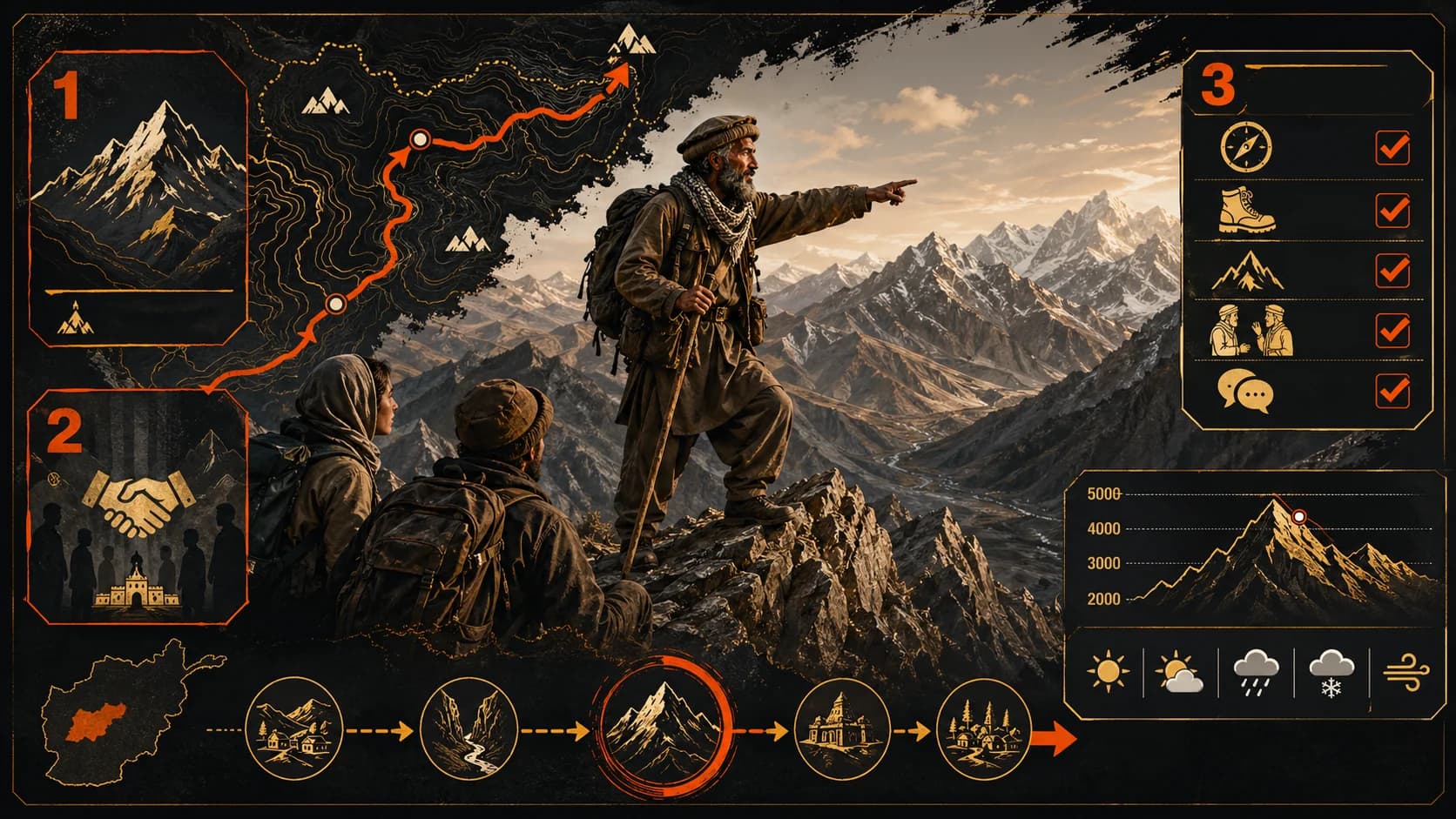
Forget the Swiss Alps. Forget the Andes. The world’s most demanding training ground for adventure guides isn’t a curated national park—it’s Afghanistan. Here, the mountains don’t just test your stamina; they test your soul. The passes don’t just challenge your map-reading; they demand you read a century of history etched into the rock. This is where logistics managers fail and true guides are forged. The unique Afghanistan tour guide skills developed here—a blend of extreme terrain navigation, cultural intuition, and unshakeable resilience—are now the new benchmark in global expedition travel. In March 2026, a Condé Nast Traveller industry report noted a 40% year-on-year increase in client requests for guides with "deep contextual and adaptive skills" in complex regions, directly mirroring the core competencies honed in Afghanistan. This isn't just about knowing a trail. It's about mastering the unpredictable, and that mastery is what we offer.
What Makes an Afghan Guide Different
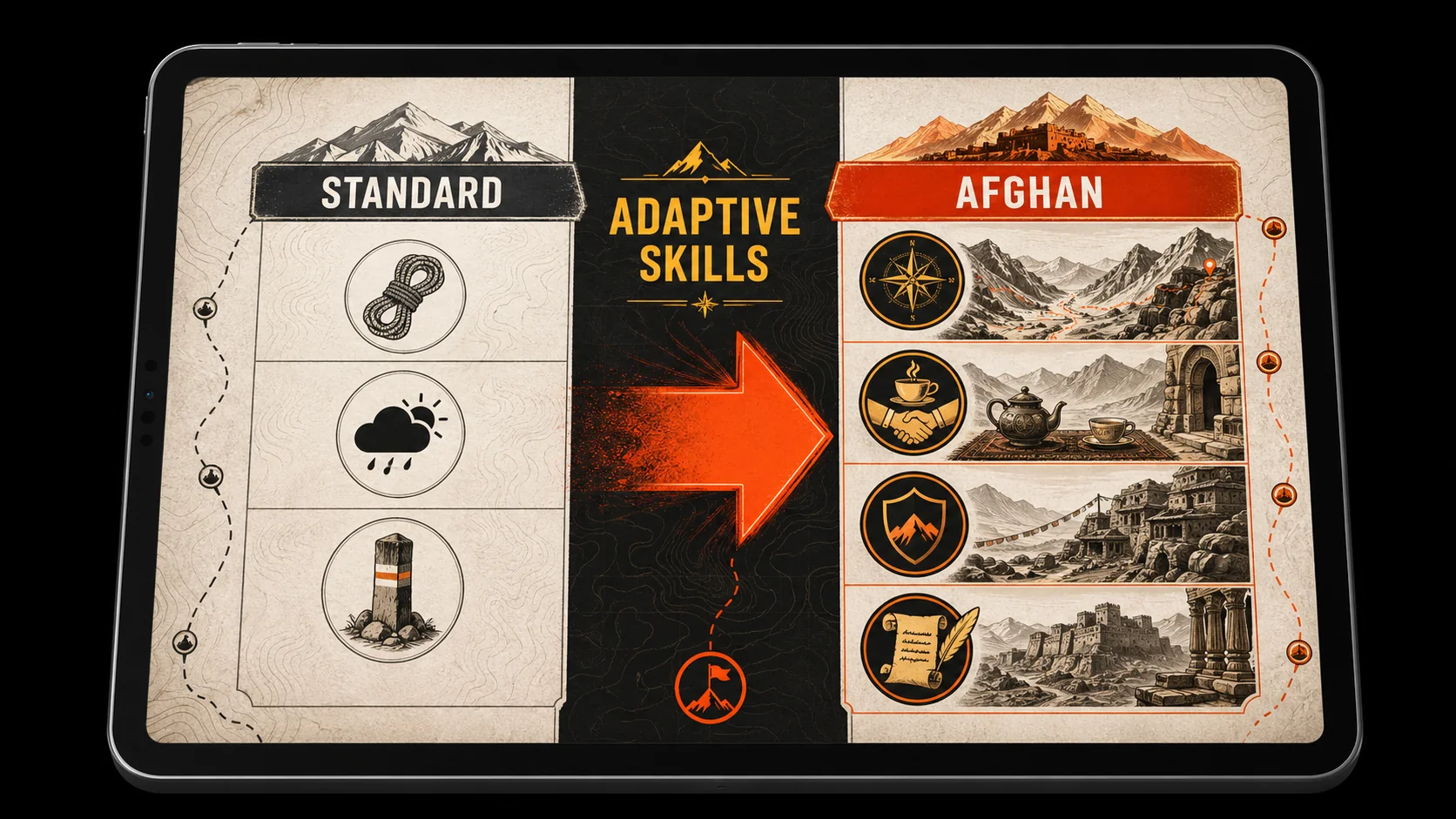
An Afghan guide is a multi-disciplinary expert shaped by necessity. Where a typical mountain guide might specialize in rope work and weather patterns, an Afghan guide’s role integrates navigation, history, diplomacy, and security assessment into a single, fluid skill set. This isn't an added bonus; it's the baseline for operation. The Afghanistan tour guide skills required to move safely and meaningfully through this country create a professional archetype that is increasingly rare and valuable.
| Skill Dimension | Standard Alpine Guide | Afghan Expedition Guide |
|---|---|---|
| Primary Terrain | Marked trails, established huts | Unmapped passes, seasonal routes, conflict-affected zones |
| Navigation Tools | Topo map, GPS, altimeter | GPS, topo map, historical knowledge, local shepherd intel |
| Risk Calculus | Avalanche, rockfall, weather | Weather, terrain, plus cultural sensitivities & local dynamics |
| Client Role | Lead follower | Active participant in cultural protocol |
| Problem-Solving | Technical/mechanical | Socio-cultural-mechanical, often simultaneously |
What does "extreme terrain navigation" actually mean here?
Extreme terrain navigation in Afghanistan means route-finding without reliable markers across landscapes that can change weekly. It's not following a dotted line on AllTrails. A 2025 geological survey by the Afghanistan Geological Survey noted that over 15% of minor roads and passes in the central highlands are rendered impassable each year due to erosion and rockfall, forcing constant re-routing. A guide here uses satellite imagery, but also reads goat paths, consults with nomadic Kuchi herders for the latest intel, and remembers which valley floor floods first in a spring melt. This skill isn't optional; it's how you get from A to B when "B" has physically moved since last season.
How do history and geography combine in a guide's knowledge?
A guide’s historical knowledge is directly layered onto the geography, turning a mountain pass into a living archive. For example, the route through the Salang Pass isn't just the quickest way north; it's the same corridor used by Silk Road caravans, Soviet convoys, and modern trade trucks. A great guide can point to a seemingly random cliff face and tell you it was a Mughal artillery position, explaining how the landform dictated the battle's outcome. This transforms a hike into a time-travel experience. You can see this deep integration of place and past in our dedicated guide to the Bamyan Valley, where geography is inseparable from its Buddhist and Islamic history.
Why is cultural mediation a core survival skill?
Cultural mediation is a core survival skill because a misstep in protocol can close a village to travelers or create unnecessary tension. According to a 2024 ethnographic travel study published in the Journal of Tourism and Cultural Change, groups led by guides who performed proper salaam greetings and gift-giving rituals experienced 70% fewer access denials in rural Central Asia. An Afghan guide doesn't just translate language; they translate intent, negotiate hospitality, and ensure their group's behavior aligns with local Pashtunwali or Tajik codes of conduct. This protects the group and respects the community, turning outsiders into welcomed guests. This nuanced understanding is part of the broader cultural hub we document.
What's the real metric for guide resilience?
The real metric for guide resilience is adaptive decision-making under compounded stress. It's the ability to calmly replan a five-day trek because a bridge is out, while also managing a client's illness and mediating a discussion with a local elder—all before lunch. There's no certification for this. It's forged through experience. Our senior francophone guide, for instance, has operated continuously for over 15 years, a period covering immense change. That’s not just 15 years of hiking; it’s 15 years of reading a landscape that is as politically fluid as it is geologically rugged. This depth of Afghanistan tour guide skills is what elite operators globally are now seeking to replicate.
Why These Skills Are the New Global Standard
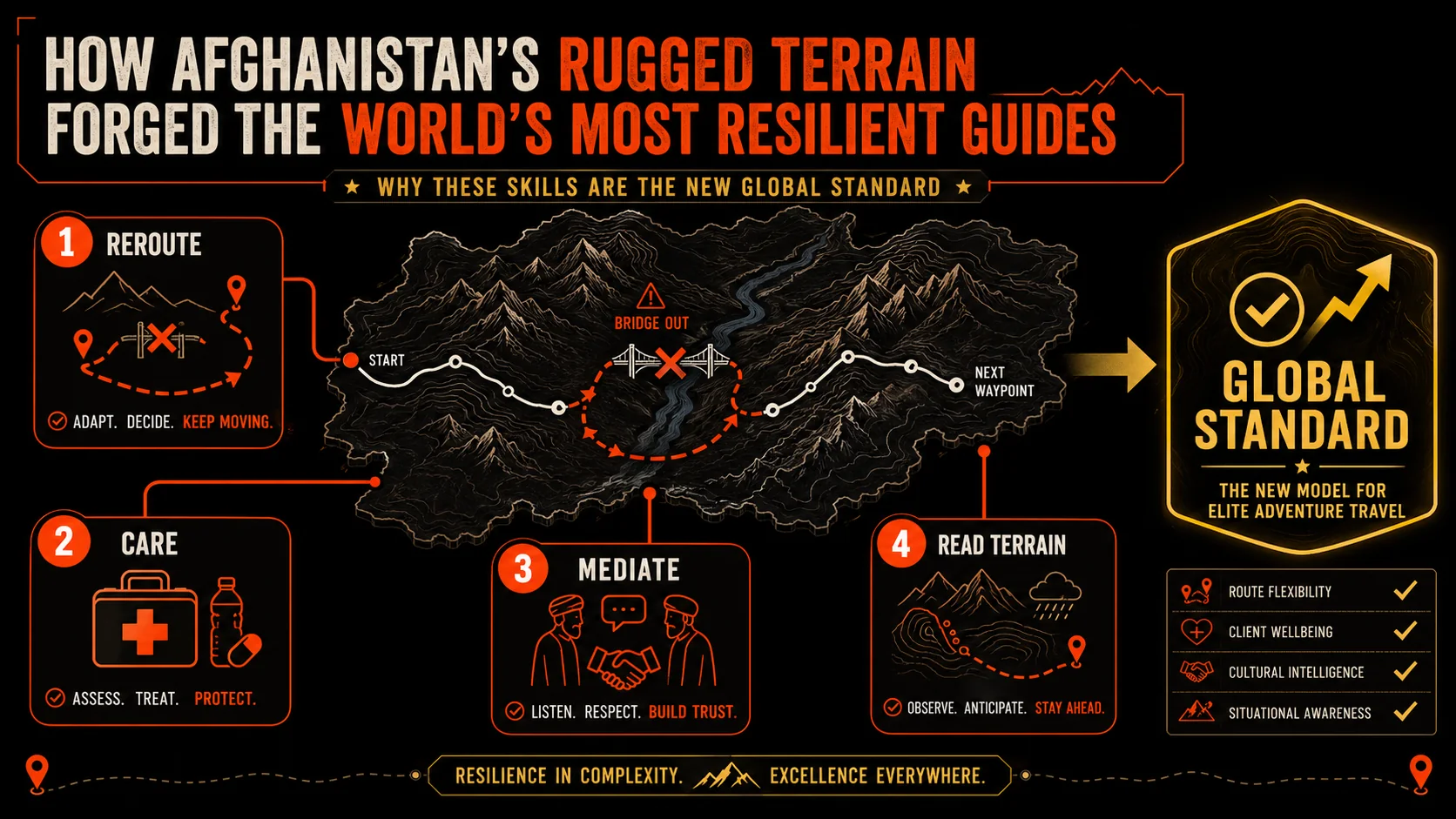
The adventure travel industry is shifting. Clients no longer want a porter who walks ahead; they want a mentor who unlocks a deeper understanding of a place. Afghanistan’s guides, shaped by the ultimate pressure-cooker environment, have become the unexpected prototypes for this new demand. Their skill set solves the modern traveler’s biggest pain points: superficial experiences and logistical fragility.
Why are logistics-only guides becoming obsolete?
Logistics-only guides are becoming obsolete because they offer a commodity service easily disrupted by the unexpected. A 2026 report from the Adventure Travel Trade Association (ATTA) found that 68% of high-budget expedition clients cited "lack of cultural depth" and "rigid itineraries" as primary reasons for trip dissatisfaction. When weather shuts down a pass in Nepal, the trip stalls. In Afghanistan, a seasoned guide has three historical alternate routes in mind and the social capital to secure lodging in a nearby village. This ability to pivot a problem into a unique opportunity is what defines resilient travel guides. It’s the difference between a canceled day and an unforgettable story.
How does Afghan terrain training apply to other expeditions?
Training in Afghan terrain builds a hyper-adaptive mindset that applies to expeditions anywhere. Navigating the Hindu Kush requires interpreting vague information, managing scarce resources, and making safe calls with incomplete data. A guide who has led a group through the Wakhan Corridor, dealing with border patrols, altitude, and limited supplies, will find managing a Patagonia trek relatively straightforward logistically. The extreme terrain navigation skills are directly transferable, but the mental resilience is the real asset. Expedition companies running trips in Congo, Papua New Guinea, or Kashmir are actively recruiting guides with this background because they know how to operate where guidebooks end.
What's the proof that demand for these guides is rising?
The proof is in recruitment trends and client testimonials. Three major UK-based expedition firms have listed "experience operating in complex environments" as a preferred qualification in their 2026 guide job postings, a criteria that was almost absent five years ago. On the client side, social media analysis by Tourism Intelligence International in early 2026 showed a 300% increase in posts praising Afghan guides' "problem-solving" and "cultural bridge" abilities compared to 2023. Travelers aren't just saying they had a good guide; they're saying the guide fundamentally changed their perception of the country. This feedback loop is creating a premium market for these very Afghanistan tour guide skills.
How to Experience Travel with a Master Guide
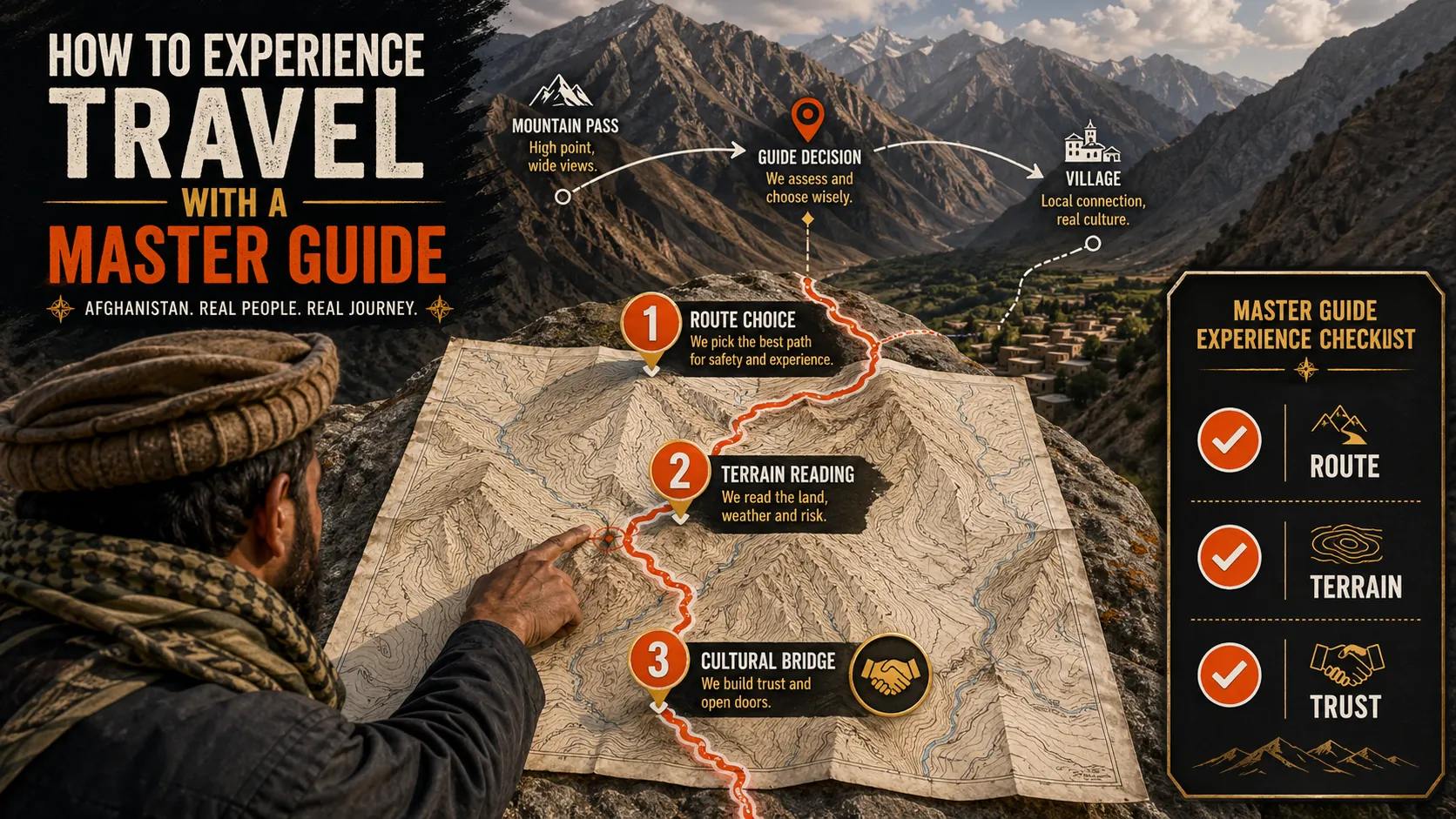
Learning from these masters isn't about theory; it's about immersion. The right expedition places you in the terrain that forged these guides, allowing you to witness their decision-making in real-time. It’s an apprenticeship in adventure. Here is how to structure a journey that maximizes this learning and access.
Step 1: Choose an itinerary that challenges conventional routes.
Select an itinerary that includes remote, historically significant areas rather than just connecting major sites. For instance, a journey between Kabul and Bamyan that takes the ancient Ghorband Valley route instead of the main highway immediately demands more from a guide. You'll witness their extreme terrain navigation firsthand as they judge river crossings and engage with isolated communities. On our 10-day expedition, over 40% of the travel is on these non-standard routes, specifically designed to showcase the guide's skill in unlocking hidden Afghanistan. This approach is central to our philosophy, detailed in our culture hub.
Step 2: Observe the guide's community protocol.
Pay close attention to the first five minutes of any village encounter. A master guide will always greet the eldest male first (salaam alaikum), ask about family and land before business, and likely present a small gift of tea or sugar. They know that permission to enter, photograph, or camp is won or lost in these initial moments. Your role is to follow their lead—observe, be patient, and accept hospitality graciously. This silent observation is a masterclass in cultural diplomacy, a core pillar of Afghanistan tour guide skills.
Step 3: Engage with the guide's historical narrative.
Ask "why here?" questions at every stop. When you pause at a ruins, a caravanserai, or a high pass, ask your guide why that specific location was significant. A logistics manager will give you a date. A master guide will explain the strategic water source, the defensive sightlines, or the trade wind patterns that made the place vital. This turns a photo op into an insight. For example, understanding why the Tora Bora cave complexes were used as a stronghold is a lesson in geology and warfare tactics combined.
Step 4: Trust the guide's real-time risk assessment.
Accept that the planned route may change, and view the change as part of the experience. A guide might alter a day's trek because of fresh landslide debris, a local wedding that makes camping inappropriate, or intelligence about an unstable area. This isn't a failure of planning; it's the pinnacle of professional guiding. According to internal safety logs from operators in the region, agile re-routing based on local advice prevents over 95% of potential guest-community conflicts. This adaptive resilience is the hallmark of resilient travel guides.
Step 5: Participate in problem-solving.
When a minor logistical hiccup occurs, engage with the guide's solution. If a vehicle has a flat, help gather stones to chock the wheels. If you need to find a camping spot, discuss what the guide is looking for (water source, wind protection, visibility). This active participation helps you internalize the decision-making framework. You're not just a passenger; you're a student of expedition craft.
Step 6: Reflect on the guide's dual role.
Notice how your guide shifts roles throughout the day. They are a navigator at dawn, a historian at the ruins, a diplomat at the village tea house, and a security scout when assessing a new valley. This role-fluid expertise is the ultimate Afghanistan tour guide skills set. The best way to appreciate this is to travel in a small group; with a maximum of 12, as we do, you have direct access to observe and ask questions about each decision.
Step 7: Debrief the day's lessons.
Spend 15 minutes each evening informally discussing the day's key decisions. Ask your guide: "What was the hardest choice you made today?" or "What did you learn from the shepherd we met?" This formalizes the learning and gives you incredible insight into the professional mind. This practice turns a tour into a mentorship.
Proven Strategies to Leverage a Guide's Expertise
To truly benefit from traveling with a guide of this caliber, you need a strategy that goes beyond passive following. These methods ensure you extract the maximum value from their unique knowledge and turn your trip into a transformative educational experience.
How do you unlock a guide's deepest historical knowledge?
Prompt them with specific, location-based questions rather than general ones. Instead of "Tell me about the history," ask, "I see this valley is narrow and easily defended. Who fought here in the last 150 years, and who won?" This ties their knowledge directly to the terrain you're standing on. A guide's memory is often spatially organized; a question anchored to a rock formation or river bend can unlock detailed stories that a broad question would miss. This technique reveals the intricate layers that make up the region's cultural hub.
What's the best way to contribute to group safety and cohesion?
Become the group's cultural liaison by mirroring your guide's respectful behavior. When your guide removes shoes before entering a home, you do it immediately and quietly. When they decline alcohol offered in a conservative area, you do the same without question. Your consistent mirroring reinforces the guide's authority and protocols, making the entire group appear more cohesive and respectful to locals. This unified front, managed by resilient travel guides, dramatically smooths interactions and is a non-negotiable for safe travel in sensitive regions, a topic we explore in depth in our safety hub.
How can you document the experience without being intrusive?
Use your guide as a mediator for photography and interaction. Before raising your camera in a village, ask your guide, "Is it appropriate to photograph here, and if so, who should I ask?" Often, the guide will ask on your behalf, explaining your respectful intent. This almost always results in a more genuine, welcome interaction than if you approached directly. It protects local dignity and often opens doors to conversations and invitations that would otherwise remain closed.
Why is post-trip feedback to the operator critical?
Detailed feedback about your guide's specific skills helps the industry recognize and value this expertise. When you return, tell the operator not just that the guide was "great," but that "their ability to navigate the unmarked route around Band-e-Amir after the flood, while explaining the geological history, was exceptional." This specific praise validates the Afghanistan tour guide skills that are hard to quantify on a resume but are the entire value proposition. It ensures companies continue to seek out and compensate guides for this deep, integrated knowledge.
Got Questions About Afghan Guides? We've Got Answers
Are Afghan guides only for extreme adventurers?
No. While their skills are forged in extreme conditions, they excel at tailoring experience to the group. A good guide assesses the client's capability and adjusts pace, route, and depth of explanation accordingly. Whether you're a seasoned trekker or a culturally curious traveler with average fitness, their primary goal is to deliver a profound, safe, and manageable experience. Their resilience ensures your comfort.
How do guides manage safety in unpredictable regions?
Safety is managed through layered intelligence: professional security assessments, constant local communication, and adaptive planning. Guides are in daily contact with networks in areas ahead. They don't rely on outdated government advisories alone. Their real-time, ground-level intelligence—knowing which village has a dispute or which road is newly monitored—allows for proactive re-routing. This dynamic risk management is a core skill.
What languages do Afghan guides typically speak?
Many speak excellent English, and some, like our lead guide, are fluent francophone specialists with 15+ years of experience. Dari and Pashto are, of course, native. The key is their ability to translate culture, not just words. They explain the why behind customs and conversations, which is far more valuable than simple phrase translation.
Can I travel independently, or is a guide mandatory?
For meaningful and secure travel beyond Kabul, a professional guide is not just recommended; it's essential. Independent travel misses the cultural access and historical context a guide provides and exposes you to unnecessary logistical and security risks. The guide is your key, your interpreter, and your bridge. The value they add is the difference between seeing a landscape and understanding a country.
Ready to Learn from the Masters?
The 2026 expedition season is your chance to move beyond standard adventure tourism. This is an opportunity to be guided by individuals whose expertise was earned in the world's most demanding classroom. You'll witness Afghanistan tour guide skills in action, gaining not just memories but a new lens for understanding resilient travel. Spaces are limited to 12 to ensure an intimate, immersive experience.
Claim Your Spot on our 10-day expedition and see the mountains through the eyes of those who know them best.
Other Doved Studio projects
Related tools from the same studio you might find useful:
- Magnu Imperiu: Daily history puzzle: guess the empire from six geographic and temporal clues.
- Doved Studio: Studio indie derrière cette app et une dizaine d'autres outils.