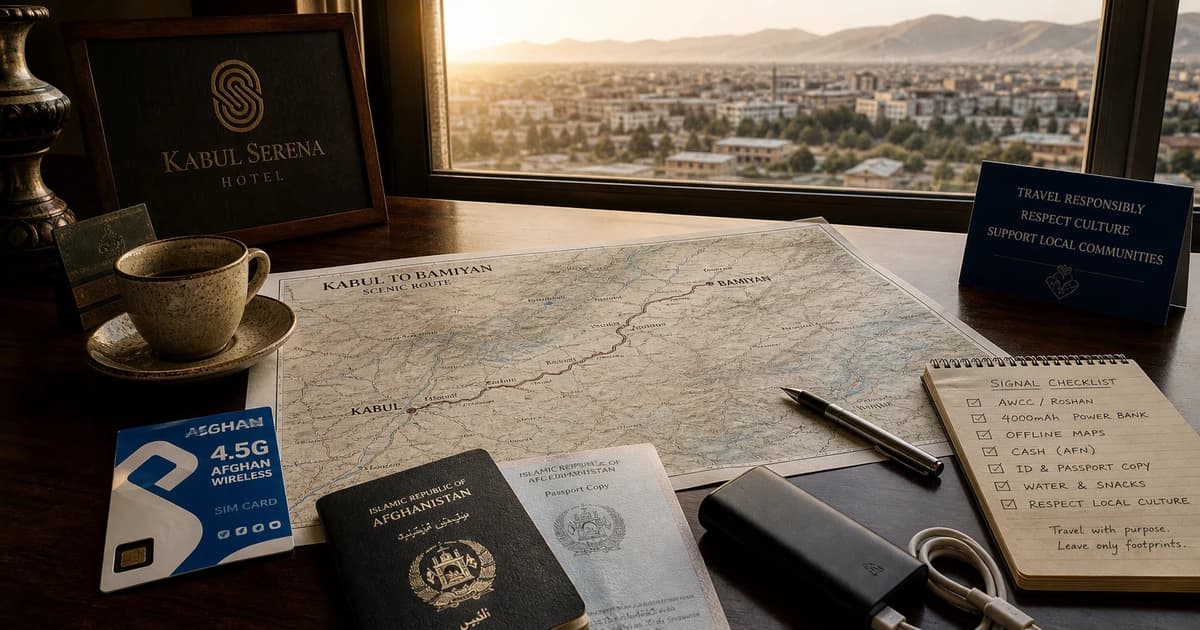
Short answer: plan your Afghanistan connectivity before the road day, not after the signal disappears. A local SIM can be useful in Kabul and other major stops, an eSIM can help on arrival, but serious travel still needs offline maps, saved contacts, a written hotel address, and a guide who treats weak signal as normal.
Afghanistan is not the place to improvise your communications stack from the airport curb. Government advisories remain severe, local rules can shift, SIM registration matters, and rural coverage can change quickly once you leave the capital. The right mindset is not "how do I stay online all the time?" It is "how do I make the trip work if the internet is patchy for six hours?"
Sources checked before writing
- US State Department Afghanistan travel advisory
- UK FCDO Afghanistan travel advice
- Afghanistan Ministry of Communications mobile operators
- OpenSignal Afghanistan mobile network experience report
The first decision: roaming, eSIM, or local SIM
Roaming is the lazy option and often the most expensive. It can be useful as a fallback for the first hour after landing, but it should not be the plan for a multi-day route. An eSIM is cleaner if it works with your device and gives you enough data for maps, messaging, and confirmation calls. A local SIM can be cheaper and gives you a local number, which can matter for drivers, guesthouses, and guides.
The catch is registration. Do not assume you can buy a SIM anonymously from a random stall and use it for the whole trip. Ask your operator what documents are currently required, which provider they recommend for your exact itinerary, and whether you should buy the SIM at an official shop instead of a street reseller.
The connection checklist
| Need | Primary plan | Backup plan |
|---|---|---|
| Airport arrival | Roaming or preloaded eSIM | Printed hotel address and pickup contact |
| Kabul movement | Local SIM or eSIM | Guide phone plus offline map |
| Kabul to Bamiyan | Local SIM tested before departure | Written route plan and no night-driving dependence |
| Band-e-Amir day | Assume patchy signal | Pre-agreed return time and vehicle plan |
| Emergency contact | Two saved local numbers | Paper card in day bag |
That table is intentionally boring. Boring is good. The glamorous version of travel planning fails exactly when you need it.
What to do before the first road day
Download offline maps for Kabul, Bamiyan, and the actual route corridor. Save your hotel, guide, driver, embassy or consular contact, insurer, and emergency family contact as offline notes. Screenshot booking confirmations and passport details. Put the phone numbers on paper because a dead phone is not an identity document.
Then test the connection in Kabul. Send a message, make a local call, load a map, and check that your messaging app still works after switching networks. If the SIM was activated by someone else, understand whose name is attached to it and whether that creates problems. Clean planning beats awkward explanations later.
The questions to ask your operator
Ask which providers work best on your actual route this month. Ask where the SIM should be bought. Ask whether a foreign passport is enough for registration. Ask whether the guide carries a second phone or second network. Ask what happens if data is down when you reach a checkpoint, hotel, or meeting point.
Weak answers sound like "internet is fine now." Strong answers name the route, the provider, the backup, and the moment where the plan changes. On an Afghanistan itinerary, the ability to cancel or reroute is part of the product.
Kabul, Bamiyan, and the remote-day reality
Kabul is the easiest place to solve connectivity. If your phone is still not working there, do not wait until the morning drive. Bamiyan and Band-e-Amir are different. They reward patience and punish assumptions. Treat data as useful when present and irrelevant to the core plan.
For highland travel, your phone is a tool, not a permission slip. The route should be viable without live Google searches, fresh WhatsApp audio, or last-minute GPS guessing. A good guide knows the road, the stop discipline, and the fallback without needing a signal bar to think.
Privacy and device hygiene
Keep your device boring. Remove unnecessary sensitive files. Use a passcode. Avoid carrying client data, unpublished reporting notes, or anything that would create risk if inspected or lost. Do not photograph checkpoints, security sites, or people who have not clearly agreed. Connectivity planning is also behavior planning.
Use a VPN only if it is legal and safe for your situation, and do not treat it as magic. The simplest privacy win is often less data on the device, fewer apps logged in, and fewer reasons to pull out the phone in sensitive places.
The practical packing list
Bring an unlocked phone, a second charging cable, a power bank, paper contact card, offline maps, local cash for top-ups, and a small waterproof sleeve for documents. If your phone uses eSIM only, confirm Afghanistan support before departure. If it uses physical SIM, bring the SIM pin and know where your home SIM will be stored.
Read this alongside the Kabul to Bamiyan operator checklist, the Afghanistan travel advisory comparison, and the Bamiyan safety reality check.
FAQ
Can I rely on an eSIM for Afghanistan?
Use it as a convenience, not the only plan. Check provider support, test on arrival, and keep offline backups.
Should I buy a local SIM in Kabul?
Often yes, but do it through a current, legal process and preferably with help from your operator or host.
Do I need offline maps?
Yes. Offline maps and written contacts are basic planning, not paranoia.
Is internet reliable outside Kabul?
It can be useful, but route planning should assume gaps, especially on remote or highland days.