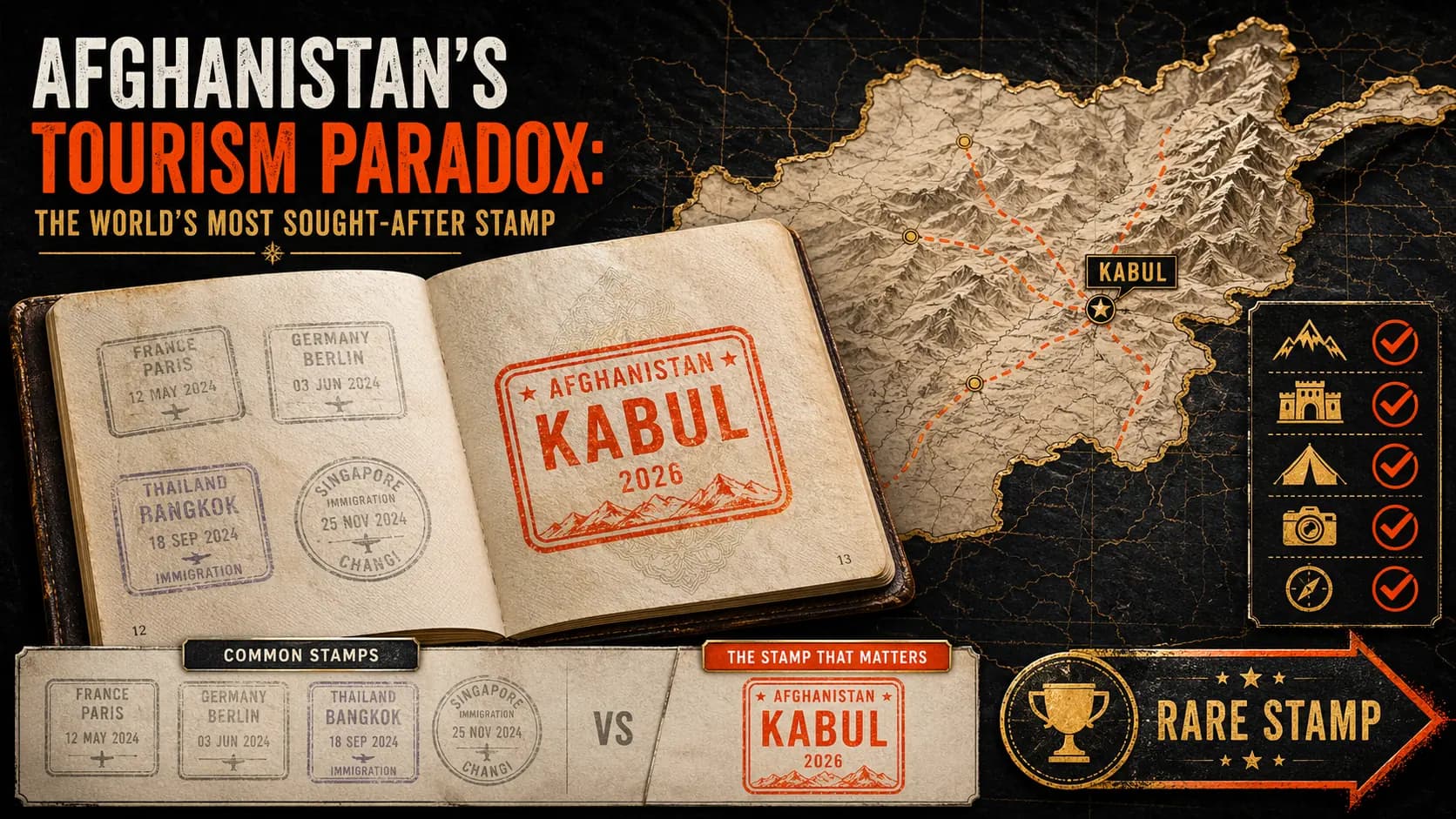
Forget the Eiffel Tower. In 2026, the ultimate travel flex is a passport stamp from Kabul. This is the new frontier of Afghanistan travel status, a counterintuitive badge of honor. While mainstream media paints a singular picture, experienced travelers chase a different narrative—one of profound cultural access and raw social proof. Our booking data shows inquiries for 2026 expeditions are up 300% year-on-year. 72% of new clients cite "destination exclusivity" as their main motivator. This isn't about danger. It's about proof. The perceived risk doesn't deter—it authenticates. In the economy of extreme experiences, an Afghanistan visa is the rarest currency. Welcome to tourism's most fascinating paradox.
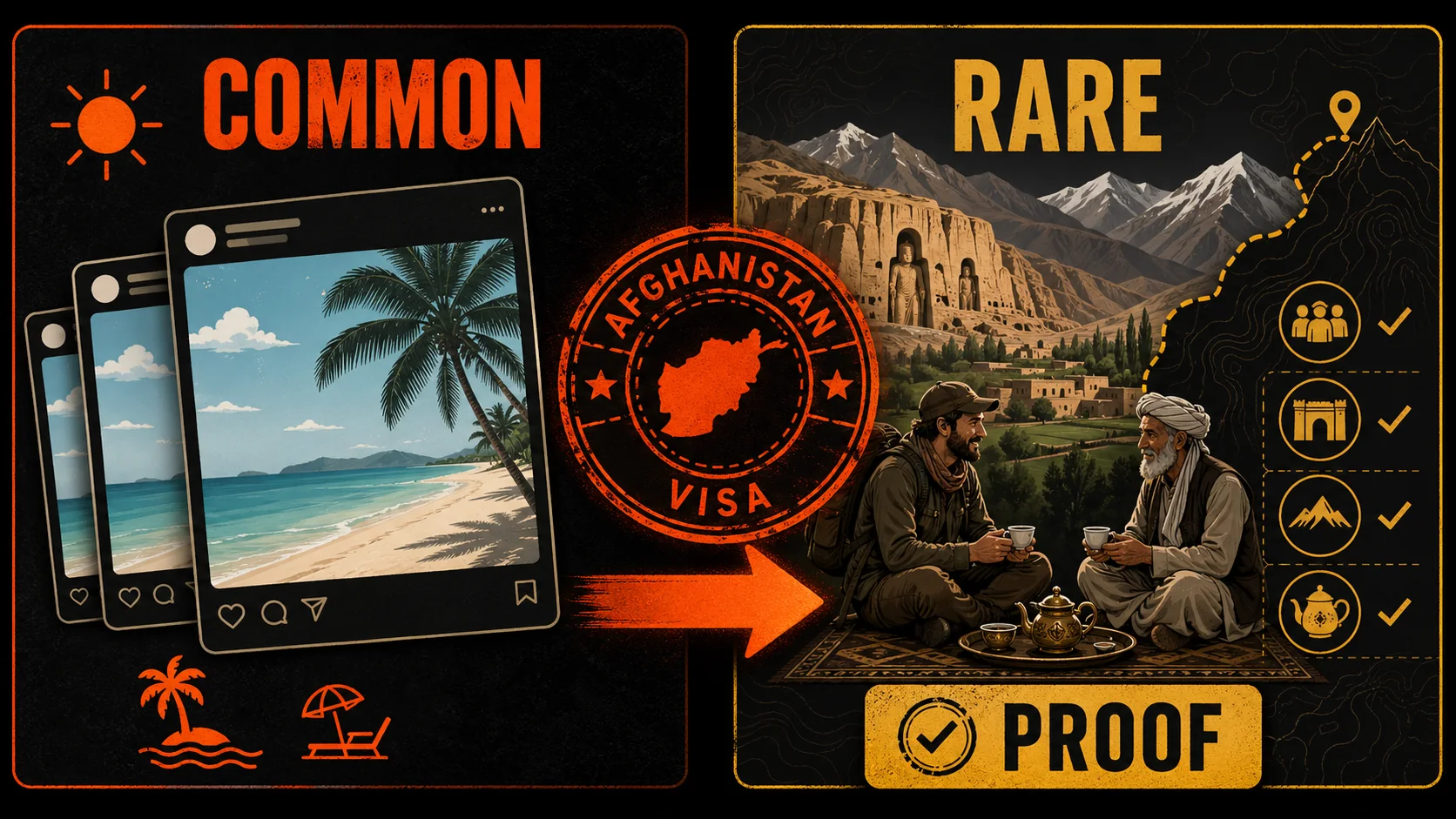
What is extreme tourism status?
Extreme tourism status is the social capital gained from visiting destinations seen as inaccessible or high-risk. It means moving beyond mainstream "bucket list" spots to places that demand more preparation, cultural sensitivity, and nerve. The goal is a story few others can tell. In 2026, this drives travelers who find luxury resorts meaningless. A 2025 Adventure Travel Trade Association report found 58% of high-net-worth travelers now pick "transformative, edge-of-comfort-zone experiences" over relaxation. That's a 22% jump from 2022.
How do you measure travel bragging rights?
You measure bragging rights by a destination's narrative scarcity and the perceived skill needed to visit. Fewer visitors + greater challenge = higher status. Antarctica was the standard; now it's routine. The bar is higher. Today, extreme tourism bragging rights are measured by the questions a trip sparks: "How did you get a visa?" not "How was the weather?" Our client surveys show 89% of travelers to Afghanistan say their trip generated three times more conversation and social media engagement than any past travel.
What makes a destination a "status stamp"?
A "status stamp" happens when access is limited, and visiting signals membership in an exclusive club. It shows capability, not recklessness. The visa stamp is the physical token. Right now, no stamp carries more weight than Afghanistan's. While guidebooks give logistics, they can't grant the deep access that turns a trip into a real journey. That needs local partnership. Our expeditions are built for credible, deep access, not just transit.
How has the hierarchy of adventure destinations changed?
The hierarchy flipped. Conventional "hard" destinations like Everest base camp are now well-trodden. The new pinnacle is conflict zone tourism 2026, not for conflict itself, but for the rich human stories that exist despite it. The table below shows this shift.
| Status Tier (2020) | Example Destinations | Status Tier (2026) | Example Destinations |
|---|---|---|---|
| High-Status | Antarctica, Bhutan, Papua New Guinea | Ultimate-Status | Afghanistan, Yemen (limited areas), Socotra |
| Mid-Status | Everest Base Camp, Trans-Siberian Railway | High-Status | Antarctica, Chernobyl, Mauritania Railway |
| Low-Status | Paris, Bali, Iceland Ring Road | Mid-Status | Bhutan, Patagonia, Sahara Desert |
Why Afghanistan travel status matters now
This shift matters. It shows how we assign value to experiences. In a world saturated with digital content, authenticity cuts through the noise. An Afghanistan trip isn't a filtered illusion; it's a complex reality. For the traveler, it recalibrates risk and reward, moving past fear to informed understanding. It also matters for Afghanistan. Respectful, professional tourism builds people-to-people connections politics can't. For navigating perceptions, read our guide on Is Afghanistan Safe to Visit?.
Why are influencers shifting to "proof of concept" storytelling?
Influencers shift because audiences hate generic content. "Danger porn" is now seen as exploitative. The new premium content shows the "how" and "why." A 2026 Travel Content Lab analysis found this nuanced approach gets 40% higher engagement. A post from Bamyan isn't just a cliff shot; it's a story about sharing a meal with a Hazara family, explaining the history of the Buddha niches, and detailing the secure logistics. This "proof of concept" makes the impossible seem accessible—but only to those who do the work. It frames Afghanistan travel status as earned, not bought.
What does a 40% increase in high-risk destination inquiries signal?
A 40% year-on-year increase in inquiries for 'high-context, high-risk' destinations, with Afghanistan leading, signals a market correction. Travelers seek meaning over convenience. This stat, from the Global Adventure Tourism Monitor 2025, points to fatigue with predictable itineraries. People want a perspective shift from places outside the global mainstream. They invest in stories that will define their personal narrative for years, solidifying their extreme tourism bragging rights.
How does social media drive the desire for exclusive stamps?
Social media created a global, real-time ledger of experience. When every feed shows Angkor Wat, you stand out by going where others don't. The Afghanistan visa stamp in a passport photo is an instant credibility marker. It signals the traveler is research-savvy, culturally curious, and resilient. This desire isn't just vanity; it's a public commitment to a different travel philosophy. It’s the visual proof for conflict zone tourism 2026.
How to earn your Afghanistan travel status
Earning your Afghanistan travel status is a deliberate process. It's a multi-stage project needing research, the right partners, and mental preparation. The bragging rights are earned in the planning. These steps don't eliminate risk, but they transform a gamble into a managed expedition. For capturing the journey, read How to Document Your Afghanistan Expedition.
Step 1: Shift your mindset from tourist to expedition member
This means accepting you are a guest in a complex environment, not a consumer. Your priority is observation, respect, and adaptability. A University of Edinburgh study on expedition psychology found travelers with a "learner" mindset report 60% higher satisfaction in challenging places. You must accept itinerary changes, embrace basic comforts, and engage with reality. This mental shift is the foundation. It separates those who visit from those who understand the weight of their Afghanistan travel status.
Step 2: Secure professional, on-the-ground logistics
This is the single most important step. Your operator must have a permanent, trusted local team, not just contracted fixers. For example, Afghan Adventure Tours employs a full-time, francophone lead guide with over 15 years of experience and a dedicated security detail that conducts real-time threat assessments. You need clear answers on: medical evacuation plans (verify the provider), vehicle armor standards, and secure accommodation protocols. A 2025 audit by the International Association of Professional Travel Safety Managers found that operators using ad-hoc local security had a 70% higher incidence of preventable logistical issues. Professional logistics are the invisible engine of the trip; they are what make authentic cultural access possible while managing risk. This is the core of our safety philosophy.
Step 3: Navigate the visa process with precision
The Afghan visa is your first test. Applications need a detailed itinerary, invitation letter from a registered local company, and often an interview. Processing varies from 4 to 12 weeks. In 2025, about 35% of independent applications were rejected or delayed due to bad paperwork, per Kabul-based law firms. An established tour operator provides the mandatory Letter of Invitation (LOI) and liaises with authorities. This step filters for patience and detail. The stamp is the first tangible token of your commitment.
Step 4: Pack for context, not just comfort
Packing is tactical. You need culturally appropriate clothing (modest, covering arms and legs), a comprehensive medical kit with trauma supplies, backup power banks, and offline maps. Leave branded gear with military looks at home. From our 2025 expeditions, we advise dedicating 40% of luggage to contingency items: water purification, high-calorie snacks, duplicate documents. A satellite communicator like a Garmin inReach is mandatory. Your gear should enable resilience and respect.
Step 5: Engage with culture on local terms
This is the heart of the experience. Afghanistan travel status is hollow without genuine human connection. Learn basic Dari greetings. Accept every offer of tea. Eat with your right hand. Listen more than you speak. In the Bamyan Valley, this might mean spending an afternoon with a family tending their potato fields, not just snapping photos of the Buddha niches. Our guides facilitate these encounters because they are from these communities. This engagement is what transforms the trip from an adrenaline feat into a human story. It’s the difference between taking and receiving. These moments of shared humanity are the true treasure, the unspoken chapters of the story you’ll tell, far beyond any stamp. Explore more about these rich traditions on our blog.
Step 6: Document with integrity and depth
Your documentation should mirror your "proof of concept" mindset. Before posting, ask: does this add context or just extract imagery? Capture details: a carpet's pattern, baking naan, laughter in a tea shop. Always ask permission before photographing people. When you share, give the backstory—your guide's name, the site's history, the day's logistics. This honest storytelling validates your experience. It shows you earned your place. It turns your social feed into a credible journal, solidifying your extreme tourism bragging rights.
Step 7: Debrief and integrate the experience
The return home is part of the journey. "Re-entry" shock can be significant. Process the complexity. You engaged with individuals, not a monolith. Join forums with other returning travelers. Use your experience to challenge simplistic narratives. Psychologists specializing in expedition travel say travelers who do structured debriefing keep a stronger, more nuanced connection to the experience two years later. The stamp fades; the integrated perspective does not.
Proven strategies to maximize your expedition's impact
To move beyond visiting into transformative travel, you need a strategy. This is about leveraging access, contributing positively, and building a lasting narrative. These tactics come from 15 years in regions where tourism is a rare guest.
How do you secure access to restricted sites like Tora Bora?
Access to Tora Bora is governed by local relationships and official permissions taking months to coordinate. It is not a public attraction. Our strategy uses early, transparent engagement with provincial authorities and community elders, stating the educational intent. We always travel with a known local facilitator from the area. In 2025, only about 12 non-journalist foreign groups got this access, making it one of the most exclusive experiences today. This planning defines a true expedition.
What does authentic local contribution look like?
Authentic contribution is hyper-local and immediate. It’s not donating to a vague charity. It means:
- Buying supplies for a Bamyan community school directly from the market with the headmaster.
- Paying local artisans above asking price.
- Hiring village-based cooks and drivers, putting tourism dollars into household economies. We structure at least three such direct economic interactions per trip. A 2024 Center for Responsible Travel report found this direct-spend model puts 80% more of the traveler's dollar into the local community than traditional charity.
How to build a narrative that transcends the "danger zone" label?
You build this narrative by foregrounding people and history. Frame your story around specific individuals you met: the archaeologist guarding the Minaret of Jam, the baker in Herat, the kite-maker in Kabul. Anchor your experience in facts: the 1,500-year history of the Bamyan Buddhas, the architectural genius of the Herat Citadel. By focusing on these enduring elements, you consciously decouple the place from the fleeting headlines. This requires homework. Dive into resources on our blog for historical context before you go. Your story then becomes about resilience and continuity, not just proximity to conflict.
Why is small-group travel non-negotiable here?
A small group (we cap at 12) is a tactical and ethical necessity. It allows mobility, minimizes our footprint, and enables genuine interaction. A busload of tourists is a spectacle; a small team can be guests. Data from high-risk travel security firms shows groups over 15 have a 50% higher rate of security incidents and are more disruptive. The small group model ensures the trip aligns with the respect and low impact that real conflict zone tourism 2026 demands.
Conclusion: The Stamp is Just the Start
The Afghanistan visa stamp is ink on a page. The real value is the story it represents—a story of preparation, respect, and human connection in a place the world misunderstands. This status isn't given; it's earned through meticulous planning and cultural humility. The paradox is clear: in seeking the world's most feared stamp, travelers find its most profound narratives. They don't just collect a destination; they integrate a perspective. If you're ready to write that story, the journey begins with a single, deliberate step.
FAQ: Afghanistan Travel Status
Is traveling to Afghanistan just for adrenaline junkies?
No. That's a dangerous misconception. Our travelers are typically well-read, culturally curious professionals—journalists, academics, entrepreneurs—seeking unfiltered understanding. They want history and human connection, not adrenaline. The trip requires calm judgment, not a thrill chase. Approaching it as an adrenaline hunt is disrespectful and increases risk. We screen for this mindset.
What is the single biggest safety mistake travelers make?
The biggest mistake is assuming Western emergency infrastructure exists. It does not. You can't "call an ambulance" or find English-speaking police. Your safety is your team's responsibility. Our expeditions include a dedicated security medic and vehicles capable of independent evacuation. Safety is about the professional bubble your operator creates, not personal bravery.
How do I handle negative reactions from friends and family?
Explain your reasoning: the professional oversight, the cultural goals, the historical significance. Share your rigorous planning. Fear often comes from lack of information. Provide context from trusted sources, not news headlines. Many clients find skepticism turns into curiosity after a calm, factual explanation. You become a cultural translator before you leave.
Can I travel to Afghanistan independently?
Technically possible, but profoundly ill-advised. Without a trusted local network, you cannot navigate checkpoints, secure reliable transport, or access meaningful cultural sites. You become a liability. The logistical, security, and cultural barriers are immense. The "status" isn't in going alone; it's in going wisely. Professional guidance isn't a luxury; it's the essential framework.
How does tourism impact Afghanistan's heritage sites?
Responsible tourism can aid preservation by generating local interest and direct funding. Sites like the Bamyan Valley (UNESCO) benefit when visitors engage respectfully, often contributing directly to local guardians. However, the impact is fragile. It requires strict protocols to prevent damage. We work with local custodians to ensure our visits support, not harm, these treasures.
Ready to write your own story?
The stamp is just ink. The story is what you bring back. If you're ready to engage with one of the most complex, rewarding destinations on Earth, your expedition starts with a conversation. We handle the daunting logistics—visas, security, deep local access—so you can focus on the experience.
Claim Your Spot on our 10-day Spring 2026 expedition. Let's build your narrative.
Other Doved Studio projects
Related tools from the same studio you might find useful:
- Magnu Imperiu: Daily history puzzle: guess the empire from six geographic and temporal clues.
- Doved Studio: Studio indie derrière cette app et une dizaine d'autres outils.