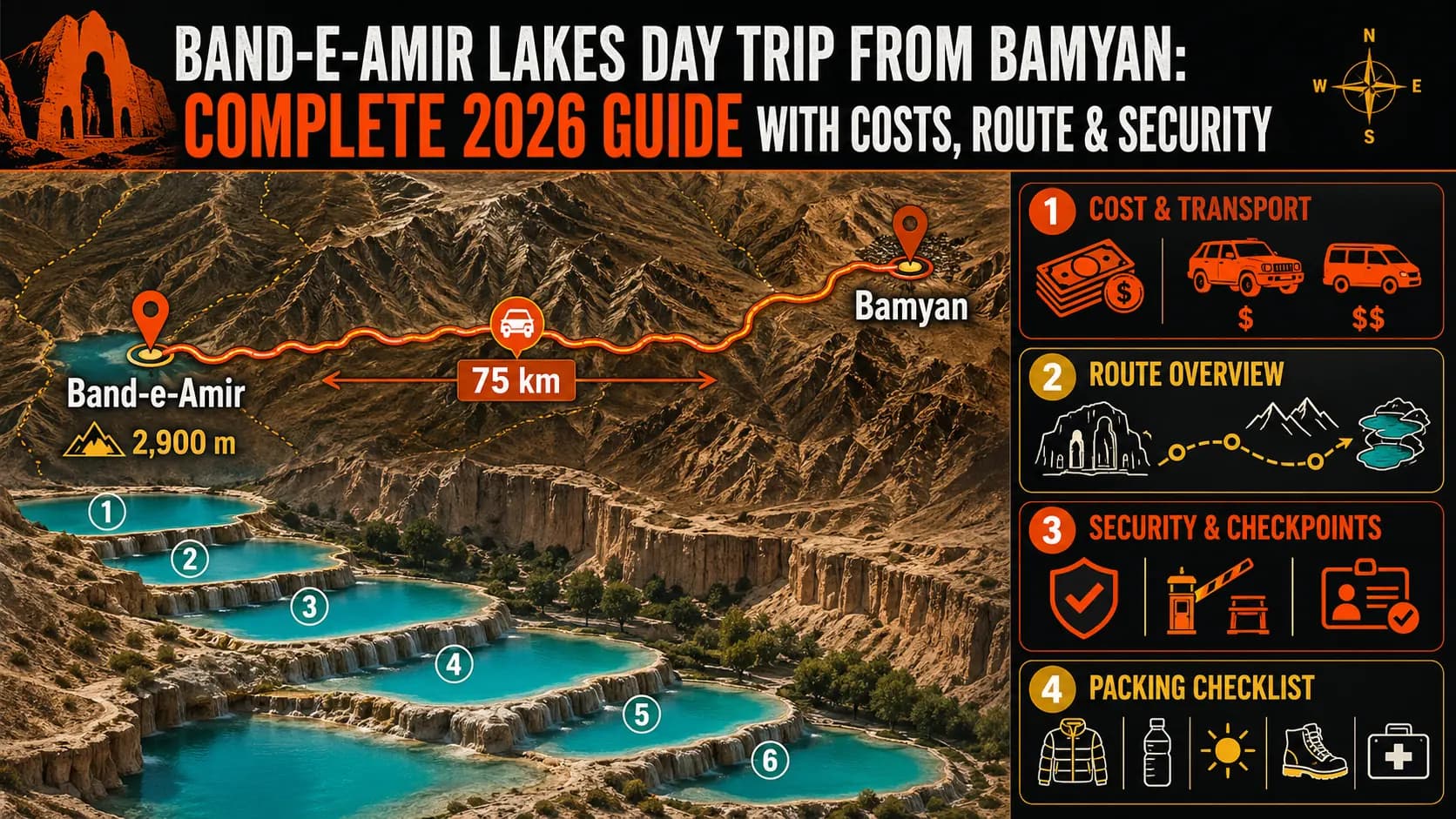
Band-e-Amir is not a myth and it is not inaccessible. Seventy-five kilometers west of Bamyan, at 2,900 meters above sea level, six turquoise lakes sit behind natural travertine dams that have been building for thousands of years. Designated as Afghanistan's first national park in 2009 and listed on the UNESCO World Heritage Tentative List since 2004, Band-e-Amir is one of the most visually striking landscapes in Central Asia. The mineral-rich water creates colors that look digitally enhanced in photographs but are entirely real in person. On our March 2026 expedition through Bamyan province, our team completed the day trip in a single outing from Bamyan town. This guide covers every practical detail you need to do the same — transport costs down to the afghani, road conditions, security checkpoints, and what to pack for a day at 3,000 meters altitude.
Getting to Band-e-Amir from Bamyan
The road from Bamyan to Band-e-Amir runs roughly 75 km west through the Hazarajat highlands. It is unpaved for most of its length — compacted gravel and dirt with stretches of washboard surface that worsen after rain. Plan for 2 to 3 hours each way depending on your vehicle and season. The road climbs from Bamyan at 2,500 m to a pass at approximately 3,100 m before descending to the lakes at 2,900 m.
Transport Options and Costs
Shared taxi from Bamyan bazaar: The most affordable option. Corolla station wagons and Hilux pickups depart from the main bazaar area once they fill up — usually four to five passengers. Cost is 1,000–1,500 AFN ($15–20 USD) per seat each way. Availability is best in the morning between 7:00 and 9:00 AM during tourist season (May–September). Outside peak months, you may wait hours for a full vehicle or need to pay for empty seats.
Private 4x4 hire: The recommended option for most visitors. A Toyota Hilux or Land Cruiser with driver for the full day costs 6,000–8,500 AFN ($80–120 USD). This gives you control over departure time, stops along the route, and flexibility at the lakes. Negotiate the price the evening before at your guesthouse — most Bamyan guesthouse owners have reliable drivers. Confirm that the price covers fuel and waiting time at Band-e-Amir.
Motorcycle: Experienced riders can rent a motorcycle in Bamyan for 2,000–3,000 AFN ($30–40 USD) per day. The road is manageable on a sturdy bike but demands confidence on loose gravel, steep grades, and blind corners with no guardrails. Not recommended for first-time Afghanistan visitors.
Departure Timing
Leave Bamyan between 6:00 and 7:00 AM. This maximizes your daylight at the lakes and puts you back in Bamyan before dark — a non-negotiable safety rule in Afghanistan. The morning light is also the best for photography at Band-e-Haibat, the main visitor lake.
Road Checkpoints
Expect one to two security checkpoints between Bamyan and Band-e-Amir. These are staffed by Taliban security personnel who will check identification. Have your passport ready, be polite, and let your driver handle the conversation in Dari. Checkpoints are routine — our guide Ahmad, who has been running this route for over a decade, describes them as "five-minute formalities."
The Six Lakes: What to Expect
Band-e-Amir consists of six separate lakes, each formed behind natural travertine dams created by mineral deposits from the water itself. The lakes are:
- Band-e-Gholaman — the easternmost lake, smaller and less visited, surrounded by low cliffs
- Band-e-Qambar — connected to Gholaman by a narrow channel, accessible by a walking trail
- Band-e-Haibat — the main visitor destination, largest and most photogenic, with tea houses and boat rentals along its southern shore
- Band-e-Zulfiqar — west of Haibat, separated by a dramatic travertine wall, deeper blue coloring
- Band-e-Panir — the whitest of the lakes, named for its cheese-like travertine formations
- Band-e-Pudina — the westernmost lake, the least accessible, requiring a longer hike
Band-e-Haibat: The Main Visitor Area
Most day-trippers spend the majority of their time at Band-e-Haibat. The lake is approximately 600 meters long and 150 meters wide, with water so vivid in turquoise that first-time visitors often stand at the rim in silence for a full minute before reaching for a camera. The travertine dams along the southern shore create a stepped cascade effect visible from the parking area.
Along the south shore, a cluster of simple tea houses operated by local Hazara families sell green tea, fresh bread, and kebabs. Local families picnic on carpets spread across the flat rocks near the water's edge — this is a place of genuine recreation for Afghans, not just a tourist spectacle. On our visit, we counted roughly 30 local families enjoying a Friday outing alongside perhaps six foreign visitors.
Swimming
Swimming is possible in July and August when the water temperature reaches 10–15 degrees Celsius. It is bracingly cold even at peak summer. Conservative dress is required — men should wear shorts or swim trunks with a shirt, women should swim in full clothing. There are no changing facilities, so plan accordingly. The water clarity is remarkable: you can see the bottom at depths of 5–6 meters.
Boat Rides
Pedal boats are available for rent at Band-e-Haibat during the visitor season. Cost is 150–200 AFN ($2–3 USD) per person for approximately 20 minutes. The boats are basic but functional, and paddling to the center of the lake gives you the best perspective on the travertine dam formations and the surrounding cliff walls.
Photography
The best light hits Band-e-Haibat in the morning between 8:00 and 10:00 AM when the sun angle maximizes the turquoise water color and illuminates the travertine. Bring a polarizing filter — it cuts the surface glare and reveals the underwater formations. Afternoon light is harsher and washes out the color. Wide-angle lenses (14–24 mm) capture the lake-to-cliff scale; a 70–200 mm telephoto isolates the travertine dam textures.
Hiking to the Upper Lakes
A trail from Band-e-Haibat leads west along the ridge to Band-e-Zulfiqar and Band-e-Panir. The full loop takes approximately 2 hours at a moderate pace, covers about 6 km, and involves 200 m of elevation gain. The trail is unmarked but visible — follow the ridge and keep the lakes on your left. Views from the high point between Zulfiqar and Panir are the most dramatic in the entire park. Bring water and sun protection; there is no shade on the ridge.
Costs Breakdown: Full Day Budget
| Expense | Budget Option | Comfortable Option |
|---|---|---|
| Transport (return) | 1,000–1,500 AFN / $15–20 (shared taxi) | 6,000–8,500 AFN / $80–120 (private 4x4) |
| Park entrance fee | 350 AFN / $5 (foreigners) | 350 AFN / $5 (foreigners) |
| Lunch (kebab, bread, tea) | 200–350 AFN / $3–5 | 200–350 AFN / $3–5 |
| Boat ride | 150–200 AFN / $2–3 | 150–200 AFN / $2–3 |
| Tips and miscellaneous | 350–700 AFN / $5–10 | 350–700 AFN / $5–10 |
| Total | 2,050–3,100 AFN / $30–43 | 7,050–9,750 AFN / $95–133 |
Local entrance fee for Afghan nationals is 50 AFN. The foreigner fee of 350 AFN ($5) was set by the Wildlife Conservation Society (WCS), which co-manages the park. Keep small-denomination AFN notes for tips and tea house purchases — no one at Band-e-Amir accepts USD or cards.
Security Briefing
Bamyan Province: Context
Bamyan province is historically one of the safest regions in Afghanistan. The population is predominantly Hazara, a Shia Muslim minority group that has maintained a distinct cultural identity and a comparatively low level of armed conflict compared to southern and eastern provinces. Before the Taliban takeover in August 2021, Bamyan was the only province in Afghanistan where women served as provincial governor (Habiba Sarabi, 2005–2013).
Current Situation (2026)
Under Taliban governance, Bamyan has remained relatively stable. UNAMA reporting categorizes Bamyan as a low-conflict zone with minimal armed incidents. The Taliban maintains administrative and security checkpoints throughout the province but open conflict is rare. Travel between Bamyan city and Band-e-Amir has been consistently accessible to both domestic and international visitors throughout 2024–2026.
That said, Afghanistan remains on the "do not travel" list for the US State Department, the UK FCDO, and the Australian DFAT. Travel insurance that covers Afghanistan is extremely difficult to obtain. You are traveling at your own risk.
Practical Security Protocols
- Register with your embassy before entering Afghanistan. The US, UK, Canada, France, and Australia all maintain consular registration systems for nationals traveling in high-risk countries.
- Travel with a local guide or driver. This is not optional. A local who speaks Dari, knows the checkpoints, and understands current road conditions is the single most important safety measure you can take.
- Do not travel after dark. All movement should be completed before sunset. This is a universal rule throughout Afghanistan, enforced by common sense if not by checkpoints.
- Checkpoint behavior: Have your passport ready but not visible from outside the vehicle. Let your driver initiate conversation. Answer questions calmly and directly. Do not photograph checkpoints or security personnel.
- Phone and data coverage: Roshan is the most reliable network in Bamyan province. You will have 3G/4G coverage in Bamyan city but connectivity becomes intermittent to nonexistent on the road to Band-e-Amir. Download offline maps before departure.
- Medical evacuation: There is no trauma hospital at Band-e-Amir and limited medical facilities in Bamyan. The nearest international-standard hospital is in Kabul, a 6–8 hour drive. Carry a comprehensive first aid kit and any personal medications.
When to Go: Seasonal Guide
May–June (Spring): Excellent conditions. Wildflowers blanket the surrounding hills, the lakes are at their highest water levels from snowmelt, and temperatures at 2,900 m range from 10–20 degrees Celsius. The road is generally passable but may have muddy sections from late snowmelt. Fewer tourists than peak summer.
July–August (Peak Summer): The warmest months with daytime highs of 25–30 degrees Celsius at lake altitude. Swimming is possible. Dust is heavy on the road. This is the busiest period with both domestic Afghan visitors and the small international travel contingent. Book your driver and Bamyan guesthouse in advance.
September–October (Autumn): Cooling temperatures (5–15 degrees Celsius), thinner crowds, and golden-brown landscape replacing the summer green. Water levels begin to drop. September is excellent for photography; October brings the risk of early snow blocking the road.
November–April (Winter): The road to Band-e-Amir is frequently impassable due to snow. Bamyan itself receives heavy snowfall. Only attempt a winter visit with a well-equipped 4x4, local driver who knows the winter road, and a tolerance for turning back if conditions deteriorate.
Packing List for the Day Trip
Sun protection: You are at 3,000 meters with no shade. UV exposure is intense. Sunscreen (SPF 50+), sunglasses with UV protection, and a wide-brimmed hat are mandatory, not optional.
Layers: Temperature can swing 15 degrees between morning departure and midday at the lakes. Bring a fleece or light insulated jacket, a windbreaker, and a base layer that wicks sweat.
Cash in AFN: No ATMs exist at Band-e-Amir. Bring enough afghani notes for entrance fees, meals, boat rides, and tips. 2,000–3,000 AFN covers a comfortable day. Exchange USD to AFN in Bamyan bazaar — the money changers at the main intersection offer fair rates.
Water: 2–3 liters minimum per person. There is no reliable clean water source at the lakes. Fill up from your guesthouse or buy sealed bottles in Bamyan before departure.
Snacks: Energy bars, dried fruit, or nuts. Tea house food is available but limited to basic kebab and bread.
Headcover for women: A scarf or shawl covering hair is required for all women in public spaces under current Taliban governance. Bring one even if you normally would not.
Passport copy: Carry a photocopy or phone photo of your passport identity page. Leave the original locked in your guesthouse in Bamyan. Checkpoints accept copies for identification; losing your original passport in rural Afghanistan is a crisis-level problem.
First aid and altitude awareness: Basic supplies — bandages, antiseptic, ibuprofen, blister plasters. At 2,900–3,100 m, mild altitude effects (headache, shortness of breath on exertion) are possible for lowland visitors. Acetazolamide (Diamox) is available in Kabul pharmacies if you want prophylaxis, though most healthy adults tolerate this altitude without medication if they spent a night in Bamyan (2,500 m) first.
Beyond the Day Trip: Combining with Bamyan
Band-e-Amir is the natural highlight of a Bamyan visit, but it is not the only reason to come. Budget at least two full days in Bamyan to cover:
The Buddha Niches: The two giant niches in the Bamyan cliff face — 55 m and 38 m tall — where the Bamiyan Buddhas stood for 1,500 years before the Taliban destroyed them in March 2001. The niches remain and are deeply affecting even empty. UNESCO has classified the site as a World Heritage property and ongoing preservation work continues on the surrounding cave complexes, which contain fragments of Gandharan Buddhist art. Read our full guide at /blog/bamyan-valley-complete-guide.
Shahr-e-Gholghola (City of Screams): The ruins of a 6th-century fortress on a hilltop overlooking Bamyan valley, destroyed by Genghis Khan's forces in 1221. A 30-minute climb from the base gives 360-degree views of the valley, the Buddha niches, and the Hindu Kush range beyond. No entrance fee.
Hazara Cuisine: Bamyan is the heartland of Hazara cooking. Try ashak (leek-filled dumplings with yogurt and meat sauce), qabuli palau (spiced rice with raisins and carrots), and bolani (stuffed flatbread). The guesthouses in Bamyan town serve excellent home-cooked meals for 200–400 AFN ($3–6). See our overview at /blog/afghan-cuisine-guide.
Combining Bamyan with a wider itinerary: Bamyan sits between Kabul (6–8 hours by road) and the Wakhan Corridor route to the northeast. Many travelers build an itinerary running Kabul to Bamyan to Band-e-Amir and back, or continue north toward Mazar-i-Sharif. For the full route breakdown, see /blog/is-afghanistan-safe-to-visit.
Frequently Asked Questions
Is Band-e-Amir safe to visit in 2026?
Bamyan province and the Band-e-Amir corridor remain among the safest areas in Afghanistan for visitors. UNAMA incident tracking shows minimal armed conflict in the Bamyan region. However, Afghanistan as a whole carries inherent risk and is listed as "do not travel" by most Western governments. You should register with your embassy, travel with a local driver or guide, and maintain situational awareness at all times. Safety is relative in Afghanistan — Band-e-Amir is low-risk by Afghan standards, but higher-risk than conventional tourism destinations.
How long is the drive from Kabul to Bamyan?
The Kabul-to-Bamyan road covers approximately 230 km and takes 6 to 8 hours depending on road conditions, vehicle type, and checkpoint frequency. The route crosses the Shibar Pass at 3,260 m. There is no commercial air service to Bamyan as of 2026. Most travelers hire a private vehicle from Kabul for 15,000–20,000 AFN ($200–280 USD) one way. Some tour operators include the Kabul-Bamyan-Kabul transfer in their package price. Afghan Adventure Tours includes this transfer on all 10-day expedition packages.
Can women visit Band-e-Amir?
Yes. Women — both Afghan and international — visit Band-e-Amir regularly. Under current Taliban governance, women must wear a headscarf covering their hair in all public spaces, and loose-fitting clothing covering arms and legs is expected. International women travelers report no harassment at Band-e-Amir, particularly when traveling with a guide. Swimming in modest clothing is possible for women, though local cultural norms strongly favor men swimming more than women. Traveling as part of a group or with a tour operator removes most practical complications.
Do I need a permit to visit Band-e-Amir?
No special permit is required beyond the park entrance fee (350 AFN / $5 for foreigners, 50 AFN for Afghan nationals). You do need a valid Afghan visa — tourist visas are issued by Taliban-controlled embassies and consulates in some countries. The visa process changes frequently; check the latest requirements with the Afghan embassy nearest to you before booking travel. No separate photography permit is required at Band-e-Amir.
Is there accommodation at Band-e-Amir?
Basic guesthouse accommodation exists at the Band-e-Haibat visitor area — simple rooms with mattresses on the floor, shared toilets, no running hot water. Rates are approximately 500–1,000 AFN ($7–14) per night. For most visitors, the better option is to base yourself in Bamyan, where guesthouses offer significantly better comfort — private rooms, hot showers, meals, and reliable electricity from solar panels. Bamyan guesthouses run 1,500–3,000 AFN ($20–40) per night including breakfast. Staying overnight at Band-e-Amir only makes sense if you want to photograph the lakes at sunrise or explore the more remote western lakes at a slower pace.
Band-e-Amir is the kind of place that resets your idea of what travel can be. No crowds, no ticket queues, no gift shops — just improbable blue water in a landscape that feels like another planet. It requires planning, it requires accepting real risk, and it rewards both in full.
For the complete Afghanistan experience — including Bamyan, Band-e-Amir, Tora Bora, and the Panjshir Valley — explore our 10-day expedition packages at Afghan Tour. Read more practical planning guides on the Afghan Tour blog, including our safety overview, packing guide, and Tora Bora caves guide.
Other Doved Studio projects
Related tools from the same studio you might find useful:
- Magnu Imperiu: Daily history puzzle: guess the empire from six geographic and temporal clues.
- Doved Studio: Studio indie derrière cette app et une dizaine d'autres outils.