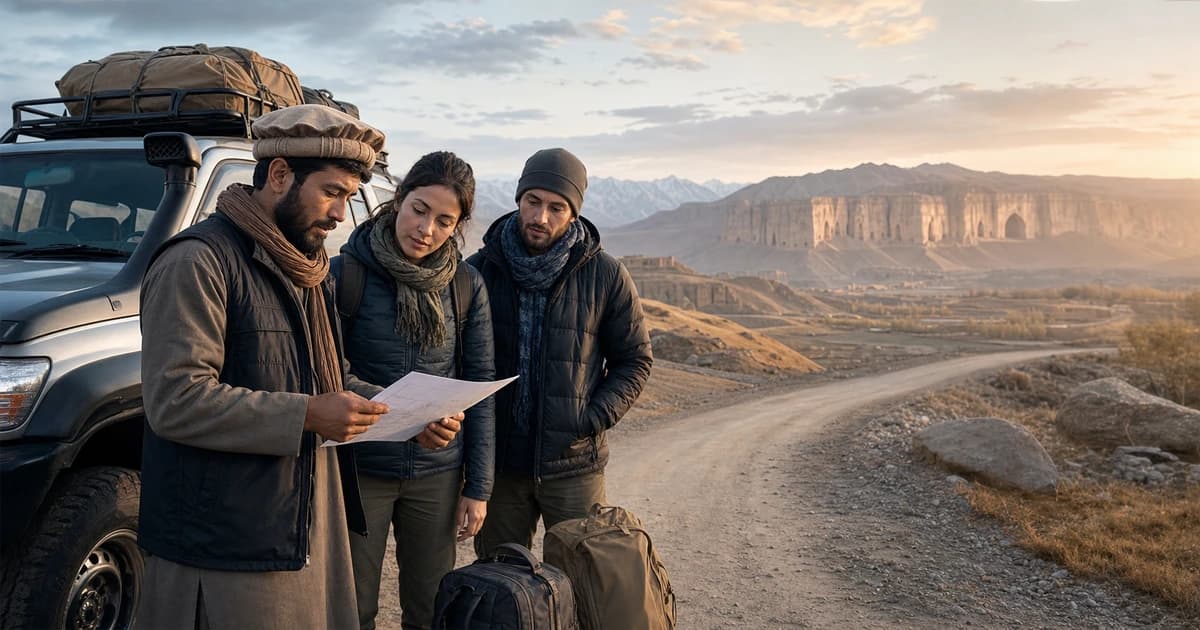
Short answer: do not treat Kabul to Bamiyan as a normal scenic transfer. Treat it as a route-planning problem with documents, local timing, vehicle discipline, checkpoint etiquette, weather, medical fallback, and a guide who can say "not today" without losing the sale.
Afghanistan is attracting more curiosity because the country is culturally extraordinary, visually overwhelming, and still wildly misunderstood by travelers who have only seen headlines. That curiosity can turn into good travel only when the planning is adult. The job is not to make risk sound sexy. The job is to make every unknown visible before a traveler pays a deposit.
Sources checked before writing
- US State Department Afghanistan travel advisory
- UK FCDO Afghanistan travel advice
- Canada Afghanistan travel advice
- UNESCO Bamiyan Valley listing
- UNAMA Afghanistan reporting
Why this route deserves its own checklist
Kabul to Bamiyan is not just a line on a map. It is the transition from the capital's compressed urban rhythm into the central highlands, where road condition, daylight, snowmelt, checkpoint density, and local context matter more than a glossy itinerary. Bamiyan sits roughly 2,500 meters above sea level. Band-e-Amir can feel calm and open, but it is still a remote high-altitude day, not a spontaneous detour.
The right operator does three things before promising the route. First, they explain the current advisory picture without trying to neutralize it with bravado. Second, they describe the actual vehicle plan, driver plan, and communication plan. Third, they make the itinerary conditional: Kabul museum today, Bamiyan tomorrow, Band-e-Amir only if road and local checks stay clean.
That is the difference between adventure travel and content tourism. Adventure travel respects the place enough to slow down.
The booking decision in one table
| Booking signal | Weak operator answer | Strong operator answer |
|---|---|---|
| Advisory awareness | "It is safe now" | "Here is what your government currently says, here is what our local checks add, and here is what would make us cancel" |
| Route timing | "About five hours" | "We leave early, avoid night road movement, and build buffer for checkpoints and surface conditions" |
| Vehicle plan | "Private car included" | "Named driver, backup vehicle logic, seatbelt rule, water, phone battery, and no unnecessary stops" |
| Local permissions | "No problem" | "We verify local access before departure and again before the final leg" |
| Medical fallback | "There are hospitals" | "Here are realistic response limits and what we require travelers to carry" |
| Photography etiquette | "Take amazing photos" | "We brief you on where cameras are unwelcome before you step out" |
Documents to verify before money moves
Start with your passport validity, visa or entry permission path, airline requirements, and travel insurance exclusions. Insurance deserves special attention because many policies exclude destinations under official "do not travel" advice. A cheap policy that refuses evacuation is decoration, not protection.
Then ask the operator for the boring documents: registration details if applicable, emergency contact protocol, what is and is not included, refund terms, and the precise name of the person meeting you at arrival. A responsible company will not be offended by this. A responsible company already expects these questions.
For Afghan Adventure Tours, the natural next step after this page is not a hard sell; it is a planning conversation. Read the broader Afghanistan travel 2026 guide, compare travel advisories, and keep the Bamiyan safety reality check open while you evaluate dates.
The Kabul departure rule
Good Kabul departures feel boring. Bags are packed the night before. Water is already in the vehicle. The driver knows the hotel pickup point. The guide has checked the local picture that morning. Nobody is negotiating roadside sightseeing after departure because the whole purpose of an early start is to reduce improvisation.
Use this rule: if the morning briefing is vague, the route is not ready. A guide should be able to answer what changed overnight, what the fallback destination is, where the first stop will be, and what you should not photograph. If the answer is "relax, my friend," relax by postponing the trip.
What to ask about Bamiyan and Band-e-Amir
Bamiyan is not just a photo stop. It is a valley with layered Buddhist, Islamic, Mongol, and modern Afghan history. The UNESCO context matters because the value is not only scenery. Travelers should understand why the niches, cliffs, caves, and cultural landscape are sensitive before arriving with a drone mindset.
For Band-e-Amir, ask three practical questions. Is the road suitable this week? How much time is planned on site before return? What is the cold-weather or wind plan? The lake color sells itself; the logistics do not.
The red flags that should stop the booking
The first red flag is a seller who dismisses official advisories as "politics" without offering a concrete local risk model. The second is a route that depends on night driving. The third is a guide who cannot explain checkpoint behavior. The fourth is a payment request before itinerary, cancellation terms, and contact chain are written down.
There is also a subtler red flag: the operator sells Afghanistan like a trophy. The best trips here are not conquest narratives. They are hosted, contextual, and humble. If the marketing makes the traveler the hero and the country the prop, the planning mindset is already wrong.
Practical packing for this route
Carry passport copies, offline maps, battery pack, conservative clothing, cash in clean bills, any medication you cannot replace locally, and a small first-aid kit. Keep camera gear minimal. A giant creator rig is not only impractical; it changes how people respond to you.
For weather, assume wider swings than your app suggests. The highlands can punish casual packing, especially if the day starts warm in Kabul and ends windy at elevation. Layers, sunglasses, and a real jacket are not luxury items.
FAQ
Is Kabul to Bamiyan safe in 2026?
No article can honestly certify that. The only responsible answer is conditional: check your government's current advisory, ask the operator for same-week route intelligence, and do not travel if the plan depends on vague reassurance.
Can I visit Band-e-Amir on the same trip?
Often it is planned with Bamiyan, but the decision should depend on road condition, daylight, weather, and local access checks.
Should I book before my visa is confirmed?
Do not pay non-refundable trip costs until you understand your document path, insurance exclusions, and operator cancellation policy.
What makes a good Afghanistan tour operator?
Clear written itinerary, local guide depth, conservative route timing, honest advisory discussion, emergency protocol, and the confidence to cancel when conditions are not right.
The operator interview script
Use these questions before you book. "Who makes the final go or no-go decision on the morning of departure?" "What happens if the road check changes after we leave Kabul?" "Which stops are planned and which stops are forbidden?" "How do you brief travelers on photography, clothing, and checkpoint behavior?" "What is the latest possible turnaround time before the route becomes irresponsible?"
The quality of the answer matters more than the charm of the person answering. A serious operator does not improvise every detail live on WhatsApp. They know the route, but they also know the limits of their knowledge. Listen for conditional language: "if," "unless," "we verify," "we do not drive after." That is a good sign. Absolute confidence is not.
How to evaluate the itinerary day by day
Day one should be low-drama arrival and orientation, not immediate road movement. Travelers need time to adapt, change cash, confirm phones, review cultural etiquette, and understand how the guide wants the group to behave. A rushed first day creates mistakes.
The Bamiyan transfer day should start early and end before fatigue makes judgment worse. The Bamiyan day itself should not be packed with every possible site. The valley rewards context: the Buddha niches, Shahr-e Gholghola, local markets, and the broader cultural landscape all need explanation. Band-e-Amir should be a separate decision, not an automatic add-on if weather, route, and timing are not clean.
Responsible tourism standard
Responsible Afghanistan travel means the traveler accepts that access is a privilege, not a product guarantee. You may miss a site. You may lose a photo opportunity. You may spend more time waiting than expected. That is not failure; it is the cost of moving respectfully through a complex place.
The best travelers ask better questions, tip fairly, avoid public political commentary, dress conservatively, and let local hosts lead. They do not turn every checkpoint, ruin, or street scene into content. Afghanistan has enough people extracting narratives from it. A better trip starts by listening.