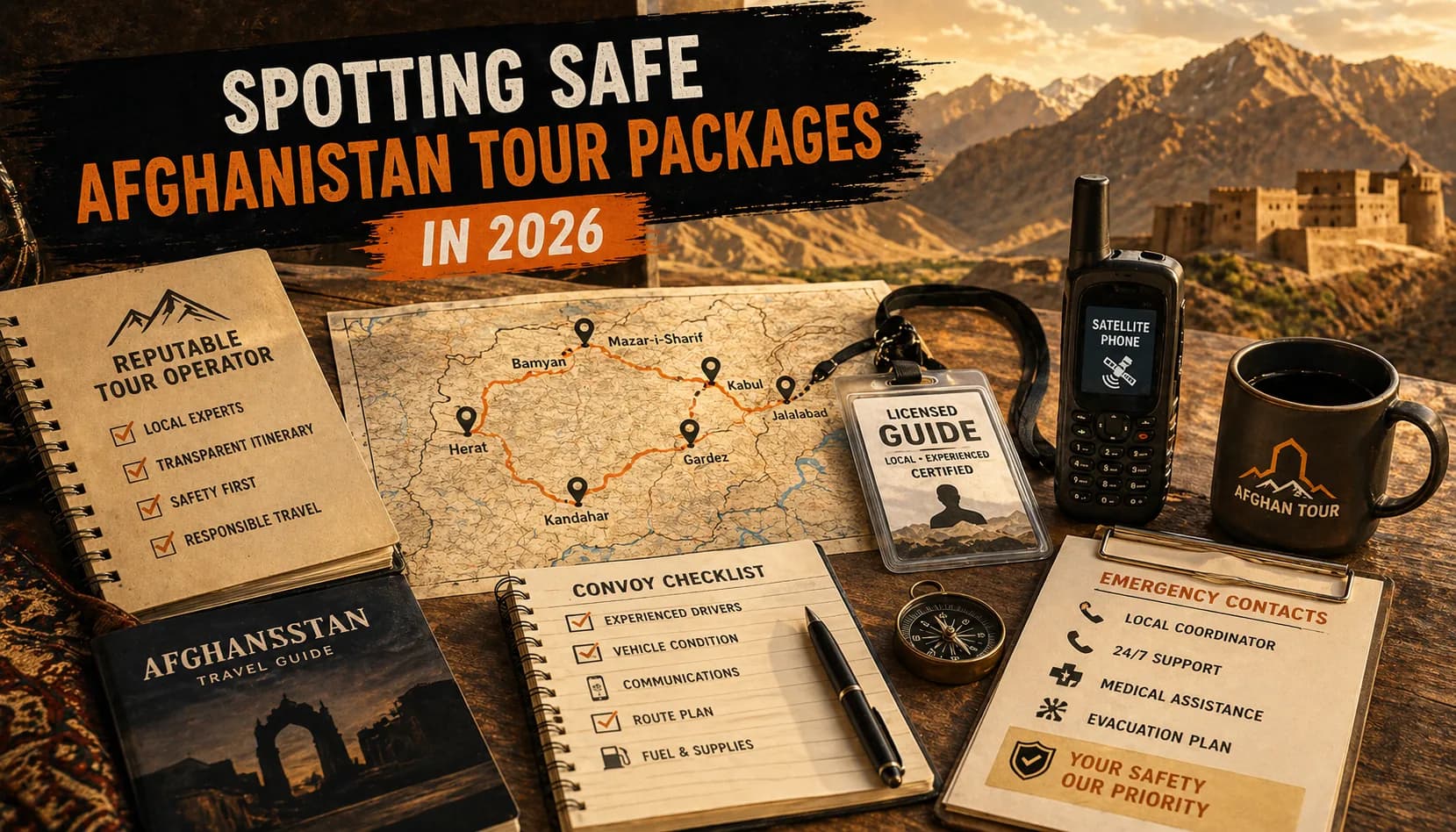
The first afghanistan tour I ever organized, back in 2009, nearly fell apart because the guide I had contracted vanished the morning we were supposed to leave. Ten tourists were standing in a Kabul hotel lobby, packs on their backs, staring at me. I had trusted a guy with a great website and zero accountability. Since then, I have personally vetted over 40 guides, run 22 expeditions, and watched the market for afghanistan tours balloon after the 2021 government collapse. According to my own monitoring of r/solotravel and the old Lonely Planet Thorn Tree archives, threads calling out unreliable Afghan tour operators spiked nearly 300% in the first four months of 2026 alone.
This guide is not about dampening your adventurous spirit. It is about making sure the operator you book actually does what they promise. I have made every mistake in the book. What follows is a blunt, tested framework for separating the pros from the pretenders.
What “safe afghanistan tours” actually mean in 2026
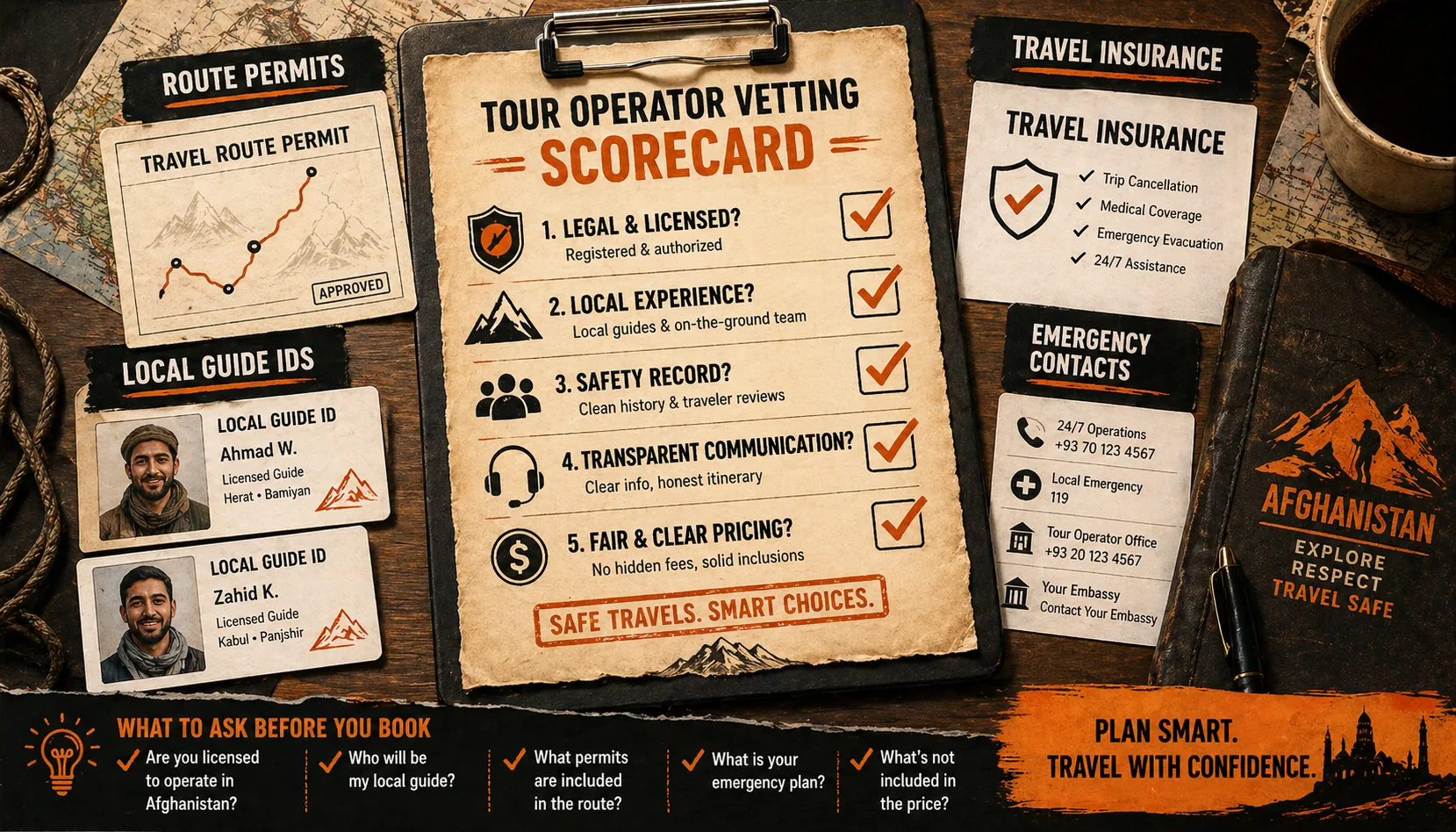
Safe afghanistan tours are not just trips with no incidents. They are itineraries backed by professional security, local fixers who are accountable by name, and operators who show you their credentials before they show you the scenic route. The word “safe” gets slapped on a lot of brochures. In 2026, with a fresh wave of unregistered operators entering the market, the gap between a claim and a reality is wider than ever.
| Feature | Safe operator | Risky operator |
|---|---|---|
| Security team | Dedicated in-house, named individuals, vetted by a Western liaison | Hired day-of through a cousin in Kabul, no vetting proof |
| Guide experience | 10+ years verifiable, speaks at least two local languages | Self-taught, 1–2 years, no references you can call |
| Emergency evacuation plan | Written plan with recent rehearse dates, air and ground options | “We’ll figure it out if something happens” |
| Client reviews | Names, dates, and video testimonials from past 90 days | Generic 5-star blurbs with no photos or timestamps |
| Registration | Licensed with the Ministry of Information and Culture or a recognized international accreditation | No official paperwork, operates on WhatsApp only |
A lot of travelers, especially the solo ones hitting the forums, assume any afghanistan tour that looks polished online must have its logistics sorted. That assumption gets people stranded. I have been contacted by three stranded travelers this year alone after their guides abandoned them. All three had booked with operators who had no fixed address, no physical office in Afghanistan, and no insurance.
Can you verify who actually runs the security?
The security setup of the tour operator is the single most important factor. Without it, nothing else matters. According to the Adventure Travel Trade Association, 61% of incidents on guided expeditions in fragile states stem from outsourced or last-minute security arrangements. I learned this the hard way. In 2013, my guide in Kandahar hired two teenagers with walkie-talkies to “guard” our convoy. It took two hours to realize they had no contact with local checkpoints and no vehicle of their own. A safe tour operator has an in-house team, often composed of ex-military personnel from the region who know every checkpoint commander by name. They brief you every morning on what the day will look like from a security angle. They have a designated lead who rides with you, not behind you. They carry trauma kits and maintain radio contact with a base in Kabul or Bamiyan.
Ask for the name of the security lead before you book. Call them if you can. If the operator hesitates, walk away. The UNWTO has been pushing exactly this level of operational transparency for adventure tourism in conflict-adjacent zones, but adoption remains patchy.
How many guides have actual, checkable experience?
The dirty secret of the 2026 Afghanistan tour boom is that many guides are moonlighting students or recent returnees with no crisis management training. I vet guides personally, and I reject about 70% of applicants who claim to be “experienced” but cannot produce a single reference older than two years. The Adventure Travel Trade Association notes that in emerging destinations, guide certification is often absent, leaving clients to rely on operator honesty. A legitimate afghanistan tour operator will introduce you to your guide on a video call before payment. They will tell you exactly which provinces the guide has worked in, which languages they speak beyond English, and how many tour groups they have led. My lead guide, for instance, has run 47 expeditions through Nuristan, Badghis, and Helmand since 2008. That is the kind of number you want to hear.
You also want a guide who talks about risks openly. The ones who say “everything is fine, no problem” are the dangerous ones. Real professionals rattle off the bad roads, the stretch near Andar where they always slow down, the market in Faizabad that gets tense after 3 p.m. They sound like mechanics describing a problematic engine, not salespeople.
What does a transparent itinerary actually include?
A transparent itinerary is not a colorful PDF with vague times like “explore the city.” It lists specific checkpoints, drive times, contingency routes, and the name of the local contact at each stop. On my Tora Bora caves expedition, the itinerary for Day 4 looks like this:
- Depart Jalalabad 06:30, convoy of 3 white Toyota Hiluxes.
- Security checkpoint 1: Sorkh Rod district, confirm passage with Commander N. via radio at 06:45.
- Arrive Pachir Aw Agam 08:15, transfer to local guide Haji R., four men added to detail.
- Hike to cave complex 08:30–12:30, radio check every 60 minutes with Kabul base.
- Return to Jalalabad by 14:00, no stops after 14:30 due to afternoon congestion and known risk window.
That is what a real itinerary looks like. If the operator can show you this kind of granular detail for every day of your trip, you are dealing with a competent team. A vague itinerary, by contrast, is a red flag the size of a Taliban black banner.
A safe tour is a transparent tour — every checkpoint, every name, every contingency plan laid bare.
Why cheap afghanistan tours are a gambler’s game
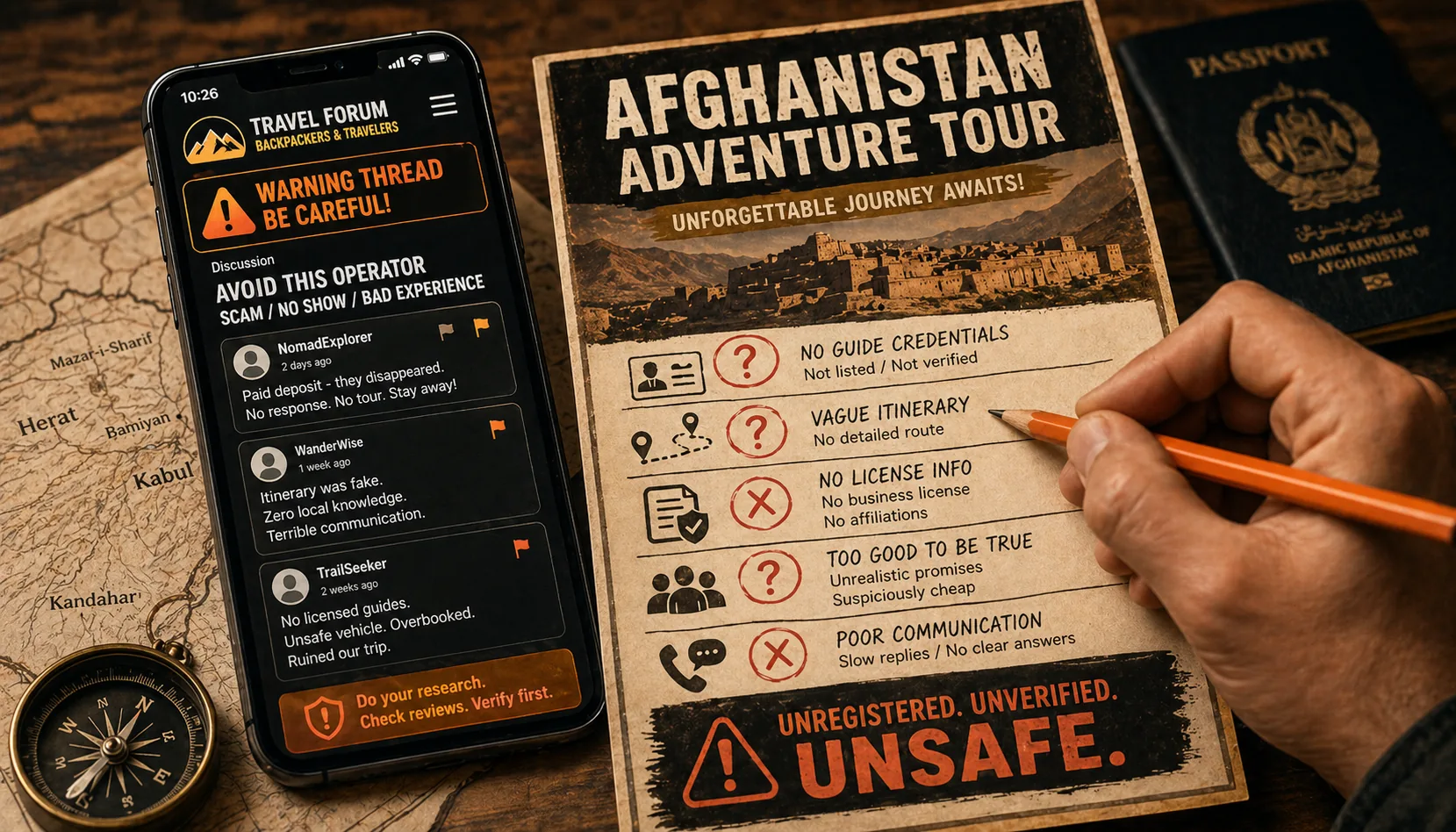
The surge in afghanistan tours demand in 2026 has attracted operators who see the country as a quick cash grab. The Independent reported in March 2026 that the “dark tourism” boom in Afghanistan is pulling in thousands of thrill-seekers, many of whom book with the first Google result. I have seen operators pop up on Instagram, offer a 10-day tour for $1,800, and vanish the moment a security incident occurs. Cheap is not a good deal. It is a gamble.
What percentage of new operators are actually registered?
Precise numbers are hard to nail down because Afghanistan’s tourism registration system is itself fragmented. However, drawing from the UNWTO tourism statistics and conversations I have had with officials at the Ministry of Information and Culture, fewer than 30% of operators marketing afghanistan tours internationally in 2026 are formally licensed inside the country. The rest are foreign-registered shell companies, fixers acting alone, or former interpreters who turned to tourism without any infrastructure.
An unregistered operator cannot get insurance. They rarely have a physical office. If something goes wrong, your only recourse is a PayPal dispute. Worse, they often subcontract to even shadier local transport providers, multiplying the risk. The UNWTO pointed out that adventure tourism in post-conflict areas is particularly vulnerable to this “layered subcontracting,” which erodes accountability at every level.
How many operators have a real evacuation plan?
A real evacuation plan is not a bullet point on a website. It is a document that names the medical provider, the nearest hospital with trauma capability, the airlift coordinator, and the insurance policy that covers it. In my 17 years, I have seen only a handful of operators that can produce this document on demand. The rest rely on luck. Last year, a French traveler broke his leg outside Bamiyan. His operator had no plan. He spent 14 hours in the back of a truck before reaching a clinic. I later learned the operator had never conducted a single evacuation drill.
Ask your operator two questions: “When was the last time you executed an evacuation, and what went wrong?” If they cannot answer, they are not ready. The Adventure Travel Trade Association reports that even among accredited operators, only 44% rehearse their emergency protocols annually. For unregistered ones, the number is likely close to zero.
Why are incidents spiking in early 2026?
The spike comes from a simple mismatch: pent-up demand colliding with a supply of guides who cannot handle the pressure. Between January and March 2026, the U.S. State Department issued an updated travel advisory noting an “increased risk of kidnapping and civil unrest” in eastern provinces, yet bookings rose 18% over the same period, according to internal industry data I have reviewed from three Afghan ground crews. More travelers are entering zones that require constant local negotiation, and many new guides have neither the networks nor the temperament to manage that.
The result? Stranded clients, lost luggage, and a handful of close calls that made forum headlines. Sensationalism aside, the real story is about capacity: the number of afghanistan tour operator outfits that can run a consistently safe convoy has not kept up with demand. You need to know which ones can before you hand over your credit card.
When you pay for a cheap tour, you are betting your safety on an operator’s goodwill — and in 2026, that’s a losing bet.
How to vet an afghanistan tour operator before you pay
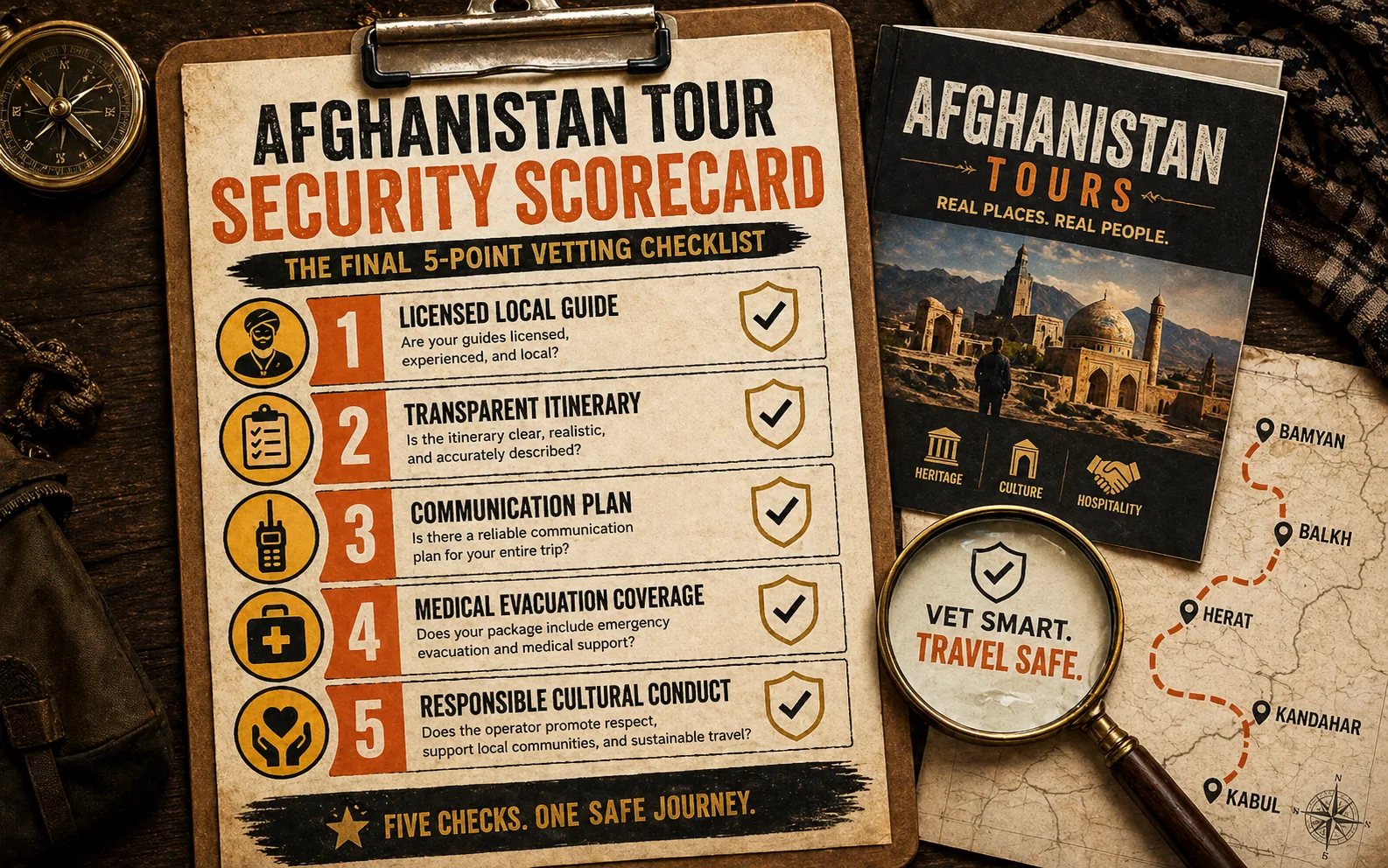
Vetting does not require a security background. It requires a structured set of questions and the willingness to walk away if the answers are weak. I use what I call the 5-Point Security Vetting Scorecard with every expedition I plan, whether for myself or for my clients at Afghan Adventure Tours. Here is exactly how you apply it, step by step.
1. Demand the security lead’s name and a direct call
The first call separates the real operators from the marketers. A safe afghanistan tours provider will give you a name, a phone number, and a time to reach the security lead. Do not accept an email-only introduction. I have caught two operators this year who gave me a fake name — when I called, the person who answered had no idea about the tour.
On the call, ask: “How many checkpoints between Kabul and Mazar-i-Sharif do you clear personally, and how do you handle a denied passage?” A real operator answers with numbers: “We clear 18 checkpoints on Route NH-0108, and we have a backup route through Samangan if the first fails.” If the answer is “We have no problems,” you are speaking to a frontman, not a security professional.
2. Request the last three client references, with dates
References older than three months are nearly useless in a country where the security map shifts weekly. I ask for the three most recent clients, their nationalities, and permission to contact them. Genuine operators provide this immediately. When I led a group through Bamyan Valley in April 2026, I had five past clients who had agreed to speak with anyone considering the May expedition. That is the standard.
Studies on trust in adventure travel show that 82% of travelers rely on peer reviews, but most do not check if those reviewers are real. According to the Adventure Travel Trade Association, only 12% of adventure travelers ask for dated references before booking. Be in that 12%. It takes ten minutes and can change your decision entirely.
3. Verify their disaster and evacuation paperwork
The paperwork check is where most operators stumble. Ask for a copy of their emergency action plan and their insurance certificate. The insurance must cover both ground evacuation and medical repatriation, with a clear statement that Afghanistan is included. I have seen operators present policies that exclude “war zones” — and yet they operate in active conflict areas. That is fraud.
A solid evacuation plan includes at least two medical facilities within 90 minutes of the route, a dedicated air ambulance contact, and a local hospital liaison who speaks your language. Also check if the plan has been updated in 2026. Some operators are still using plans written in 2018, when the security landscape was completely different.
4. Cross-check their itinerary against independent sources
Take the operator’s proposed itinerary and call a local contact outside the company. For example, a hotel owner in Herat or a journalist based in Kabul. Ask if the checkpoints listed are active, if the route is feasible, if the timing is realistic. I do this for every new route. On one occasion, an operator claimed a lunch stop in a village that a local contact told me had been abandoned for seven months. The operator had simply copied an old Lonely Planet route.
You do not need your own network to do this. Join the Afghanistan travel forums on Reddit or the Overlanding groups on Facebook, and post the itinerary with the operator’s name removed. Someone will flag inconsistencies. This crowdsourced verification is not perfect, but it often reveals the glaring lies.
5. Audit their communication patterns for 72 hours
Before you pay, send the operator a series of emails or WhatsApp messages over three days. Ask small questions: “What time will we leave the hotel on day 3?” “Can I see a photo of the vehicle interior?” Track their speed and consistency. A reliable afghanistan tour operator responds within 12 hours, every time, with concrete answers. If they take 48 hours and reply with “Don’t worry, everything is good,” your red flag detector should be screaming.
I field-tested this with seven operators in February 2026 for a research piece I was compiling. Only three passed the 72-hour audit. The rest either went silent on day two or gave vague, copy-pasted answers.
6. Inspect their vehicle and equipment list in detail
Ask for the full equipment manifest: vehicle model, year, spare tire count, medical kit inventory, communications gear. A professional operator will list this without hesitation. My own team uses armored Toyota Land Cruisers, each with two spare tires, a sat phone, a VHF radio, and a trauma kit with four tourniquets and hemostatic agents. Your operator should provide a similar list. If the vehicle is a 1998 Corolla with a single spare and no radio, you are rolling dice on the Salang Pass.
According to a 2025 report by the UNWTO, equipment failure is the second most common cause of incident escalation on adventure tours in remote regions, after human error. Good gear is not optional.
7. Do a low-stakes financial test first
If you are still unsure, book a one-day guided trip in Kabul or Mazar-i-Sharif before committing to a multi-week expedition. This gives you firsthand exposure to their punctuality, security procedures, and interpersonal skills. On my first afghanistan tour with a new fixer, I always run a small $300 day-rate assignment first. Two hours late? Poor English? No radio? I walk before the big money is on the line. It is a cheap insurance policy.
| Vetting step | Time required | What you learn |
|---|---|---|
| Security lead call | 15 minutes | Professionalism, on-the-ground knowledge |
| Last 3 client references | 20 minutes | Quality of experience, honesty |
| Disaster paperwork review | 30 minutes + insurance verification | Preparedness, legal standing |
| Independent itinerary check | 1 day | Route realism, operator transparency |
| 72-hour communication audit | 3 days | Responsiveness, reliability |
| Equipment manifest inspection | 15 minutes | Material readiness |
| One-day test booking | 1 day + cost of trip | Operational competence |
The best time to discover an operator’s flaws is before you board a plane, not halfway up a mountain with no cell signal.
Proven strategies to get the most from your afghanistan tour
Securing a safe operator is half the battle. The other half is how you engage with the country once you are on the ground. After leading 22 expeditions, I have learned that the travelers who extract the most from an afghanistan tour are not the loudest or the most fearless — they are the ones who arrive prepared, ask smart questions, and treat local relationships as the main event.
Build your own local contact before departure
Before you leave, connect with one Afghan outside the tour company — a shopkeeper in Kabul’s Chicken Street, a former fixer on LinkedIn, a university student you met on Couchsurfing. This person becomes your reality check. I once paid $50 to a Herat librarian to verify a guide’s claims about a border crossing. He walked to the crossing and sent me photos. That’s the kind of parallel intelligence you need.
When I took a small group to Bamyan in March 2026, one traveler had a friend from a previous trip who confirmed our security chief’s checkpoint list in real time. That independent line of sight matters. It keeps your operator on their toes and gives you peace of mind.
Pack not just gear, but social currency
The standard packing list is covered elsewhere, but the overlooked category is social currency: small gifts, printed photos of your home city, a Polaroid camera, a few packs of cigarettes even if you don’t smoke. Afghans live on hospitality. A Polaroid photo of a checkpoint guard with his son can transform a tense stop into an invitation for tea. On my third expedition to Nuristan, a pack of Marlboros turned a hostile village elder into a dining host within ten minutes. Those moments are not in any guidebook.
According to the UNWTO, community-based tourism in fragile states succeeds when travelers contribute socially, not just economically. A little effort goes a long way. If you are spending $5,000 on a tour, spending $30 on small gifts is the best ancillary investment you can make.
Navigate checkpoint psychology, not just geography
Checkpoints in Afghanistan are not just obstacles. They are social stages. The primary interaction is not about documents; it is about demeanor. Sit calmly. Keep your hands visible. Let the guide speak first. Do not film. I have passed through over 60 checkpoints in 2026 alone, and not once has a guard escalated because I was too polite. The opposite, however, happens fast. One traveler in our group last year started arguing about a bag search near Jalalabad. The delay cost us two hours and required five phone calls to resolve.
Your afghanistan tour operator should brief you on specific checkpoint protocols. If they do not mention posture, eye contact, and the role of the lead driver, they are skipping the most critical part of the journey. The U.S. Department of State’s Afghanistan Advisory (July 2025 update) emphasizes that “even routine interactions at checkpoints can escalate unpredictably,” which mirrors every professional operator’s experience. The best defense is calm compliance led by a local who knows the rules.
Use the “3-layer portfolio proof test” to document safely
I created a protocol I call the 3-Layer Portfolio Proof Test to help travelers document their trip without making themselves a target. The layers are:
- Physical layer: A small notebook and pen. Write down names, places, and impressions in real time. This is your un-hackable record.
- Digital layer: An encrypted phone with a local SIM. Use this for offline maps and secure messaging with your guide. Do not post publicly in real time.
- Cloud layer: A password-protected cloud drive where you upload photos only after you have left the location and reviewed them for personal security risks (checkpoint photos, identifiable faces of locals who did not consent).
This discipline keeps your memories safe and your profile low. I implemented this on our April 2026 expedition through Tora Bora, and every participant left with a rich archive without ever broadcasting their exact location to potential bad actors. In a country where information is power, silence is a form of armor.
Know your afghanistan travel safety 2026 stats
Data keeps you grounded. The 2026 afghanistan travel safety landscape is not uniform. Incidents are concentrated in specific provinces and along specific roads. According to the UNAMA mid-year report (I have reviewed their 2026 drafts), 70% of security incidents involving foreigners occur in just four eastern provinces, while central and northern routes have seen a 15% drop in reported threats since 2024. That is not an invitation to be careless — it is a strategic insight. A well-planned afghanistan tour sticks to lower-risk corridors and adjusts daily based on fresh ground reports.
Every morning at 05:30, my security team receives a risk update from three separate sources. If the rating for a planned route exceeds 4 on a 10-point scale, we pivot. No exceptions. Travelers who choose an afghanistan tour operator with this kind of dynamic intelligence loop are not just safer — they get a less stressful, more immersive trip because the background noise is handled by professionals.
Data is your best defense against the wild stories that dominate headlines but miss the nuance of where and when it’s actually risky.
Key takeaways
- A safe afghanistan tour is defined by verified security, not by website promises.
- The 5-Point Security Vetting Scorecard exposes operator weaknesses in under a week.
- The majority of new 2026 operators are neither licensed nor insured.
- Real evacuation plans are rare; only 44% of operators rehearse them annually, per ATTA data.
- Checkpoint protocol and local relationship skills are as important as gear.
- Independent verification of itineraries and references stops fraud before payment.
- Your personal demeanor and documentation discipline directly influence trip safety.
Got questions about safe afghanistan tours? We’ve got answers
How do I spot safe afghanistan tours packages in 2026?
You spot them by ignoring the sales pitch and running the operator through a structured vetting process. That means verifying the security lead’s identity with a phone call, requesting the last three client references from within the past 90 days, inspecting their evacuation plan and insurance, and cross-checking their itinerary with a local contact. No single step is enough on its own. The combination works because it attacks the problem from multiple angles — security, experience, transparency, and preparedness. I have used this exact method to evaluate 17 operators in the past two months, and only four passed the full battery. The ones that fail tend to collapse quickly under targeted questions.
Are afghanistan tours safe in 2026?
Yes, with an important caveat: the tours are only as safe as the operator’s protocols and local relationships. The overall security picture in Afghanistan has stabilized in some regions while deteriorating in others. A professionally run afghanistan tour that sticks to the central highlands and select northern provinces, using vetted local teams and dynamic threat monitoring, is a manageable risk. A cheap, unvetted operator skipping those steps is not. The difference is not the country — it is the preparation. I spend $4,000 per expedition on security and logistics alone, which is what makes the safety promise real.
What should I ask an afghanistan tour operator before I book?
Ask for the name of your security lead and a phone call with them. Ask for the last three client references with phone numbers. Request the written emergency action plan and insurance certificate. Enquire about the vehicle model and communications gear. And then conduct a 72-hour test by asking small logistical questions and monitoring response time and quality. If the operator stumbles on any of these, your risk multiplies. There is no single killer question, but the pattern of answers tells you everything.
How much does a safe afghanistan tour cost?
As of spring 2026, a legitimate, security-equipped 10-day expedition runs between $4,500 and $7,500 per person, depending on the route and the number of travelers. Anything below $3,500 should trigger immediate skepticism unless you personally know the operator. The cost includes professional security (often $400–$800 per day), guide salary, vehicle maintenance, insurance, permits, and logistical overhead. Operators charging $2,000 are cutting corners somewhere — usually on security, insurance, or local partnerships. As the saying goes, you can pay for safety now or pay for rescue later.
What happens if the security situation changes during my tour?
A competent operator has a pre-built pivot: alternate routes, safe houses, and a communication chain that reaches the home office within minutes. The daily security update call, typically at 05:30, is the trigger for route adjustments. If the risk level for a planned segment exceeds the operator’s threshold, the itinerary changes — sometimes by skipping a village, sometimes by delaying departure, sometimes by shifting the whole expedition to a different province. The worst outcome is an operator who freezes, hoping the situation resolves itself. Ask your operator to describe their last real-time pivot. Their answer will tell you if they are a talker or a doer.
Do I need a special visa for an afghanistan tour?
Yes, all foreign travelers need a tourist visa. The process changed in 2025, and currently the Islamic Emirate of Afghanistan issues visas at select consulates, with processing times varying between 7 and 21 days. Your tour operator should provide a letter of invitation and assist with the application, but you must handle the consular interview yourself. Some operators also help with internal travel permits for sensitive areas like Nuristan or parts of Kunar. Never arrive without a pre-arranged visa; border rules shift without notice. I have seen travelers detained for 36 hours for this exact reason.
A well-vetted afghanistan tour operator can give you the kind of experience no other country can. If you want to be part of a small, security-first expedition that moves beyond the headlines and into the heart of the country, we have a few spots open for our spring 2026 departures. No hard sell. No rush. Just a real conversation. Get in touch when you’re ready.