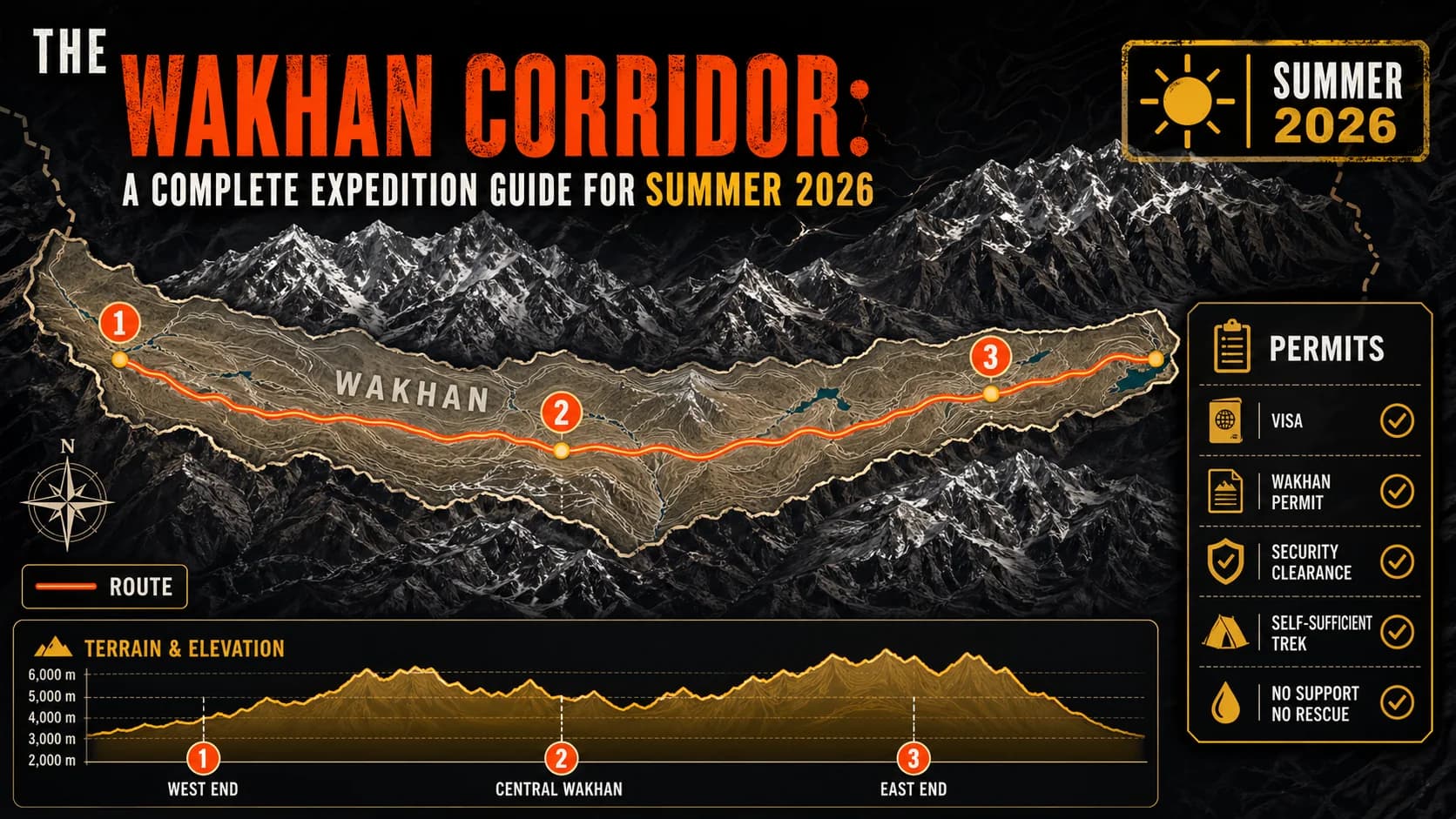
The Wakhan Corridor is a narrow strip of Afghan territory that stretches like a finger between Tajikistan, Pakistan, and China, reaching all the way to the Chinese border at its eastern tip. It is one of the most geographically dramatic and culturally isolated regions anywhere on Earth. For a handful of trekkers each summer, it offers something that barely exists anymore: genuine remoteness, complete silence, and landscapes that have looked the same for centuries.
This is not a trail you find on AllTrails. There are no huts, no waymarked paths, no helicopter rescue on speed dial. But for those willing to prepare properly, the Wakhan Corridor in summer 2026 offers what may be a once-in-a-generation window of access. Here is everything you need to know.
Understanding the Geography
The Wakhan Corridor runs roughly 350 kilometers from the Ishkashim district in the west to the border with China's Xinjiang region in the east. At its narrowest point, it is barely 13 kilometers wide. The Afghan Wakhan is bounded to the north by the Panj River (which forms the Tajik border) and to the south by the Hindu Kush range and the Pakistani border.
The corridor rises dramatically from around 2,500 meters at Ishkashim to over 4,900 meters at the Little Pamir plateau in the east. The landscape transitions from irrigated green valleys near Ishkashim, through narrow river gorges, to vast, treeless high-altitude plateaus that look more like Mongolia than anything you associate with Afghanistan.
Three major geographic zones define the corridor:
- The Lower Wakhan (Ishkashim to Qala-e-Panja): Fertile valley floor, Wakhi villages, accessible by vehicle on rough roads. Elevation 2,500-3,000m.
- The Middle Wakhan (Qala-e-Panja to Sarhad-e-Broghil): Narrowing valley, fewer settlements, road deteriorates to track. Elevation 3,000-3,500m. This is where most vehicle access ends.
- The Upper Wakhan and Pamirs (Sarhad-e-Broghil eastward): No roads, no permanent structures beyond yurts. The Great and Little Pamir plateaus. Elevation 3,500-4,900m+. This is what you came for.
Why Summer 2026 Is a Unique Window
Several factors converge to make summer 2026 a distinctive opportunity for Wakhan expeditions.
The Afghan Ministry of Tourism has been actively issuing corridor-specific travel permits since late 2025, with a streamlined process that did not exist even two years ago. Local guides in the Wakhan report that the permitting route through Faizabad is functioning more reliably than at any point in the past five years.
On the Tajik side, the Pamir Highway infrastructure continues to improve, making the approach to the Ishkashim border crossing more predictable. Several small guesthouses have opened in Ishkashim town on the Afghan side, providing a staging point that previously required camping from day one.
The Wakhi and Kyrgyz communities in the corridor have organized themselves more formally for tourism support. A small cooperative of Wakhi horsemen now operates out of Sarhad-e-Broghil, offering pack animals and local guides with standardized (though still negotiable) pricing.
None of this means the Wakhan is becoming easy. It means the difference between "nearly impossible to organize" and "very difficult but achievable with proper planning." That gap is worth acting on.
The Three Main Routes
Route 1: The Classic Wakhan Valley Trek (10-12 days)
Ishkashim to Sarhad-e-Broghil and back
This is the most accessible route and the one most first-time Wakhan visitors should consider. It follows the main valley floor, visiting Wakhi villages, ancient fortresses, and hot springs.
Day-by-day outline:
- Day 1: Arrive Ishkashim, arrange permits and supplies, meet guide. Overnight guesthouse.
- Day 2: Drive to Qala-e-Panja (3-4 hours on rough road). Visit the remains of the ancient fortress. Camp or local homestay.
- Day 3: Trek from Qala-e-Panja toward Zong village. 18km, moderate terrain along the river. Elevation gain minimal.
- Day 4: Zong to Yamit. 15km. Side trip to Bibi Fatima hot springs if time and energy permit.
- Day 5: Yamit to Sust. 14km. Terrain begins to narrow. River crossings may be necessary depending on snowmelt.
- Day 6: Sust to Sarhad-e-Broghil. 16km. This is the last permanent settlement. Resupply here if continuing east.
- Day 7: Rest day in Sarhad-e-Broghil. Acclimatize. Arrange horses if continuing to the Pamirs.
- Days 8-10: Return journey via same route, or arrange vehicle pickup from Qala-e-Panja if road conditions allow.
- Days 11-12: Buffer days for weather delays, vehicle breakdowns, or permit complications.
Difficulty: Moderate. Suitable for experienced hikers in good physical condition. No technical climbing.
Route 2: The Little Pamir Expedition (18-22 days)
Ishkashim to Little Pamir plateau and back via Sarhad-e-Broghil
This is the marquee Wakhan experience. You leave all roads and permanent settlements behind and enter the world of the Kyrgyz nomads on the high plateau.
Day-by-day outline:
- Days 1-6: Follow Route 1 to Sarhad-e-Broghil.
- Day 7: Depart Sarhad-e-Broghil with pack horses. Trek up the Wakhan River valley. 12km. Camp at approximately 3,600m.
- Day 8: Continue up valley. 14km. Terrain becomes increasingly barren. Camp at 3,800m.
- Day 9: Cross into the Daliz Pass area. Steep ascent to approximately 4,200m. Short day, 10km, to allow acclimatization.
- Day 10: Descend into the Little Pamir basin. First sightings of Kyrgyz yurts. Camp near Kyrgyz settlement at 4,000m.
- Days 11-13: Explore the Little Pamir. Visit Kyrgyz families (with guide introduction — never approach uninvited). Trek to viewpoints overlooking the Wakhjir Valley toward China. Optional side trek to Chaqmaqtin Lake (4,100m).
- Day 14: Begin return journey.
- Days 15-19: Retrace route to Sarhad-e-Broghil and then to Ishkashim.
- Days 20-22: Buffer days. You will need them. Weather, horse logistics, river conditions, and sheer fatigue make buffer days non-optional on this route.
Difficulty: Hard. High altitude, complete remoteness, no evacuation options in the Pamir section. Requires previous high-altitude experience.
Route 3: The Great Pamir Circuit (24-30 days)
Full east-west traverse via both Pamir plateaus
This is the expedition-grade route. It covers both the Little and Great Pamir, with passes above 4,800m and sections where you may not see another human for days. Only a handful of groups attempt this each year.
This route requires:
- A minimum of two experienced guides
- A string of at least 6-8 pack horses
- Full expedition medical kit including altitude medication
- Satellite communication device (not optional)
- A realistic fitness level that allows sustained effort at 4,000-4,900m for two weeks
We do not provide a day-by-day breakdown for this route because conditions dictate the schedule, not the other way around. If you are considering this route, you need a guide who has done it before, and you need to plan the itinerary with them on the ground based on current conditions.
Difficulty: Very hard. Expedition-grade. Not recommended without prior 5,000m+ experience.
Altitude Profile and Acclimatization
The altitude progression in the Wakhan is one of its most dangerous features because it can feel deceptively gradual. You start at 2,500m in Ishkashim and may feel fine. By the time you reach 4,000m+ in the Pamirs, altitude sickness can hit hard if you have not acclimatized properly.
Key altitude benchmarks:
- Ishkashim: 2,500m
- Qala-e-Panja: 2,900m
- Sarhad-e-Broghil: 3,200m
- Little Pamir entry: 4,000m
- Chaqmaqtin Lake: 4,100m
- Highest passes (Great Pamir route): 4,800-4,950m
Acclimatization protocol:
- Spend at least 2 nights below 3,000m before ascending
- Never increase sleeping altitude by more than 500m per day above 3,000m
- Build in rest days at Sarhad-e-Broghil (3,200m) and upon reaching the Pamir plateau (4,000m)
- Carry acetazolamide (Diamox) as prophylaxis — discuss dosing with a travel medicine doctor before departure
- Know the symptoms of HACE and HAPE. Descent is the only reliable treatment once symptoms appear
Best Timing: The Summer Weather Windows
The Wakhan Corridor has a brutal climate with a narrow window of accessibility.
- May: Snow still blocks most passes above 4,000m. Lower Wakhan accessible but rivers swollen. Not recommended.
- June: Early June still risky. Late June (after ~June 20) is the earliest reliable window for the lower routes. Passes may still carry snow.
- July: Prime month. Warmest temperatures, lowest river levels, clearest passes. Daytime temperatures at 4,000m around 10-15°C. Nighttime can drop to -5°C. This is when to go if you can choose.
- August: Still good, but afternoon thunderstorms become more frequent. Early August is preferable.
- September: Early September can work for lower routes. Temperatures dropping fast. By mid-September, high passes become unreliable. Snow can arrive any day.
- October onward: Corridor effectively closed to trekking.
The recommendation: Aim for a July departure for any route involving the Pamirs. Late June works for the valley route only.
Permits and Bureaucracy
This is where many Wakhan expeditions fail before they begin. The permit situation is navigable but requires patience and a local fixer.
What you need:
- Afghan visa: Apply through the Afghan embassy or consulate in your country. Processing times vary from 2-8 weeks. Do this first.
- Badakhshan travel permit: Issued in Faizabad, the provincial capital. Your guide or local agency should arrange this before your arrival. Expect 1-3 days processing.
- Wakhan Corridor specific permit: A secondary permit required for travel beyond Ishkashim. Also arranged through Faizabad. This is the one that can cause delays.
- Ministry of Tourism registration: A newer requirement as of 2025. Your agency should handle this, but verify it has been done.
Practical advice:
- Do not attempt to arrange permits independently. Use an Afghan tour operator with Wakhan experience.
- Build 3-5 extra days into your schedule for permit delays. This is not paranoia; it is planning.
- Carry multiple printed copies of all permits. You will be asked to show them at checkpoints.
- Carry passport-sized photos (at least 6). They are requested at various bureaucratic stages.
Choosing a Guide
There is no responsible way to trek the Wakhan without a local guide. This is not a matter of trail navigation alone — it is about community relationships, language, security awareness, and logistical knowledge that no guidebook can substitute.
What to look for:
- Wakhi or Kyrgyz language ability. Your guide must be able to communicate with local communities. Dari alone is not sufficient in the upper Wakhan.
- Previous Wakhan experience. Ask specifically how many times they have guided in the corridor and on which routes.
- Horse logistics connections. The guide should have direct relationships with horsemen in Sarhad-e-Broghil if you are going beyond.
- Satellite phone or communicator. Non-negotiable for any route beyond the valley floor.
- First aid training. At minimum, wilderness first aid certification.
Expect to pay: $50-80/day for an experienced Wakhan guide, plus their food and transport. Horse hire is separate, typically $15-25/day per horse including handler.
The Pack List
The Wakhan requires expedition-grade gear even for the valley route. There are no shops, no lodges, and no resupply beyond Sarhad-e-Broghil.
Essential Gear
- Tent: 4-season, freestanding, rated to -10°C minimum. Wind is the primary threat at altitude.
- Sleeping bag: Comfort-rated to -15°C for Pamir routes, -10°C for valley route. Down preferred for weight, but synthetic if you cannot keep it dry.
- Sleeping pad: R-value 5.0 or higher. The ground at 4,000m is brutally cold.
- Trekking boots: Broken-in, waterproof, ankle support. You will cross streams daily.
- Camp shoes: Lightweight sandals or down booties for camp.
- Trekking poles: Strongly recommended for river crossings and scree.
- Backpack: 65-75L if using pack horses, 85L+ if self-supported.
Clothing Layers
- Base layer (merino wool preferred)
- Insulating mid-layer (fleece or light down)
- Down jacket (for evenings at altitude)
- Hardshell jacket (waterproof, windproof)
- Hardshell pants
- Sun hat with neck protection
- Warm hat (fleece or wool)
- Gloves (liner + insulated pair)
- Sunglasses (Category 4, side shields recommended above 4,000m)
Technical Equipment
- Water purification (filter + chemical backup — SteriPEN batteries die, bring tablets too)
- Headlamp with spare batteries
- Satellite communicator (Garmin inReach or similar) with active subscription
- Solar charger panel (minimum 20W)
- Power bank (20,000mAh minimum)
- First aid kit (see medical section)
- Repair kit (duct tape, cord, needle and thread, spare buckles)
Food Strategy
There is no resupply in the upper Wakhan. Plan every gram.
- Caloric requirement: 3,500-4,500 calories/day at altitude under load. Most trekkers underestimate this.
- Staples: Bring dehydrated meals, energy bars, nuts, dried fruit, instant noodles, powdered milk, tea, sugar, and salt. Variety matters for morale.
- Local food: In Wakhi villages (lower route), you may be offered bread (non), yogurt, and tea. Accept graciously, but do not plan your nutrition around it. In the Pamirs, Kyrgyz families may share qurut (dried yogurt balls) and bread, but supplies are scarce — bring a gift of tea, sugar, or rice in return.
- Cooking: Bring a reliable stove (MSR or Jetboil style) and sufficient fuel canisters. You cannot buy fuel in the Wakhan. Calculate 100g of gas per person per day as a minimum.
- Water: Rivers and streams are abundant. Water from glacial sources above 4,000m is generally safe but should still be filtered. Below 4,000m, near settlements and livestock, always purify.
Cultural Context: The Wakhi and Kyrgyz
The Wakhan is home to two distinct communities, and understanding them is both a practical necessity and a moral obligation.
The Wakhi People
The Wakhi inhabit the lower and middle corridor. They are Ismaili Muslims (followers of the Aga Khan) and have a distinct language, Wakhi, which is part of the Eastern Iranian language family. They are settled agriculturalists and herders, living in stone and mud-brick houses in small villages along the river.
Wakhi hospitality is legendary and genuine. If invited into a home, remove your shoes, accept tea, and sit where indicated. Do not photograph people without asking. Women may be present but may not engage directly with male visitors — follow the lead of your guide.
The Aga Khan Development Network (AKDN) has been active in the Afghan Wakhan for decades, building schools, clinics, and bridges. Many Wakhi speak some English as a result of AKDN educational programs.
The Kyrgyz of the Pamir
The Kyrgyz of the Afghan Pamir are among the most isolated communities in Central Asia. Numbering only around 1,500-2,000, they are semi-nomadic herders living in yurts on the high plateau, raising yaks, sheep, and horses.
They speak Kyrgyz and have limited contact with the outside world. Their situation is one of extraordinary hardship — no roads, no electricity, no permanent medical facilities, and temperatures that drop below -40°C in winter. Infant mortality is high, and many health problems go untreated.
Interaction with the Kyrgyz requires sensitivity. Always approach through your guide. Bring gifts — tea, sugar, rice, basic medicines (paracetamol, ibuprofen) are deeply appreciated. Do not photograph children without parental permission. Do not enter a yurt uninvited.
If you buy handicrafts (felt work, woven bands), pay generously. The cash economy is almost nonexistent here, and your purchase may be the only cash income a family sees for weeks.
Photography Opportunities
The Wakhan is one of the most photogenic places on Earth, and it is nearly unphotographed compared to more accessible mountain regions.
What to shoot:
- Landscapes: The transition from green valley to high desert to glacial plateau is extraordinary. Dawn light on the Hindu Kush from the Pamir side is world-class.
- Portraits: With permission, Wakhi and Kyrgyz faces tell stories that words cannot. Always ask. Always show the image on your screen. Offer to send a print if you can.
- Wildlife: Marco Polo sheep (Ovis ammon polii) inhabit the Great Pamir. You may see them at distance. Snow leopard presence is confirmed but sightings are extremely rare. Marmots are abundant and photogenic.
- Night sky: Zero light pollution. The Milky Way at 4,000m in the Pamir is staggering. Bring a fast wide-angle lens and a lightweight tripod.
Gear notes: Protect cameras from dust and cold. Batteries drain fast at altitude and low temperatures — carry spares in an inner pocket. A zoom lens (24-200mm equivalent) is more practical than carrying multiple primes.
Medical Considerations
This is not a trip where you can wing the medical preparation.
Before departure:
- Visit a travel medicine clinic at least 6 weeks before departure
- Ensure routine vaccinations are current (tetanus, typhoid, hepatitis A and B)
- Discuss altitude medication (acetazolamide) and carry a prescription
- Carry a dental emergency kit — there is no dentist within days of travel
- Get a comprehensive travel insurance policy that explicitly covers helicopter evacuation from remote areas in Afghanistan. Read the fine print. Many policies exclude Afghanistan entirely.
First aid kit essentials:
- Broad-spectrum antibiotics (prescribed in advance — ciprofloxacin for GI, amoxicillin-clavulanate for respiratory/wound)
- Anti-diarrheal medication (loperamide)
- Oral rehydration salts (at least 10 packets)
- Strong painkillers (ibuprofen 600mg, paracetamol with codeine if obtainable)
- Blister care (Compeed or similar)
- Wound care (antiseptic, sterile gauze, adhesive bandages, butterfly strips)
- Altitude medication (acetazolamide, dexamethasone for emergencies)
- Antihistamine
- Eye drops (dust and UV irritation common)
- Sunscreen (SPF 50+, reapply frequently at altitude)
- Lip balm with SPF
Emergency Evacuation: The Hard Truth
There is no mountain rescue service in the Wakhan Corridor. If you are injured or critically ill in the upper Wakhan or the Pamirs, here is the reality:
- Below Sarhad-e-Broghil: Vehicle evacuation to Ishkashim is possible in 1-3 days depending on road conditions. From Ishkashim, a flight or long drive to Faizabad for basic medical care.
- Above Sarhad-e-Broghil: Evacuation is by horse or carried stretcher to Sarhad, then by vehicle. This can take 3-7 days. There is no helicopter service operating in the Afghan Wakhan.
- Satellite communication is your only link to the outside world. A Garmin inReach with an active SOS subscription can alert international rescue coordination centers, but response times to the Wakhan are measured in days, not hours.
This is not written to discourage. It is written so you make your decision with open eyes. People trek the Wakhan successfully every summer. But the margin for error is thin, and self-reliance is not optional.
Cost Breakdown
A realistic budget for a summer 2026 Wakhan expedition, assuming a 3-week trip on the Little Pamir route:
| Item | Estimated Cost (USD) |
|---|---|
| International flights (to Kabul or Dushanbe) | $800 - $1,500 |
| Internal flights/transport to Ishkashim | $200 - $400 |
| Afghan visa | $100 - $160 |
| Permits and fees | $100 - $200 |
| Guide (21 days at $60-80/day) | $1,260 - $1,680 |
| Pack horses (10 days at $20/day x 2-3 horses) | $400 - $600 |
| Food and cooking fuel (21 days) | $300 - $500 |
| Accommodation in Ishkashim (pre/post trek) | $50 - $100 |
| Satellite communicator rental + subscription | $150 - $300 |
| Travel insurance (Afghanistan-rated) | $200 - $500 |
| Gear (if purchasing new) | $500 - $2,000 |
| Contingency fund | $300 - $500 |
| Total | $4,360 - $8,440 |
Most trekkers spend in the range of $5,000-6,500 all-in, excluding new gear purchases.
For comparison, a guided trek of comparable length and difficulty in Nepal or Pakistan costs $3,000-$8,000 through an agency. The Wakhan is not cheap, but it is not unreasonably expensive for what you get — which is an experience almost no one on Earth has had.
Practical Tips Nobody Puts in Guidebooks
- Bring a phrasebook or word list in Wakhi. Even 20 words transform your interactions. "Tashakor" (thank you) goes far, but "Khoshtip" (how are you? in Wakhi) opens doors.
- Cash only. Bring clean, new US dollar bills in small denominations ($1, $5, $10, $20). Torn or old bills are refused everywhere.
- Charge everything before Sarhad-e-Broghil. Some guesthouses in the lower Wakhan have solar charging, but it is unreliable. Your solar panel is critical beyond Sarhad.
- Dust is relentless. Ziplock bags for electronics, camera gear, and documents. Not optional.
- River crossings can be life-threatening. Glacial rivers peak in afternoon heat. Cross in the morning when flow is lowest. Use trekking poles, face upstream, and unclip your pack waist belt so you can ditch it if you fall.
- Do not fly a drone without explicit permission from your guide and local community leaders. In many areas, drones are associated with military surveillance and will cause serious problems.
- Gift-giving etiquette matters. Small, practical gifts (pens, notebooks for children, basic medicines, tea and sugar for adults) are appropriate. Do not give candy to children — dental care is nonexistent. Do not give money to children.
- Your trash is your responsibility. There is no waste management. Carry out everything you carry in. Burn nothing — the air is too clean to pollute.
Final Thoughts
The Wakhan Corridor is not a trip you take because it is on a list. It is not a destination you can reduce to an Instagram caption. It is a place where the scale of the landscape and the depth of the silence change something in how you perceive the world.
The people who live here — the Wakhi farmers who coax crops from stony soil, the Kyrgyz herders who survive winters that would defeat most of us — deserve visitors who come with respect, preparation, and humility. If you do that, the Wakhan will give you something no other place can.
Summer 2026 is an open window. Prepare properly, go with good people, and you will come back with stories that last the rest of your life.
Other Doved Studio projects
Related tools from the same studio you might find useful:
- Magnu Imperiu: Daily history puzzle: guess the empire from six geographic and temporal clues.
- Doved Studio: Studio indie derrière cette app et une dizaine d'autres outils.