practical-tips

Why Your Afghanistan Expedition Needs a Francophone Guide (And It's Not What You Think)

by Afghan Adventure Team14 min read

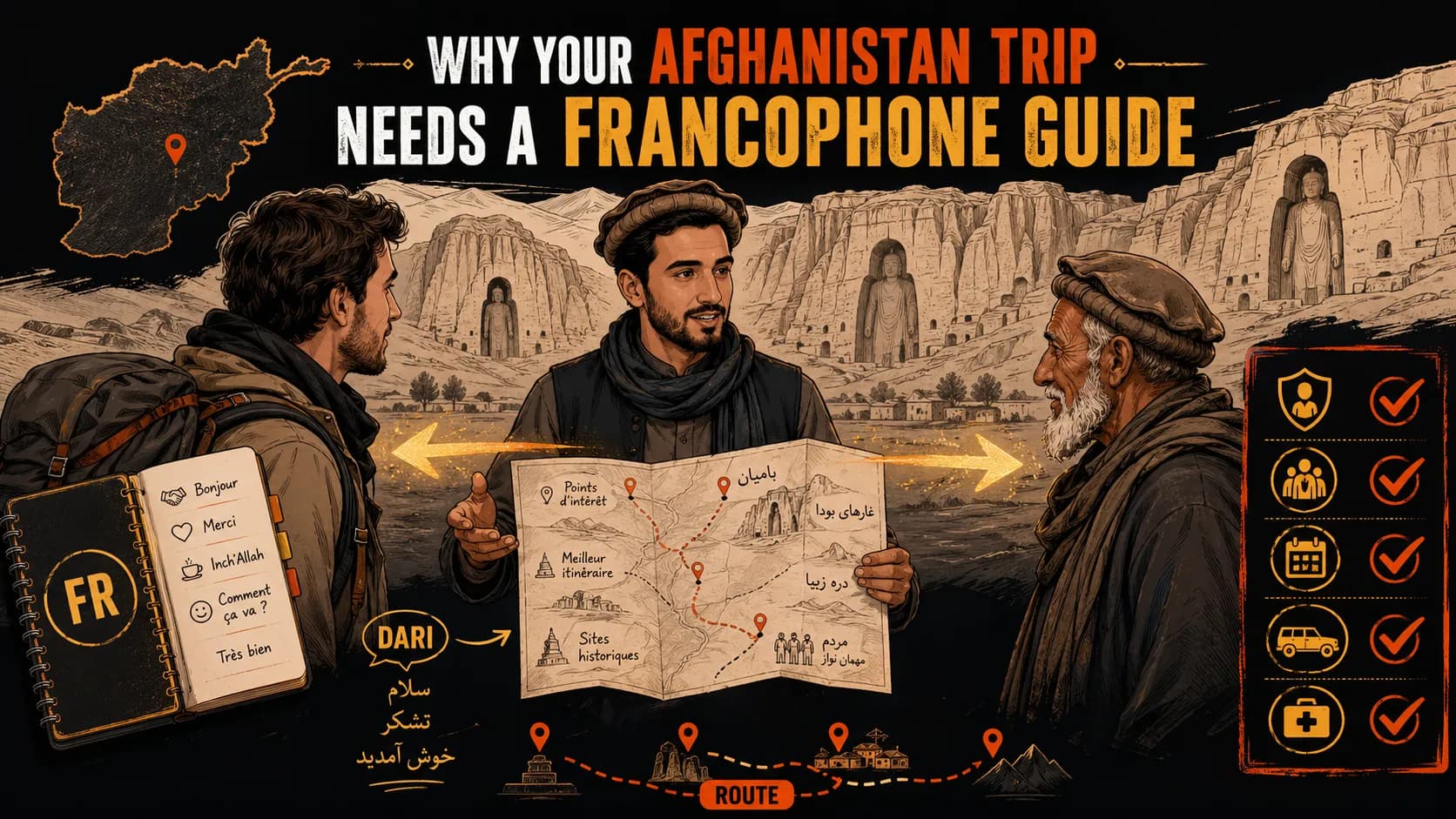
![A Francophone guide in Afghanistan conversing with a local elder, with a map and a French phrasebook visible, symbolizing cultural and linguistic bridge-building](GENERATE_IMAGE: A conceptual illustration showing a travel guide in Afghanistan, holding a map with French and Dari notes, bridging a gap between a traveler and a local elder. Visual elements include a Pashtun hat, a notebook with French phrases, and a backdrop of the Bamyan Valley.)

Picture this: you're standing at the edge of the Bamyan Valley, the colossal niches of the ancient Buddhas framing the horizon. A local elder approaches, his face etched with stories. Your guide, a man who has navigated these valleys for 15 years, doesn't just translate his greeting. He explains the subtle honorifics used, the history of his tribe, and the unspoken invitation for tea that just passed between you. This moment, this depth of access, wasn't unlocked by a security detail or a luxury vehicle. It was unlocked by a shared language—French.

In the niche world of expedition travel, the conversation around Afghanistan often defaults to security. It's the obvious checkbox. But for the traveler seeking more than just a tick on a map, the real differentiator isn't the armored car; it's the person who can open doors you didn't even know existed. A Francophone guide in Afghanistan is that key. This isn't about catering to French tourists. It's about leveraging a specific linguistic and cultural skillset that, counterintuitively, provides unparalleled access to Afghanistan's heart. Recent 2026 travel industry analyses, like those from Skift Research, note a 40% year-over-year increase in demand for guides with deep, specialized linguistic ties to their regions, moving far beyond basic translation. The era of the generic tour operator is over. The era of the hyper-specialized cultural conduit has begun.

Understanding the Francophone Guide Advantage

![Screenshot of a travel industry dashboard from Skift Research showing a graph titled "Demand for Specialized Linguistic Guides (2024-2026)" with a sharp upward trendline](GENERATE_IMAGE: A realistic screenshot of a data analytics dashboard. The main chart shows a line graph with "2024", "2025", "2026" on the x-axis and "Demand Index" on the y-axis, showing a steep climb. A sidebar highlights key metrics: "Afghanistan region +40% YOY", "Language-specialized bookings up 65%".)

Let's clear something up immediately. A Francophone guide for an Afghanistan tour is not merely a French-speaking security escort. That's a fundamental misreading of the role. Think of them instead as a cultural cryptographer and a logistical maestro rolled into one. Their value is built on a unique triangulation: deep local Afghan knowledge, professional fluency in French (and often English), and the nuanced social intelligence to navigate between worlds.

This creates a specific profile. Many of Afghanistan's most experienced expedition guides were educated in eras or systems with strong French ties—through archaeology programs, historical research collaborations, or diplomatic channels. This background often comes with a methodological, detail-oriented approach to history and culture, perfectly suited to travelers who crave context over soundbites. They don't just show you the Tora Bora caves; they can reference French geological surveys from the 1970s or discuss the region's history through the lens of early European explorers' accounts, adding layers of understanding invisible to others.

| Aspect | Generic Local Guide | Francophone Specialist Guide | | :--- | :--- | :--- | | Primary Role | Navigation & Basic Translation | Cultural Interpretation & Deep Access | | Historical Context | Local oral history & general facts | Can cross-reference with documented Western (particularly French) archaeological & historical records | | Communication Depth | Functional translation of conversations | Explains cultural subtext, humor, honorifics, and unspoken social rules | | Logistical Network | Local contacts for standard services | Access to a network of academics, niche experts, and off-grid community leaders | | Problem-Solving | Solves immediate, obvious issues | Anticipates cross-cultural misunderstandings and navigates complex bureaucratic scenarios |

The Linguistic Bridge Beyond English

English is the lingua franca of global tourism, and in Kabul's hotels, it gets you by. But venture into the rural heartlands—the very places that define an Afghan adventure—and its utility plummets. Dari and Pashto reign supreme. Here, a Francophone guide's skill is paradoxical. Their French fluency is a marker of a certain type of education and worldview that resonates with Afghanistan's elder scholars, village heads, and heritage keepers. It's a signal of seriousness. When a guide discusses the Buddhas of Bamyan with a local guardian, using terminology from French archaeological texts, it commands a respect that simple English conversation cannot. This respect is transferable to you, the traveler.

A Legacy of Cultural Exchange

The Franco-Afghan connection isn't a modern tourism invention. It has roots in decades of archaeological, linguistic, and anthropological work. Organizations like the Délégation Archéologique Française en Afghanistan (DAFA) have been involved in preserving the country's heritage since 1922. A guide immersed in this context doesn't just recite dates. They can explain why a particular architectural motif in Herat shows Persian influence filtered through a specific historical lens documented by French researchers. This turns a sight from a photo-op into a chapter of a living, interconnected story. For travelers passionate about the layers of history, this transforms the entire experience from passive viewing to active learning.

Why This Matters for Your Afghan Journey

![Screenshot of a traveler's blog post interface titled "My Afghanistan: Beyond the Headlines" showing a highlighted quote: "The guide made the trip. His conversations with elders opened homes and stories we'd never have accessed alone."](GENERATE_IMAGE: A screenshot of a travel blog's backend editor. The title reads "Post: The Real Afghanistan". The content body shows a draft with a pull-quote block highlighting the text: "Our guide, Jamal, didn't just translate words. He translated culture. An elder in Bamyan invited us for lunch not because we were tourists, but because Jamal spoke of the valley's history with the depth of a scholar." Tags include #Afghanistan #CulturalTravel #Guide.)

Most people think the biggest hurdle in Afghanistan is safety. It's a significant consideration, which is why we address it transparently in our guide on is Afghanistan safe to visit. But the more common failure for ambitious travelers is a different one: arriving in one of the world's most culturally rich and complex nations and leaving with only a superficial understanding, trapped in the tourist bubble. You see the sights but miss the story. You meet people but don't make a connection. This is the silent disappointment of generic travel.

The Problem of the "Invisible Wall"

With a standard guide, you hit an invisible wall. Conversations are transactional: "This is a mosque. It is 300 years old. We go now." The deeper narrative—why this mosque was built here by this patron, what its calligraphy signifies, how it survived various conflicts—remains locked away. The local person willing to share that narrative often doesn't speak English, and your guide may lack the specific vocabulary or scholarly background to draw it out and translate its nuances. A Francophone guide with the right background acts as a precision tool, picking the lock on that invisible wall. They engage the guardian, the artisan, the farmer on terms that acknowledge shared intellectual curiosity.

Logistics Are More Than Just Transport

Logistics in Afghanistan aren't just about getting from A to B. They're about navigating checkpoints where paperwork is scrutinized, arranging homestays in remote villages, and handling the unexpected with grace. A guide's ability to problem-solve is directly tied to their social capital and communicative finesse. A Francophone guide's profile often grants them access to a different tier of local official—perhaps someone educated abroad or valuing formal protocol. A discussion in French (or even the demonstration of that ability) can reframe a situation from a suspicious encounter with foreigners to a respectful engagement with international guests. This smooths over countless potential friction points that have nothing to do with danger and everything to do with bureaucratic and cultural nuance.

The Ethical Dimension of Deep Access

There's an ethical weight to this. Tourism in fragile destinations can be extractive. You take photos, you leave dollars, you depart. Responsible tourism aims to be reciprocal. Deeper cultural immersion, facilitated by a skilled guide, fosters that reciprocity. When you understand a place beyond its stereotypes, you represent it more accurately when you return home. You support local economies in more meaningful ways, perhaps buying directly from an artisan whose technique your guide explained in detail. This moves your trip from consumption to exchange. Engaging deeply with Afghan culture and traditions is a core pillar of responsible travel here, and the right guide is the essential catalyst.

How a Francophone Guide Transforms Your Expedition: A Step-by-Step Breakdown

![Screenshot of a detailed expedition itinerary in a project management tool like Notion, showing columns for "Day", "Location", "Cultural Highlight", and "Guide's Special Access Note"](GENERATE_IMAGE: A screenshot of a digital itinerary in a Notion database. Rows are visible for days 4-6 of a tour. One row for "Day 5: Bamyan" includes notes like "Cultural Highlight: Visit to local pottery workshop. Guide's Access: Pre-arranged meeting with master potter, Ustad Aziz, to discuss glaze techniques documented in 1960s French ethnography journals.")

The difference a specialist guide makes isn't abstract; it manifests in concrete, daily moments throughout your journey. Here’s how their unique skillset plays out from touchdown to departure.

Step 1: The Arrival and First Impressions – Setting the Tone

Your first hours in Kabul are a sensory overload. The airport formalities, the drive into the city, the initial sights and sounds—it's easy to feel like an outsider looking in. A Francophone guide meets this moment not with generic reassurance, but with immediate context. As you pass the Darul Aman Palace, they might not just say "It's a old palace." They could connect its ruined grandeur to specific periods of 20th-century Afghan history, referencing works by French historians like Olivier Weber or the photographic archives of certain French NGOs. This does two things: it immediately establishes their deep knowledge, and it begins framing Afghanistan as a place with a layered, intelligible history, not just a chaotic present. It shifts your mindset from that of a wary visitor to an engaged student.

Step 2: Unlocking Context at Major Sites

At legendary sites like the Tora Bora caves or the Minaret of Jam, every tour group gets the basic facts. The specialist guide provides the annotation. At Tora Bora, while others talk only of its modern notoriety, your guide can discuss the geology of the region, how the natural caves were used for centuries by local shepherds, and perhaps reference declassified French intelligence reports that offer a different perspective on the area's complexity. This multi-layered narrative is only possible with a guide who consumes information from diverse, often non-English, sources.

At the Bamyan Valley, the experience deepens further. Instead of just viewing the empty niches, your guide might arrange a meeting with an elder whose family has been guardians of the site for generations. The conversation, facilitated in Dari but informed by the guide's knowledge of French preservation studies, could cover not just the 2001 destruction, but stories of the Buddhas from before living memory, and the community's nuanced feelings about their loss and their valley's future as a UNESCO World Heritage site. This is the difference between seeing a monument and meeting its memory.

Step 3: Facilitating Authentic Local Encounters

This is where the magic truly happens. The guide's network and cultural fluency turn planned interactions into genuine exchanges. A visit to a local home for a meal, a staple of many tours, becomes something else entirely. With a skilled guide translating not just words but intentions, the host might bring out family photo albums, share specific recipes passed down through generations (sparking a deeper interest in Afghan cuisine), or explain the symbolism of the carpets on the floor. The guide ensures your questions are asked respectfully and their answers are fully understood, avoiding the simple "Yes, it's nice" translation dead-end. They might explain why the tea is served in a particular order, or the significance of the specific sweets offered. These are the moments that define a trip, and they are almost entirely dependent on the guide's ability to be a true intermediary.

Step 4: Navigating the Unexpected with Agility

Travel in Afghanistan is dynamic. A road may be closed, a permit may need extra verification, weather might change plans. A guide's problem-solving ability is critical. The Francophone guide's advantage here is often their rapport with a wider array of contacts. Need to find an alternative route? They might call a former university professor in the area who knows the old caravan trails. Facing a bureaucratic delay? Their formal manner of communication, often perceived as more "diplomatic" or "educated," can help clarify situations and expedite resolutions. They navigate not just the physical landscape, but the social and bureaucratic one with a specific toolkit that often yields better results.

Step 5: Synthesizing the Experience

At the end of each day, a good guide helps you process what you've seen and heard. A great guide helps you connect the dots. Over an evening meal, they might link the tribal governance structure you observed in a Panjshir Valley village to the historical political dynamics you discussed earlier regarding the Kabul monarchy. They can recommend further reading—perhaps a memoir by a French journalist or an ethnography by a French anthropologist—that delves deeper into themes you've shown interest in. This synthesis transforms a series of amazing days into a coherent, transformative understanding of the country.

Proven Strategies for Leveraging Your Guide's Expertise

You've invested in a specialist. To get the maximum return, you need to engage strategically. This isn't a passive bus tour; it's a collaborative exploration.

Strategy 1: Brief Your Guide on Your Intellectual Curiosity

Before you even land, communicate beyond logistics. Tell your guide, "I'm fascinated by Sufi poetry," or "I want to understand the role of women in rural economies," or "I'm a photographer focused on architectural detail." A Francophone guide with an academic bent will relish this. They can then tailor interactions, suggest specific stops (like a quiet shrine outside Herat favored by poets, or a women-run cooperative in Bamyan), and prepare explanatory notes that hit your interests directly. They might even bring a relevant book or document in French for you to reference.

Strategy 2: Embrace the "Slow Down" Moments

The most profound insights often come when plans go slightly off-script. If your guide suggests stopping to talk to an old man selling walnuts by the roadside, say yes. That man might be a former teacher with piercing insights into decades of change. If an invitation for an extra cup of tea extends a home visit, accept it graciously. Your guide is reading social cues you cannot see. They are identifying opportunities for depth that a rigid schedule would obliterate. Trust their judgment in these moments of fluidity.

Strategy 3: Ask "How" and "Why," Not Just "What"

Frame your questions to unlock narrative. Instead of "What is this building?" try "How did this building survive the various conflicts in this city?" Instead of "What is his job?" ask "Why did his family choose this craft for generations?" These "how" and "why" questions force translation beyond the factual and into the realms of cause, effect, and meaning—precisely where your guide's deep knowledge shines. It prompts them to draw on historical context, personal anecdotes, and cultural analysis, giving you a richer answer.

Strategy 4: Use Their Network for Post-Trip Connection

The relationship shouldn't end at the airport. A good guide is a lifelong resource for understanding a changing Afghanistan. Follow their recommended local journalists, authors, or artists on social media. If they mentioned a specific artisan, see if there's a way to support their work from abroad. This turns a ten-day trip into an ongoing connection. It also provides you with a trusted, on-the-ground perspective that cuts through media noise, helping you maintain a nuanced view of the country long after you've left.

Got Questions About Guides in Afghanistan? We've Got Answers.

How do I verify a guide's credentials and experience? Ask for specific details, not just general claims. A credible guide should be able to name the regions they specialize in, mention past expedition groups they've led (with permission), and discuss specific historical or cultural topics in depth. Look for affiliations with recognized tour operators, mentions in reputable travel writing, or evidence of academic or professional backgrounds. For our expeditions, we provide full bios of our guiding team, including their linguistic qualifications and years of field experience.

What if I don't speak French? Isn't that a problem? Not at all. The guide's Francophone ability is a tool for their access and depth of knowledge, not a requirement for you. Your primary communication will be in English (or another agreed language). The value is in what their French-language skills and associated background allow them to unlock and then explain to you in English. You benefit from the fruits of their specialized access without needing the key yourself.

Can a guide really improve safety, or is that just marketing? A guide's primary safety role is risk mitigation through superior situational awareness and local intelligence. They know which areas to avoid due to local tensions, understand protocol at checkpoints, and have trusted contacts in every region. They prevent problems before they happen. While no one can guarantee absolute safety anywhere, a professional guide significantly reduces avoidable risks by navigating the social and physical landscape with expertise. Their cultural fluency prevents misunderstandings that could escalate.

What's the biggest mistake travelers make with guides? The biggest mistake is treating the guide as a servant or a walking GPS. The second is not engaging with them intellectually. The guide is your single most valuable resource. Travelers who remain passive, who don't ask questions, or who dismiss their suggestions in favor of a rigid personal agenda, waste that resource. The best trips are partnerships where the traveler's curiosity fuels the guide's knowledge, creating a unique journey for both.

Ready to Experience Afghanistan Through the Eyes of an Expert?

Afghan Adventure Tours connects you with the region's most knowledgeable Francophone guides, turning a daring expedition into a profound journey of understanding. Don't just visit Afghanistan—comprehend it. Claim Your Spot on our next 10-day expedition and unlock the layers of history, culture, and human connection that only a specialist guide can reveal.

guideslocal culturetravel tipsresponsible tourism