Afghanistan is one of the cheapest countries on earth to travel in. A plate of kabuli pulao costs less than a dollar. A guesthouse in Bamyan charges what a parking meter in London does per hour. A shared taxi across an entire province runs about the price of a latte in Manhattan. The problem is not that Afghanistan is expensive — it is that almost nobody publishes reliable pricing data for a country where Booking.com does not operate, Google Maps directions end at the border, and the last Lonely Planet edition is from 2017.
This guide fixes that. Every price listed here comes from our operational records across 15 years of organizing expeditions in Afghanistan, updated with March 2026 field data. On our most recent assessment trip, our team priced accommodation in four cities, logged transport costs across six major routes, and documented food prices in bazaars, street stalls, and restaurants from Kabul to Mazar-i-Sharif. All prices are given in both USD and Afghan Afghani (AFN) at the current exchange rate of approximately 71 AFN to $1 USD, as reported by XE Currency. That rate fluctuates — check it before you go.
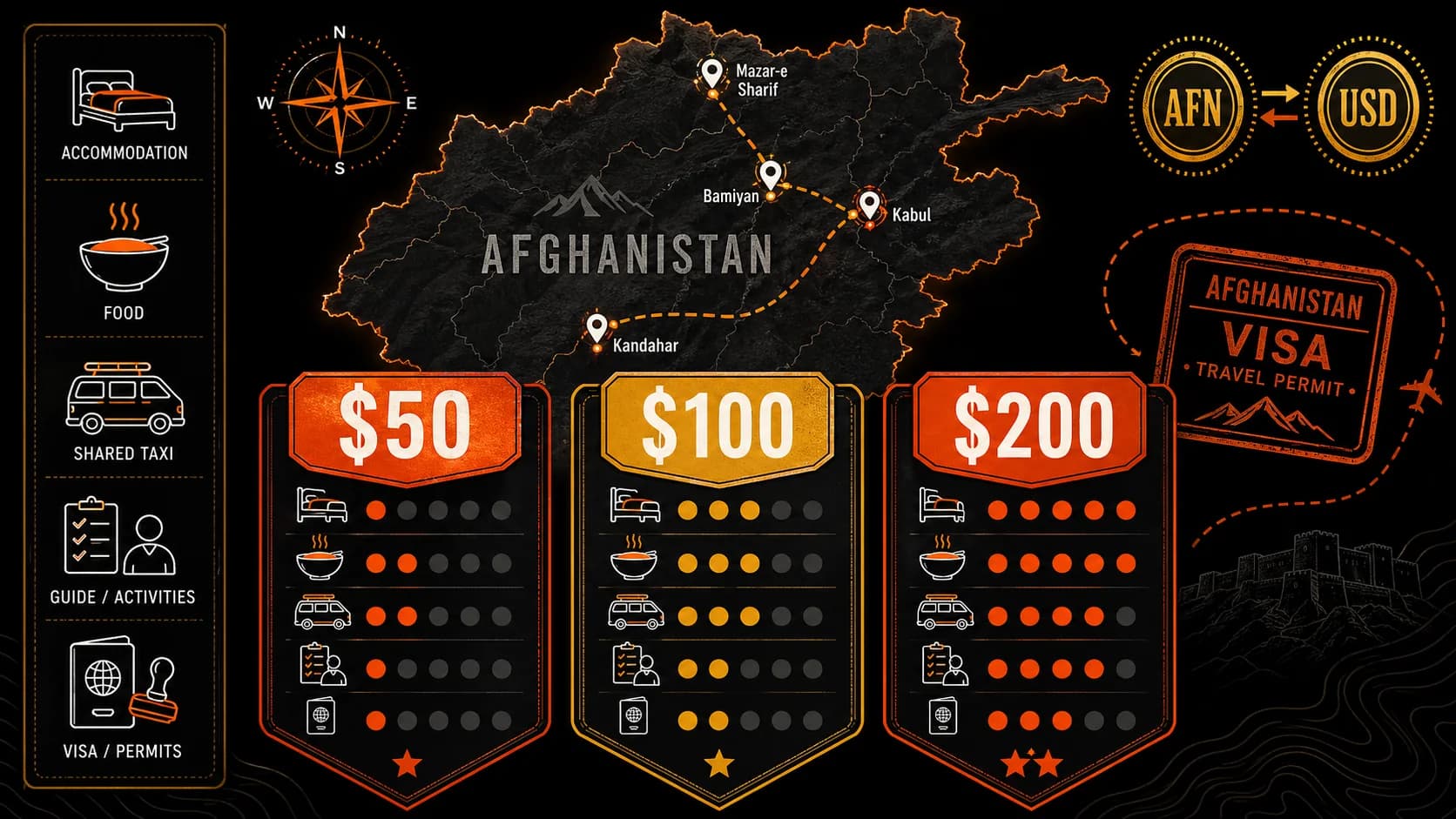
What follows is a complete cost breakdown across three budget tiers: the budget backpacker spending $50-80 per day, the mid-range independent traveler at $100-150 per day, and the fully guided expedition at $200-500 per day. By the end of this article, you will know exactly how much cash to bring and what it buys you.
The 3 Budget Tiers
Afghanistan travel costs split cleanly into three tiers, each representing a fundamentally different travel experience. The tier you choose affects not just your comfort but your safety margin, your access to remote areas, and the depth of cultural interaction you get.
| Tier | Daily Cost (USD) | Daily Cost (AFN) | Style | Who It Suits |
|---|---|---|---|---|
| Budget | $50-80 | 3,550-5,680 AFN | Guesthouses, shared transport, street food, no guide | Experienced backpackers with prior conflict-zone travel |
| Mid-Range | $100-150 | 7,100-10,650 AFN | Decent hotels, private car, local guide, restaurants | Independent travelers who want structure without a package |
| Guided Expedition | $200-500 | 14,200-35,500 AFN | All-inclusive with security, guide, 4x4, meals, permits | First-timers and anyone who wants zero logistics stress |
The budget tier is technically possible but comes with real tradeoffs — you are navigating checkpoints without a guide, negotiating transport in Dari or Pashto, and staying in places with no English-speaking staff. The mid-range tier is the sweet spot for most travelers. The guided expedition tier, including our own Afghan Adventure Tours 10-day package, runs approximately $5,000 all-inclusive ($500/day) and removes every logistical burden including security coordination, permits, and domestic flights.
Accommodation Prices
Accommodation in Afghanistan ranges from $5 homestays in rural villages to $100-plus hotel rooms in Kabul. There is no Airbnb. There is no Booking.com. You either book through a local fixer, show up and ask, or your tour operator handles it. Here is what you will actually pay in 2026.
Kabul
Kabul has the widest range of accommodation in the country. The backpacker end starts around $15 per night for a basic guesthouse room — clean enough, private bathroom if you are lucky, possibly hot water. The Wazir Akbar Khan and Shar-e-Naw neighborhoods have the highest concentration of foreigner-friendly options.
Mid-range hotels in the Serena area run $60-100 per night. The Kabul Serena Hotel itself — one of the few internationally managed properties still operating — charges $120-180 per night for a standard room, though availability for foreign tourists fluctuates based on the security climate.
Regional Cities
| City | Budget (per night) | Mid-Range (per night) | Notes |
|---|---|---|---|
| Kabul | $15-25 (1,065-1,775 AFN) | $60-100 (4,260-7,100 AFN) | Widest selection, book via fixer |
| Bamyan | $10-20 (710-1,420 AFN) | $30-50 (2,130-3,550 AFN) | Peak season (June-Sept) prices higher |
| Mazar-i-Sharif | $20-40 (1,420-2,840 AFN) | $50-80 (3,550-5,680 AFN) | Better hotel stock than most cities |
| Herat | $15-30 (1,065-2,130 AFN) | $40-70 (2,840-4,970 AFN) | Quality has improved significantly since 2024 |
| Jalalabad | $10-20 (710-1,420 AFN) | $25-45 (1,775-3,195 AFN) | Limited options, mostly guesthouse-style |
Homestays
Rural homestays are the cheapest and often the most rewarding accommodation in Afghanistan. Families in the Wakhan Corridor, Panjshir Valley, and villages around Bamyan host travelers for $5-10 per night (355-710 AFN), typically including dinner and breakfast. Afghan hospitality is not performative — you will be fed generously, offered the best room in the house, and treated as an honored guest. Tipping $5-10 beyond the agreed rate is customary and deeply appreciated.
One critical note: homestays require either a guide who has pre-arranged the stay or genuine local connections. You cannot simply walk into a village unannounced and expect accommodation, particularly as a foreigner. Our guide Ahmad, who has operated in Bamyan province for 12 years, maintains relationships with over 40 host families across the central highlands.
Food Costs
Afghan food is extraordinarily cheap and extraordinarily good. The national cuisine revolves around rice dishes, grilled meats, fresh bread, and aromatic spices — the flavors of a Central Asian crossroads that has absorbed Persian, Mughal, and nomadic culinary traditions over centuries.
Street Food and Bazaar Prices
| Item | Price (USD) | Price (AFN) |
|---|---|---|
| Kabuli pulao (national rice dish, full plate) | $1-2 | 71-142 |
| Bolani (stuffed flatbread) | $0.30-0.50 | 21-36 |
| Mantu (steamed dumplings, 10 pieces) | $1.50-3 | 107-213 |
| Ashak (leek dumplings with yogurt) | $1-2 | 71-142 |
| Lamb/chicken kebab plate with bread | $2-4 | 142-284 |
| Naan (fresh from tandoor) | $0.10-0.20 | 7-14 |
| Chai (green or black tea, per pot) | $0.20-0.50 | 14-36 |
| Fresh fruit (1kg seasonal) | $0.50-1 | 36-71 |
| Water bottle (1.5L) | $0.30 | 21 |
| Coca-Cola/Pepsi (330ml) | $0.40-0.60 | 28-43 |
A full day of eating from street stalls and bazaars costs $5-8 (355-568 AFN) and you will eat very well. The bazaar food in Afghanistan is fresh — bread baked minutes ago, kebabs grilled to order, rice dishes cooked in massive communal pots that turn over constantly. Food safety is generally reliable at busy stalls with high turnover. Avoid anything that has been sitting uncovered in heat.
Restaurant Meals
Sit-down restaurants in Kabul and major cities charge $5-10 (355-710 AFN) for a full meal with drinks. The upper end gets you a generous spread — multiple dishes, fresh naan, salad, and tea. There are no Michelin stars here, but the quality of cooking in Afghan restaurants routinely exceeds what you would pay three times as much for in neighboring Pakistan or Iran. A full day eating at restaurants runs $15-25 (1,065-1,775 AFN).
Must-Try Dishes and What They Cost
Kabuli pulao ($1-2): Afghanistan's national dish. Basmati rice slow-cooked with lamb, raisins, carrots, and cardamom. Every region makes it slightly differently. The Kabul version uses more raisins; the northern version is heavier on carrots. Non-negotiable eating.
Mantu ($1.50-3): Steamed dumplings filled with spiced ground lamb and onion, topped with a tomato-meat sauce and garlicky yogurt. The Afghan answer to Central Asian manti, and arguably the best version anywhere.
Bolani ($0.30-0.50): Stuffed flatbread filled with potatoes, leeks, or pumpkin, pan-fried until crispy. The ultimate Afghan street food — cheap, filling, available everywhere.
Chapli kebab ($2-3): Spiced minced meat patties from the Pashtun tradition, cooked in bone marrow fat. Rich, intensely flavored, and best eaten with fresh naan and raw onion.
Transport Costs
Getting around Afghanistan is where budget tiers diverge most dramatically. The difference between a $15 shared taxi seat and an $80 private 4x4 is not just comfort — it is the difference between a six-hour journey wedged between strangers on a deteriorating road and a flexible itinerary where you stop when you want, detour to points of interest, and arrive without needing a chiropractor.
Within Cities
Kabul taxis are cheap and ubiquitous. A ride within the city center costs $2-5 (142-355 AFN). There is no Uber or ride-hailing app. You flag taxis on the street or ask your guesthouse to call one. Always agree on the price before getting in — meters do not exist. Tuk-tuks and shared minivans within cities cost even less at $0.50-1 (36-71 AFN) per trip.
Intercity Transport
| Route | Shared Taxi (per seat) | Private 4x4 (whole car) | Time | Notes |
|---|---|---|---|---|
| Kabul to Bamyan | $15-20 (1,065-1,420 AFN) | $80-120 (5,680-8,520 AFN) | 6-8 hours | Passes through Ghorband Valley, altitude to 3,400m |
| Kabul to Mazar-i-Sharif | $20-30 (1,420-2,130 AFN) | $120-160 (8,520-11,360 AFN) | 7-9 hours | Via Salang Pass (3,878m), road quality variable |
| Kabul to Jalalabad | $8-12 (568-852 AFN) | $50-70 (3,550-4,970 AFN) | 2-3 hours | Best road in Afghanistan, dramatic descent from 1,800m to 575m |
| Kabul to Herat | $40-60 (2,840-4,260 AFN) | $250-350 (17,750-24,850 AFN) | 15-18 hours | Long haul, most travelers fly |
| Mazar to Bamyan | $25-35 (1,775-2,485 AFN) | $130-170 (9,230-12,070 AFN) | 8-10 hours | Rough road, no direct shared taxi — may require staging in Pul-i-Khumri |
| Bamyan to Band-e-Amir | $5-8 (355-568 AFN) | $30-40 (2,130-2,840 AFN) | 1.5-2 hours | Short but unpaved, stunning scenery |
Domestic Flights
Kam Air operates domestic flights between Kabul and several cities. These are genuinely useful for covering long distances — especially the Kabul-Herat route, which takes 15-18 hours overland.
- Kabul to Mazar-i-Sharif: $80-120 one way (5,680-8,520 AFN)
- Kabul to Herat: $100-150 one way (7,100-10,650 AFN)
- Kabul to Kandahar: $80-110 one way (5,680-7,810 AFN)
Book through a local travel agent or directly at the Kam Air office — online booking is unreliable. Flights cancel frequently due to weather, mechanical issues, or low passenger counts. Always have an overland backup plan. On our March 2026 Mazar expedition, our Kam Air flight from Kabul was delayed by six hours — our guide had a backup vehicle on standby.
Guide and Security Costs
This is where the "do I need a guide?" question gets answered. The short version: yes, you need a guide in Afghanistan. The long version follows.
Guide Pricing
| Service | Daily Rate (USD) | Daily Rate (AFN) | What You Get |
|---|---|---|---|
| Local city guide | $20-30 | 1,420-2,130 | Navigation, translation, checkpoint assistance, local knowledge |
| Independent regional guide | $30-50 | 2,130-3,550 | Multi-day travel, route planning, accommodation booking, cultural context |
| Fixer/translator | $40-60 | 2,840-4,260 | Logistics coordination, official contacts, problem-solving |
| Armed escort (where required) | $50-80 | 3,550-5,680 | Security for higher-risk transit corridors |
| Full expedition with Afghan Tour | ~$500/day | ~35,500 | Guide, 4x4, driver, security, accommodation, meals, permits, domestic flights |
Why a Guide Is Worth the Money
Afghanistan has no tourist information centers. Road signs are in Dari and Pashto script. Checkpoints require communication in local languages and understanding of current protocols. Hotel bookings happen through phone calls and personal relationships, not websites. Medical facilities are scarce and require local knowledge to locate. A guide is not a luxury in Afghanistan — they are your translator, your fixer, your cultural interpreter, and your safety net.
In most provinces, travel without a guide is technically possible but practically inadvisable. The exceptions are Kabul (where you can navigate independently with basic preparation) and well-trodden routes like the Kabul-Jalalabad highway. Everywhere else — including Bamyan, the Wakhan Corridor, and the northern circuit — a guide transforms your experience from stressful survival to genuine cultural immersion. Our guide network includes 12 vetted professionals who collectively speak Dari, Pashto, English, French, and Uzbek. Read more in our guide to why a francophone guide changes everything.
Fixed Costs Before You Go
These are the one-time costs that apply regardless of your daily budget tier.
Visa
Afghanistan currently issues tourist visas on arrival at Kabul International Airport for most nationalities. The cost ranges from $100 to $160 depending on your passport — US, UK, and EU citizens typically pay $100-120, while some nationalities face higher fees. The process takes 30-60 minutes at the airport. You need: a passport valid for at least six months, two passport-size photos, a hotel booking or letter of invitation, and cash in USD (exact change speeds things up). See our complete Afghanistan Visa 2026 guide for nationality-specific requirements and the e-visa process that launched in late 2025.
Travel Insurance
Finding travel insurance that covers Afghanistan is one of the biggest practical hurdles. Most mainstream providers (World Nomads, SafetyWing, Allianz) explicitly exclude Afghanistan from coverage. The providers that do cover it charge a premium:
- Battleface: $150-250 for 14 days, covers Afghanistan specifically including medical evacuation
- Global Rescue: $250-350 for membership plus evacuation coverage
- Tangiers International: $200-300 for 14 days, popular among conflict-zone travelers
Medical evacuation insurance is not optional. The nearest quality hospital for serious trauma is in Dubai or Delhi. Evacuation from Kabul costs $30,000-50,000 without insurance. Factor this into your planning. Further details in our Afghanistan travel insurance breakdown.
Communications and Other Fixed Costs
| Item | Cost (USD) | Notes |
|---|---|---|
| Local SIM card (Roshan, 10GB data) | $5-10 | Available at Kabul airport, covers most major cities |
| Local SIM card (MTN, 10GB data) | $5-8 | Better coverage in some eastern provinces |
| VPN subscription | $3-10/month | Essential — many sites are restricted, use before arrival |
| Portable battery bank | $15-30 | Power outages are frequent outside Kabul |
| Tips (guides, drivers, hotel staff) | $5-10/day | Customary and deeply appreciated |
| Photocopies of documents | $1-2 | Keep copies of passport, visa, insurance — checkpoints may ask |
Sample 10-Day Budgets
Here are three complete 10-day itineraries with every cost itemized. These cover the Kabul-Bamyan-Mazar triangle — the most common tourist route in Afghanistan.
Budget Traveler: ~$700 Total
| Category | Total Cost (10 days) |
|---|---|
| Accommodation (guesthouses, $15/night avg) | $150 |
| Food (street food + bazaar, $7/day) | $70 |
| Transport (shared taxis, 4 routes) | $70 |
| Local guide (4 days only, $30/day) | $120 |
| Visa on arrival | $110 |
| Travel insurance (Battleface, 14 days) | $180 |
| SIM card + VPN | $15 |
| Tips and miscellaneous | $50 |
| Total | ~$765 |
This tier works but comes with significant compromises. No guide for 6 out of 10 days means navigating checkpoints, transport, and accommodation on your own. Shared taxis run on Afghan time — delays of hours are normal. We do not recommend this tier for first-time visitors. Read our honest safety assessment by province before deciding.
Mid-Range Independent: ~$1,500 Total
| Category | Total Cost (10 days) |
|---|---|
| Accommodation (hotels, $40/night avg) | $400 |
| Food (restaurants, $18/day) | $180 |
| Transport (private car 6 days @ $100, shared 4 days) | $660 |
| Regional guide (full 10 days, $40/day) | $400 |
| Visa on arrival | $110 |
| Travel insurance (Battleface, 14 days) | $200 |
| SIM card + VPN | $15 |
| Domestic flight Mazar-Kabul | $100 |
| Tips and miscellaneous | $80 |
| Total | ~$2,145 |
This is the sweet spot. A guide for the full trip, a private vehicle for the major routes, decent accommodation, and the flexibility to stop, explore, and deviate from the plan. Most independent travelers we advise end up in this range.
Guided Expedition (Afghan Tour): ~$5,000 Total
| Category | Total Cost (10 days) |
|---|---|
| Afghan Adventure Tours all-inclusive package | $5,000 |
| Personal spending money (souvenirs, extra snacks) | $100-200 |
| Total | ~$5,200 |
The $5,000 package includes: Kabul airport pickup, all accommodation, all meals, private 4x4 with driver, experienced francophone guide, security coordination, all domestic transport (including flights where needed), checkpoint facilitation, permits for restricted areas, and 24/7 logistics support. The only things not included are your international flights to Kabul, your visa fee, and your travel insurance. For a full breakdown of what the expedition covers, see our Afghanistan Tours Decoded guide.
Money Tips
Afghanistan runs on cash. Understanding the money system before you arrive saves you stress, bad exchange rates, and potentially dangerous situations.
Currency Basics
The Afghan Afghani (AFN) is the official currency. As of March 2026, the exchange rate sits at approximately 71 AFN per $1 USD, though this fluctuates — it ranged from 68 to 77 AFN per dollar over the past 12 months. Check XE.com for the current rate before traveling. US dollars are widely accepted in Kabul — hotels, guides, and some shops quote prices in USD. Outside Kabul, AFN is strongly preferred and sometimes the only accepted currency.
Exchanging Money
Exchange at the Sarai Shahzada money market in Kabul — it is the largest money exchange market in the country and offers rates within 1-2% of the interbank rate. Your guide or hotel can arrange a money changer if you prefer not to go to the market yourself. Airport exchange rates are 5-10% worse than Sarai Shahzada.
Critical Cash Rules
Bring enough cash for your entire trip. There is effectively one sometimes-working ATM in Kabul (at the Kabul Serena Hotel) and it accepts Visa only, has withdrawal limits, and is frequently out of service. Do not plan around ATM access. Western Union and Hawala transfers exist but are unreliable for tourists.
Bring crisp, recent USD bills. Afghan money changers reject torn, marked, or old-series bills. $20 and $50 denominations are ideal — $100 bills sometimes face scrutiny over counterfeiting concerns, and small bills ($1, $5) give you poor exchange rates. Bills should be series 2013 or newer.
Do not flash large amounts. Afghanistan is generally safe from petty theft by regional standards, but common sense applies. Keep your main cash reserve in a money belt or hidden pocket. Carry a day's worth of spending money in a separate accessible pocket. Our guides carry a small safe in the vehicle for clients who prefer secure storage during excursions.
Frequently Asked Questions
Is Afghanistan expensive to visit?
No. Afghanistan is one of the cheapest countries in the world for travelers. Daily costs range from $50-80 on a tight budget to $100-150 for comfortable independent travel. Food, accommodation, and local transport are a fraction of what they cost in neighboring Iran or Pakistan. The main expenses are guides ($30-50/day), private transport ($80-120/day for a 4x4), and the fixed costs of visa and insurance that apply regardless of trip length.
Can I travel Afghanistan on $50/day?
Technically yes, but we do not recommend it without significant prior experience in challenging destinations. At $50/day you are staying in the cheapest guesthouses, eating exclusively from street stalls, using shared transport, and navigating without a guide. This works in Kabul for a few days but becomes risky in other provinces where language barriers, checkpoint protocols, and lack of tourist infrastructure require local knowledge.
Do I need a guide in Afghanistan?
For most travelers, yes. A guide handles checkpoint communication, accommodation booking, cultural navigation, and emergency situations. In Kabul, experienced travelers can get by independently. Outside Kabul — particularly in Bamyan, the Wakhan, and the northern provinces — a guide is essential. Budget $30-50/day for an independent guide or consider a full expedition package that includes guiding as part of the all-inclusive rate.
Where can I exchange money in Afghanistan?
The Sarai Shahzada market in central Kabul offers the best exchange rates in the country. Hotels and guesthouses exchange money at 5-10% worse rates. Outside Kabul, exchange options are limited to local bazaar money changers who may offer poor rates for USD. Exchange enough AFN in Kabul before heading to other provinces. The exchange rate in March 2026 is approximately 71 AFN per $1 USD.
Is the $5,000 Afghan Tour expedition worth it?
For first-time visitors, absolutely. The $5,000 covers 10 days all-inclusive: accommodation, meals, private 4x4, driver, francophone guide, security, permits, and domestic flights. That works out to $500/day — which sounds expensive until you realize that arranging the same components independently costs $200-300/day anyway, plus weeks of logistical planning, plus the stress of coordinating everything yourself in a country with no online booking infrastructure. The value is in the expertise, the access, and the peace of mind. See our full expedition breakdown for day-by-day details.
Prices in this guide reflect March 2026 field data and are subject to change. Exchange rates fluctuate — always verify the current USD/AFN rate before travel. For personalized budget planning for your Afghanistan trip, contact our team.
Other Doved Studio projects
Related tools from the same studio you might find useful:
- Magnu Imperiu: Daily history puzzle: guess the empire from six geographic and temporal clues.
- Doved Studio: Studio indie derrière cette app et une dizaine d'autres outils.